深圳溯源
Couldn't load pickup availability
衣服尺寸:
胸围/腰围/臀围:94/80/98 厘米
衣长:115 厘米
细节描述:
在服装史的浩瀚长河中,有些衣物不仅是蔽体的织物,更是凝固的时光与流动的史诗。眼前这件上世纪六十年代的古董旗袍,便是一件集东西方美学、纺织工业奇迹与时代精神于一体的孤品。它并非普通的旧衣,而是一段关于“香港制造”黄金时代的华丽注脚。
一、面料与图案:意大利织银工艺的视觉盛宴
若仅以“红色”或“闪光”来概括这件旗袍的面料,未免太过轻慢了它的工艺价值。
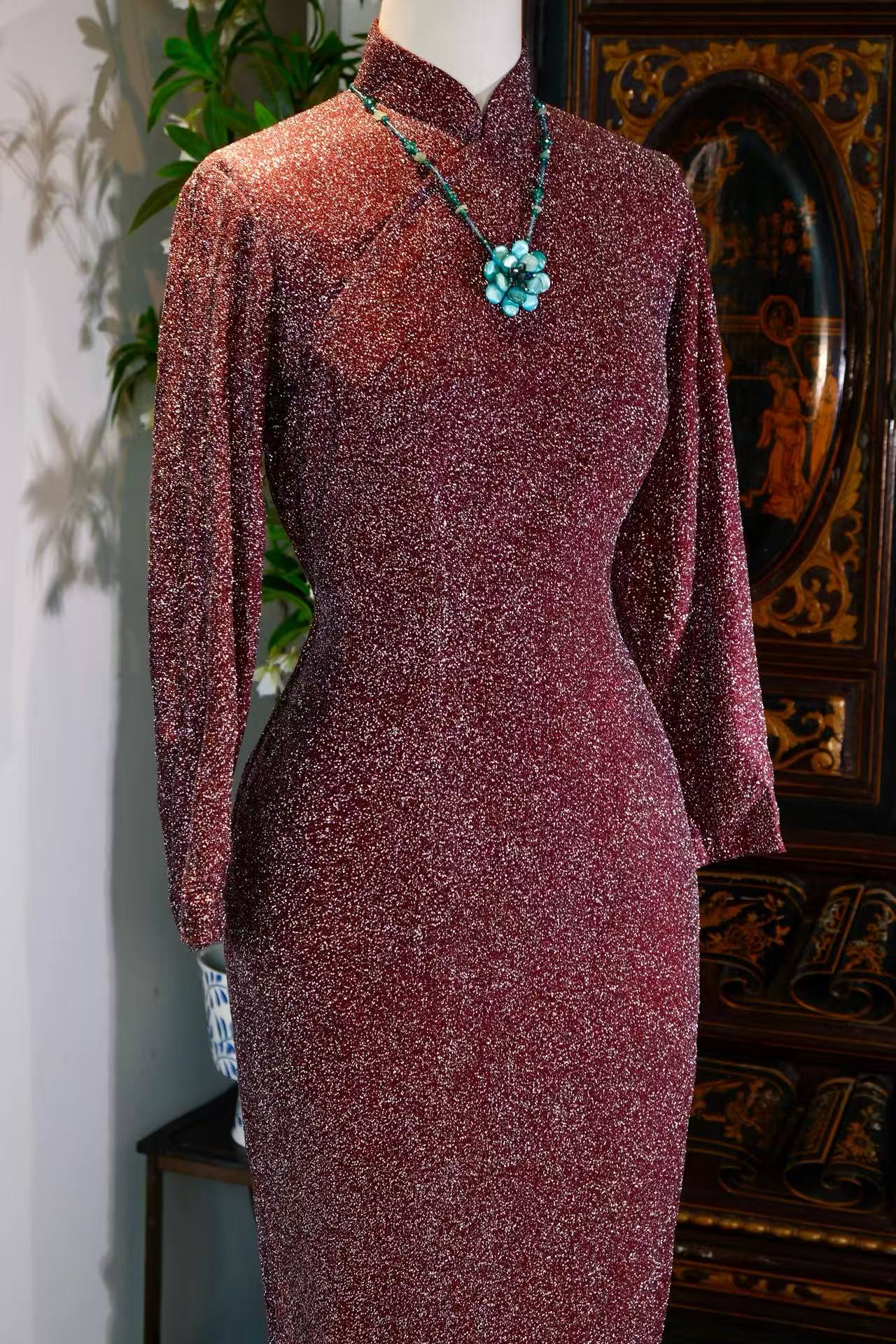
这件旗袍采用的是极为罕见的意大利进口织银面料。在六十年代,香港作为亚洲的时尚与纺织中心,汇聚了来自欧洲的顶级面料资源。这种面料并非简单的印染,而是通过复杂的提花织造工艺,将极细的银丝线与深酒红色的底纱交织在一起。
- 色彩美学: 它的底色并非正红,而是一种深邃醇厚的勃艮第酒红,如同陈年的红酒,透着岁月的沉淀感。
- 光影纹理: 仔细观察其表面,无数微小的银色颗粒如同夜空中的繁星,又似洒落在红丝绒上的碎钻。这种“满底碎花”般的视觉效果,实则是由无数根金属丝线构成的抽象肌理。在自然光下,它呈现出一种低调的奢华;而在灯光流转间,整件衣服仿佛拥有了呼吸,波光粼粼,流光溢彩。
- 触觉想象: 这种织银面料通常具有一定的挺括度,能够完美支撑起旗袍的线条,同时内里往往衬有柔软的丝绸或棉布,以保证穿着的舒适度,这是当时高级定制才有的考究。
二、形制与剪裁:六十年代海派风韵的极致演绎
从服装史的角度审视,这件旗袍的剪裁正处于传统与现代的完美交汇点。
- 立领: 经典的元宝领设计,高度适中,既修饰了颈部线条,又保留了东方的含蓄美。
- 省道与曲线: 不同于早期平裁旗袍的宽大,这件六十年代的旗袍深受西式立体剪裁的影响。你可以清晰地看到胸省和腰省的运用,它们精准地勾勒出了女性的S型曲线。这种“西体中用”的剪裁方式,正是张爱玲笔下那个摩登时代的真实写照——既有着传统的骨架,又有着现代的肉身。
- 长袖设计: 贴合手臂的长袖设计,不仅增加了端庄感,更让那份织银的光泽顺着手臂的线条流淌而下,直至指尖。
三、引经据典:衣香鬓影中的文化隐喻
《诗经·秦风》有云:“锦衣狐裘,颜如渥丹。”古人早已懂得华服与气色的相得益彰。而这件旗袍,恰是“锦衣”的现代诠释。
在那个年代,香港名媛出入于半岛酒店的下午茶会或是邵氏片场的首映礼,身上穿的便是这般光彩夺目的衣裳。它让人联想到王安忆在《长恨歌》中对上海女性着装的描写,那种对细节的执着和对美的追求,跨越了地域,在香港得到了延续和升华。
这不仅仅是一件衣服,它是那个时代女性独立意识觉醒的象征。她们不再满足于宽袍大袖的遮掩,而是勇敢地展示身体的曲线,用这种带有西方工业文明色彩的“织银”面料,宣告着一种自信、张扬且不失优雅的新东方女性形象。
四、稀缺性与收藏价值:不可复制的时代绝唱
为何说它是稀缺的孤品?
1. 面料的不可再生性: 六十年代的意大利织银面料,随着环保法规的收紧和纺织工艺的迭代,那种含有真实金属成分且手感独特的老面料早已停产。如今的仿制品多为化学涂层,缺乏这种由内而外透出的金属质感和厚重感。
2. 保存的难度: 金属丝线随着时间推移容易氧化变黑或断裂,能像这件一样,历经半个多世纪依然色泽如初、银光闪烁,且版型没有严重变形,实属凤毛麟角。这需要历任藏家极尽呵护的珍藏。
3. 历史的见证: 它是“Made in Hong Kong”从廉价加工走向高端定制的见证物。每一件这样的古董衣,都是研究二十世纪中叶东亚时尚变迁的实物标本。
结语:
这件织银旗袍,静默无言,却胜过千言万语。它是一首用丝线和银光谱写的诗,等待着下一位懂它的主人,穿上它,去续写那段未了的流金岁月。当你披上它的那一刻,你穿的不是衣服,而是六十年的风华绝代。
Measurements / Size Guide:
Bust / Waist / Hips: 94/80/98 cm
Total Length: 115 cm
Detailed Description:
To capture the material soul of this archival qipao with reductionist labels like "red" or "glittering" is to fundamentally misinterpret its historical engineering value.
This garment is sculpted from an exceptionally scarce, imported mid-century Italian silver-woven textile (woven gold/silver lamé). During the 1960s, Hong Kong stood as the premier haute couture and maritime commercial trade hub of Pan-Asia, pooling elite textile resources from historic European mills. This specific yardage bypasses basic surface printing or superficial chemical coating; instead, it relies on complex jacquard drawloom mechanics to interlace microscopic silver metallic wires directly with deep wine-red base structural yarns.
Chromatics of the Canvas: The ground color deliberately rejects bright, flat primary reds, opting instead for a profound, saturated burgundy wine-red. It carries the visual weight of an aged vintage, radiating an organic depth born of half a century of gentle oxidation.
The Architecture of Light: Upon close inspection of the pile, countless minute silver metallic segments manifest like an infinite matrix of stars across a midnight sky, or shattered premium diamonds strewn over dark velvet. This all-over abstract motif (mandi suihua) functions as a highly ordered, tactile texture. Under diffused natural light, it maintains a disciplined, low-profile luxury; however, under the shifting artificial lights of an evening gala, the entire textile achieves an organic animation—resembling undulating, liquid gemstone waves.
Tactile Ergonomics: This vintage metallic-weave yardage inherently possesses a rigid, structural tensile strength. It effortlessly maintains the architectural framework of the qipao silhouette without collapsing. To achieve absolute wearer comfort and shield the skin from raw metallic friction, the interior is meticulously interlined with historical soft silk or fine cotton—a definitive hallmark of mid-century high-grade bespoke commissions (Tailor Shop).
Examined through the strict framework of costume archaeology, the pattern drafting of this garment sits precisely at the golden intersection of ancestral Eastern heritage and post-war Western technical innovation.
The Mandarin Neckline: The structure retains the classic, stiffly interlined Yuanbao collar (yuanbao ling). Engineered to a calibrated, moderate vertical height, it beautifully elongates the architecture of the neck line while preserving the elegant composure of traditional Eastern modesty.
The Geometry of the Dart: Departing from the flat, rectilinear, two-dimensional construction of early Republican era robes, this 1960s specimen completely embraces Western three-dimensional anatomy. One can trace the clean, deep paths of the bust darts and waist darts (se省). This flawless structural translation beautifully models a highly contoured S-curve silhouette (hourglass silhouette). It serves as the tangible, physical manifestation of the modern era captured so fiercely in Eileen Chang's literature—safeguarding an ancestral skeleton while housing a contemporary form.
The Extended Sleeve: The close-fitted, tailored long sleeve configuration not only amplifies the formal dignity of the piece but ensures that the reflective luster of the silver-woven thread cascades uninterrupted down the anatomy of the arm, terminating cleanly at the wrist.
The ancient Book of Songs (Shijing: Qin Wind) famously muses: "Clad in magnificent embroidered silk robes over fine fox furs, her countenance radiates like unblemished cinnabar." The literati have long recognized that haute couture exists to synchronize with and elevate the human spirit. This silver-woven qipao stands as the absolute modern manifestation of that historical jinyi (splendid silk apparel).
During this mid-century chapter, elite Hong Kong matrons and cinema icons navigated the afternoon teas of the Peninsula Hotel or graced the red-carpet premieres of the Shaw Brothers studios wrapped in textiles of this exact caliber. It evokes the sensory descriptions penned by Wang Anyi in The Song of Everlasting Sorrow regarding the sartorial devotion of metropolitan women; that fierce obsession with microscopic detail and the pursuit of absolute beauty cut directly across geographical borders, migrating from old Shanghai high society to find its ultimate post-war renaissance along the shores of Victoria Harbour.
This dress operates as an explicit declaration of awakening female autonomy. The modern women of this generation completely abandoned the hiding, loose frameworks of traditional ancestral gowns. They stepped forward to showcase the natural contours of their physical forms, utilizing a highly industrialized, Western-born "silver-woven" textile to announce a self-assured, bold, and fiercely elegant manifestation of the New Eastern Woman.
What parameters elevate this specific artifact into the realm of absolute museum-grade scarcity?
The Extinction of Vintage Loom Metallurgy: Authentic 1960s Italian lamé and silver-woven textiles, utilizing genuine metallic composition fibers, have been completely erased by modern environmental manufacturing regulations and high-speed industrial screen-printing overhauls. Modern commercial reproductions rely almost exclusively on superficial synthetic plastic coatings, which completely lack the weight, organic drape, and internal metallic refraction of vintage yardage.
The Miracle of Conservation: Organic textiles housing true metallic threads are notoriously volatile historical artifacts; they are hyper-susceptible to catastrophic oxidation, tarnish blackening, and structural wire fracture over time. For this garment to survive over six decades with its structural brilliance intact, its silver wefts completely free of severe corrosion, and its pattern geometry unwarped is an extraordinary anomaly that speaks to decades of immaculate custodial care.
Physical Evidence of Trade Sociology: This piece stands as a material monument documenting the historical transition of the "Made in Hong Kong" registry—marking its evolution from a low-cost manufacturing zone into a global capital of elite, high-grade custom tailoring. Every stitch serves as a primary source document for archiving 20th-century Pan-Asian fashion migration.
This silver-woven qipao stands quietly in the deep recesses of time, yet its material presence speaks with absolute authority. It is an epic poem written in the language of silk and metallic geometry. It stands frozen, waiting for its next true custodian—a connoisseur who will don this wearable history to continue its unfolding legacy of elegance, dignity, and everlasting mid-century glamour.