深圳溯源
Couldn't load pickup availability
衣服尺寸:
胸围/腰围/臀围/衣长:86/74/94/135 厘米
细节描述:
【器以载道,衣以传情】
在服装史的长河中,二十世纪六十年代的香港旗袍,无疑是一座难以逾越的高峰。彼时,东西方文化在香江交汇,传统技艺与现代审美在此碰撞出璀璨的火花。这件出自那个黄金年代的提花织锦缎旗袍,不仅是一件御寒蔽体的衣物,更是一段被封存的时光,一首穿在身上的无声诗篇。
【纹样解析:疏影横斜,暗香浮动】
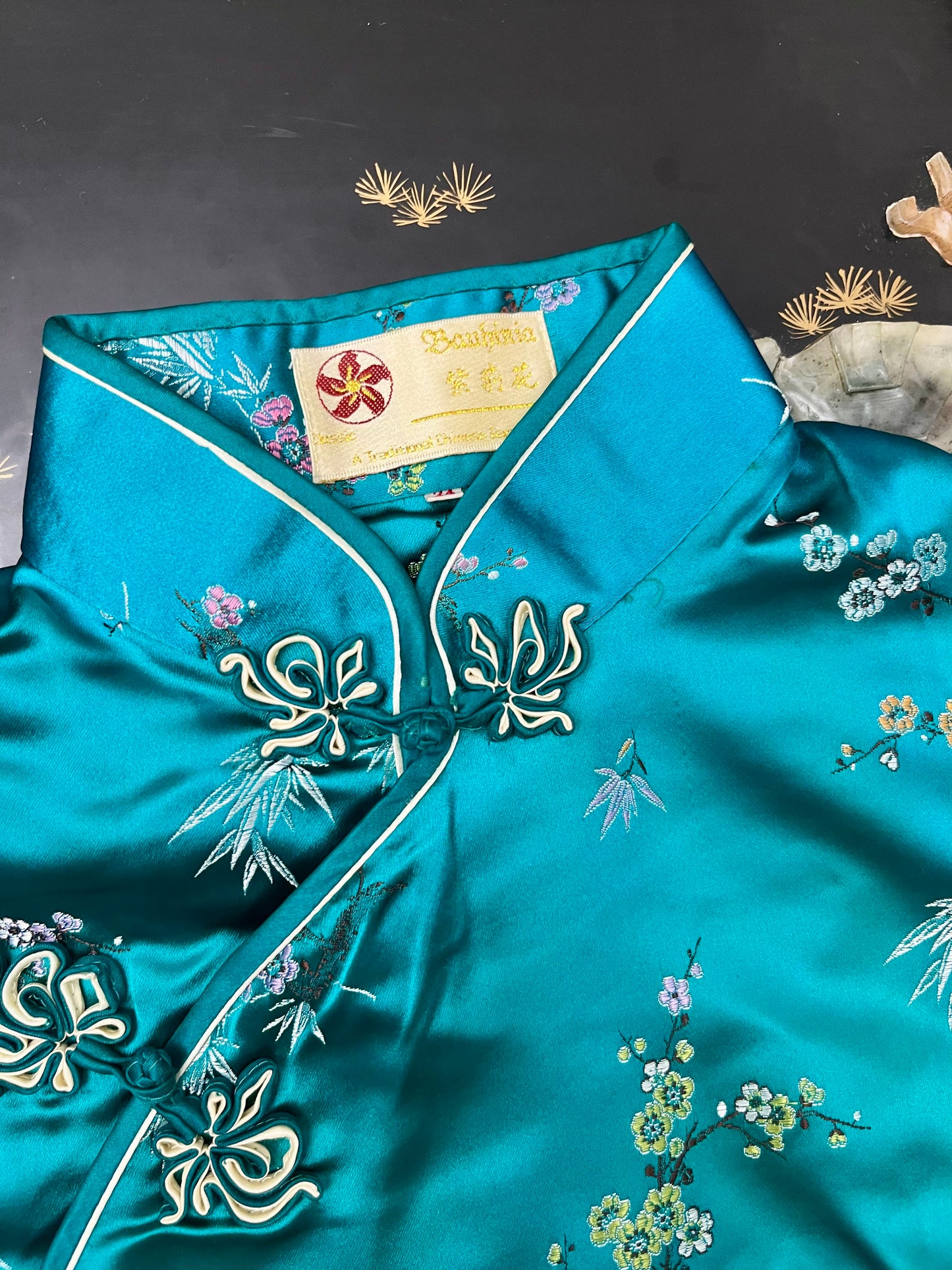
细观此衣,其面料选用的是极具时代特征的提花织锦缎。这种面料质地紧密厚实,手感滑糯,且自带一种低调而奢华的光泽感,随着光线的流转,呈现出如海水般深邃的蓝绿色渐变(Teal/Peacock Blue),宛如一汪碧水,深不可测又波光粼粼。
衣身遍布的纹样,并非艳俗的大红大绿,而是采用了清雅高洁的“岁寒三友”变体与折枝花卉相结合的设计。
- 竹影婆娑: 我们可以看到翠绿的竹叶穿插其间,姿态挺拔而不失柔美,象征着君子之风与坚韧的生命力。郑板桥曾云:“咬定青山不放松,立根原在破岩中。”这竹纹的植入,赋予了女性柔美中不失刚毅的气质。
- 繁花似锦: 粉色、紫色的小花错落有致地散落在枝叶间,似梅花之傲骨,又似桃花之烂漫。这些花朵并非写实的大朵牡丹,而是采用了更为文人画意的“折枝”手法,疏密有致,留白得当,正应了宋代花鸟画中“格物致知”的细腻精神。
【工艺之美:盘扣与滚边的极致】
请注意领口处的细节,这是整件衣服的灵魂所在。
- 花式盘扣: 采用了极为复杂的“如意扣”与“蝴蝶扣”的变体设计。工匠利用同色系的缎带,通过折叠、缠绕、缝合,制作出立体感极强的装饰结。这种盘扣不仅是功能性的系结,更是纯粹的装饰艺术,寓意着吉祥如意、福寿绵长。
- 极细滚边: 领口、襟边均采用了同色滚边夹极细的白色(或米色)出芽。在深色底料的衬托下,这道白边如同勾勒工笔画的笔触,清晰地界定了衣服的轮廓,极大地提升了视觉上的精致度与高级感。这种“宽袍窄袖、滚边精细”的特征,正是六十年代海派与港式旗袍融合的典型标志。
【岁月故事:流金岁月的优雅见证】
这件旗袍诞生于上世纪六十年代的香港。那是一个张爱玲笔下“倾城之恋”余韵尚存,而又充满蓬勃生机的年代。那时的名媛淑女,出入于中环的写字楼或半山的大宅,身上穿的便是这样一件剪裁合体、面料考究的旗袍。
它见证了那个时代的摩登与保守并存。七分袖的设计(Three-quarter sleeves),既保留了东方的含蓄内敛,遮挡了手臂最粗的部分,又露出了纤细的手腕,便于日常活动与工作,体现了当时女性走向社会、追求独立的精神风貌。那紧致的腰身剪裁(Darts),完美贴合人体曲线,是西式立体剪裁技术在中式服装上运用的成熟体现。
【稀缺性与收藏价值】
正如《长恨歌》中所云:“风吹仙袂飘飖举,犹似霓裳羽衣舞。”真正的古董衣,是有温度的历史。
这件旗袍之所以珍贵,在于其不可复制性:
1. 面料绝版: 当年的老式提花织锦缎,因织造工艺复杂、成本高昂,如今已鲜有生产,现存的老料更是用一寸少一寸。
2. 手工温度: 那繁复的花式盘扣与精细的归拔工艺(Ironing technique to shape the fabric),皆出自老裁缝的一双巧手,机器无法替代那份指尖的温度。
3. 保存完好: 历经六十载光阴,丝绸虽易脆化,但这件衣服色泽依旧饱满,无明显破损,实属凤毛麟角。
它不仅是一件衣裳,它是东方美学的缩影,是那个流金岁月里,女性自信、优雅、从容的最佳注脚。拥有它,便是拥有了一段可以触摸的历史,一份永不褪色的东方雅致。
Measurements / Size Guide:
Bust / Waist / Hips / Total Length: 86/74/94/135 cm
Detailed Description:
In the long river of costume history, the Hong Kong qipao of the 1960s undoubtedly stands as an insurmountable peak. At that time, Eastern and Western cultures converged in the Fragrant Harbor, where traditional craftsmanship and modern aesthetics collided to produce brilliant sparks. This jacquard brocade qipao, originating from that golden era, is not merely a piece of clothing to fend off the cold and cover the body, but a frozen segment of time—a silent poem worn upon the form.
Observing this garment closely, its fabric utilizes a jacquard brocade that is highly characteristic of the era. This fabric possesses a dense and thick texture with a smooth, waxy hand-feel, and carries an inherent, low-profile yet luxurious luster. As the light shifts, it presents a deep teal or peacock blue gradient resembling ocean water, looking like a pool of green water—unfathomably deep yet shimmering with ripples.
The patterns distributed across the body of the garment eschew vulgar, loud reds and greens, adopting instead a design that combines a refined, noble variation of the "Three Friends of Winter" with broken-branch floral motifs.
Whirling Bamboo Shadows: One can see emerald green bamboo leaves interspersed throughout, upright in posture yet not lacking in softness, symbolizing a gentleman's character and a resilient vitality. Zheng Banqiao once wrote: "Bite into the green mountain and never let go; your roots originate fundamentally within the broken rocks." The insertion of this bamboo motif endows the woman's demeanor with a fortitude that complements her softness.
A Tapestry of Blossoms: Small pink and purple flowers are arranged in a well-scattered manner among the branches and leaves, resembling the proud character of plum blossoms yet also the romantic brilliance of peach blossoms. Rather than realistic, large-petaled peonies, these flowers employ a more painterly, intellectual "broken-branch" (zhezhi) technique. They are spaced with proper density and appropriate negative space (liubai), precisely corresponding to the delicate spirit of "investigating things to extend knowledge" (gewu zhizhi) found in Song Dynasty flower-and-bird paintings.
Please pay close attention to the details at the collar, which serve as the very soul of the entire garment.
Fancy Frog Closures (Pankou): These utilize an extremely complex design variation combining the "Ruyi closure" and the "butterfly closure." Using matching satin ribbons, the artisan folded, twisted, and stitched them together to create highly dimensional decorative knots. These frog closures are not merely functional fasteners, but pure decorative art, carrying auspicious meanings of good fortune and long life.
Ultra-Fine Piping: The collar and edge closures all implement matching piping paired with an ultra-fine white (or beige) piping extension (chunya). Against the contrast of the dark background fabric, this white edge acts like the stroke of a fine-brush gongbi painting, clearly defining the silhouette of the garment and immensely elevating its visual refinement and high-end feel. This characteristic of "wide robes with narrow sleeves, fine and meticulous piping" is precisely the classic marker of the fusion between the Shanghai and Hong Kong styles in the 1960s.
This qipao was born in 1960s Hong Kong. It was an era when the lingering charm of the "love in a fallen city" described by Eileen Chang still existed, yet it was also filled with vigorous vitality. The socialites and elegant ladies of that time, frequenting the office buildings of Central or the grand mansions of the Mid-Levels, wore precisely this kind of well-tailored qipao made of exquisite fabrics.
It witnessed the coexistence of modernity and conservatism during that era. The three-quarter sleeve design fundamentally preserved Eastern reserve and modesty by covering the thickest part of the arm, while revealing the slender wrists to facilitate daily activities and work—reflecting the spiritual outlook of women at that time as they entered society and pursued independence. The tightly fitted waist construction (darts) perfectly matches the curves of the human body, representing a mature manifestation of applying Western three-dimensional tailoring techniques to Eastern attire.
As stated in Song of Everlasting Sorrow: "The wind blows the celestial sleeves, fluttering and lifting them up, looking just like the dance of the rainbow and feather garments." Genuine antique clothing is history with a human temperature.
The reason this qipao is precious lies in its absolute irreproducibility:
Discontinued Fabric: The old-style jacquard brocade of those days, due to its complex weaving process and exorbitant costs, is rarely produced today. Surviving vintage fabric is consumed inch by inch, with none to replace it.
Hand-crafted Warmth: The complex, fancy frog closures and the meticulous iron-molding technique used to shape the fabric (guiba) all originated from the skilled hands of old tailors. Machines cannot replicate that warmth from the fingertips.
Perfect Preservation: Having experienced sixty years of time, silk is inherently prone to becoming brittle. Yet, this garment's coloration remains completely saturated and it shows no obvious damage, making it truly one in a million.
It is not merely a piece of clothing; it is a epitome of Eastern aesthetics and the finest footnote to a woman's confidence, elegance, and composure during those golden years. Possessing it means possessing a segment of touchable history—a forever unfading Eastern refinement.