溯源
Couldn't load pickup availability
衣服尺寸:
胸围/腰围/臀围/衣长:86/72/90/95 厘米
细节描述:
一、 纹样解构:春意闹枝头的立体诗篇
观此衣,首先映入眼帘的便是那满幅流淌的生机。这并非寻常的平面印花,而是一场关于“光”与“影”的织造游戏。
- 底色之美: 旗袍通体采用了一种极为罕见的“豆绿”或称“柳黄”色作为底色。这种颜色在色谱中处于黄与绿的临界点,既有初春柳芽的嫩黄,又有雨后草色的青翠。古人云“绿杨烟外晓寒轻”,正是这种色调的极致写照,它不似正绿般庄重沉闷,也不像纯黄般轻浮,而是透着一种温润如玉的油脂感,极具东方女性的含蓄韵味。
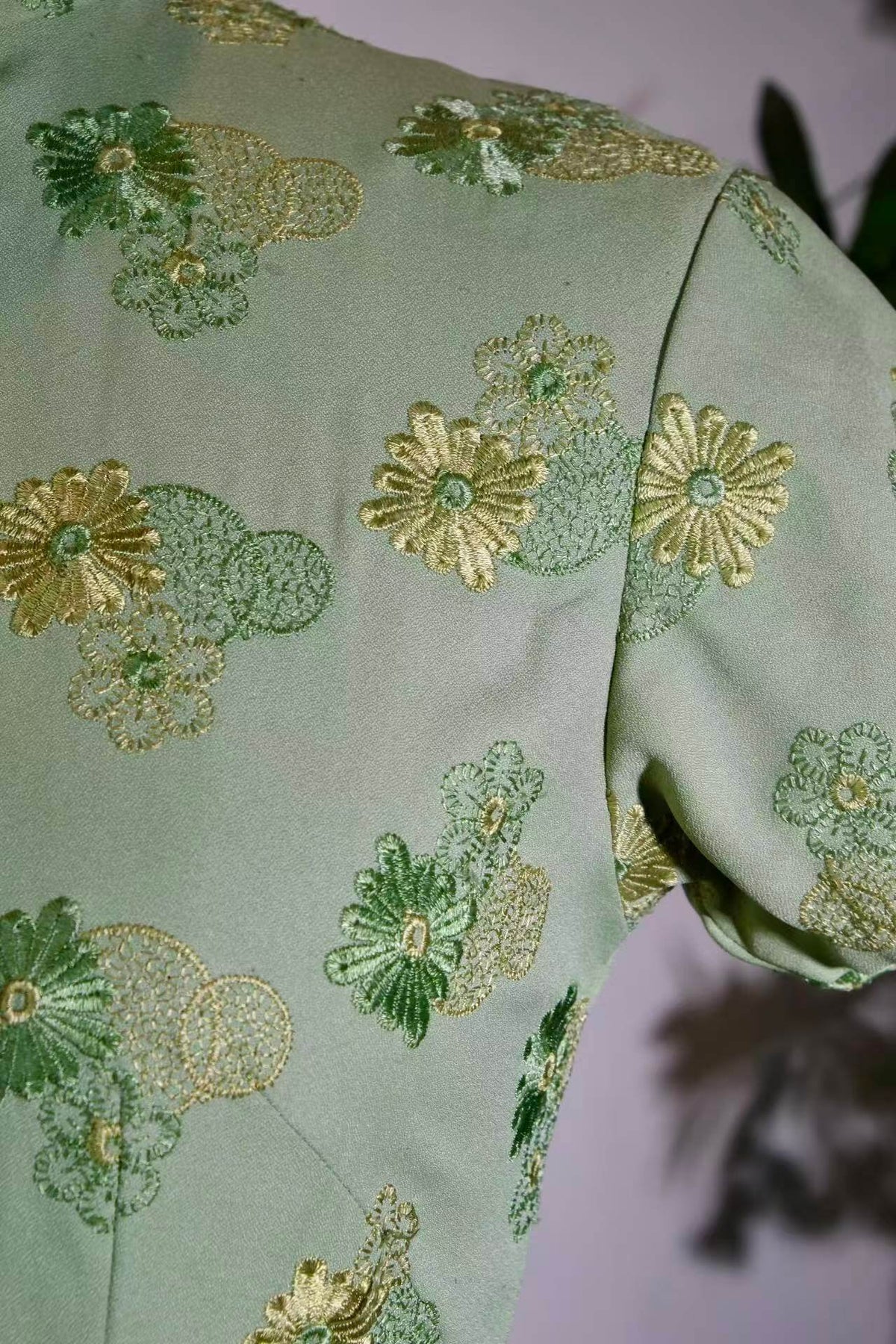
- 刺绣工艺: 图案采用了上世纪六十年代意大利进口的提花机绣(Jacquard Embroidery)工艺。请注意观察那些花朵与枝叶,它们并非平铺直叙,而是具有明显的浮雕感。
- 花型: 主体纹样为抽象化的菊花与团花变体。花瓣层层叠叠,利用金线与绿线的交织,模拟出花朵盛开时的繁复层次。
- 枝叶: 辅以云纹状的叶片或藤蔓,采用了镂空感的网眼针法,使得面料在视觉上透气而不厚重。
- 色彩流转: 绣线使用了彩色丝线混纺。随着光线的移动,金色的部分熠熠生辉,如同阳光洒在花瓣上;而绿色的部分则深沉内敛,构成了画面的骨架。这种“遍地锦”式的布局,疏密有致,既保留了传统吉祥纹样的寓意,又融入了现代设计的构成感。
二、 历史溯源:跨越重洋的时尚对话
这件旗袍不仅仅是一件衣物,它是20世纪60年代全球化贸易与文化交流的活化石。
- 面料身世: 标签所示的“意大利进口”,揭示了那个时代台湾纺织业的辉煌背景。60年代是台湾旗袍制作的黄金时代,当时的裁缝店极尽奢华之能事,往往不惜重金从欧洲(特别是意大利和法国)进口高档人造丝、醋酸纤维或混纺提花面料。意大利面料以其先进的印染技术和独特的光泽感著称,这种面料在当时属于顶级奢侈品,非普通人家所能消受。
- 产地工艺: “台湾产”则代表了当时世界上最精湛的旗袍制作工艺。彼时的台北,汇聚了来自上海的红帮裁缝与本地匠人,他们将西式立体剪裁(如省道、装袖)与中式平面结构完美融合。这件旗袍的收腰弧度、肩部的圆润处理以及领口的挺拔,皆显示出极高的制版水准。
三、 艺术风格与稀缺性:孤品难求的传世价值
从服装史的角度审视,这件作品具有极高的学术研究价值与收藏价值。
1. 中西合璧的审美典范:
它处于传统向现代过渡的关键节点。虽然保留了立领、开衩等经典元素,但其面料的选择完全是西化的、国际化的。这种“西式面料+中式剪裁”的组合,是海派文化在海外延续并升华的典型代表。正如张爱玲所言:“对于不会说话的人,衣服是一种语言。”这件衣服讲述的是一位受过良好教育、拥有国际视野的现代女性形象。
2. 不可复制的时代绝响:
- 工艺的失传: 这种特定配色的意大利老面料,随着化工染料的迭代和纺织厂的变迁,早已停产。如今的机器再也织不出那种带着岁月沉淀的柔和光泽。
- 保存的难度: 此类含丝量或人造丝较高的古董衣,历经六十载岁月,极易脆化或褪色。但这件旗袍色泽依然鲜亮如新,绣线未见断裂,品相之完美,实属凤毛麟角。
3. 引经据典的文化互文:
《诗经》有云:“绿兮衣兮,绿衣黄里。”虽原诗以此寄托忧思,但在今日看来,这抹绿色更多了一份“瞻彼淇奥,绿竹猗猗”的高洁与君子之风。它不张扬,却自有风骨。穿着这样一件旗袍,仿佛穿越回了那个白衣飘飘、书卷气浓郁的年代,每一步摇曳,都是对那个优雅时代的致敬。
结语:
这不仅是一件可以穿着的艺术品,更是一段被织物封存的历史。它等待着懂它的人,去抚摸那些凸起的绣线,去感受六十年前那个春天的温度。
Measurements / Size Guide:
Bust / Waist / Hips / Total Length: 86/72/90/95 cm
Detailed Description:
I. Pattern Deconstruction: A Three-Dimensional Poem of Spring Bustling on the Branches
Viewing this garment, what first catches the eye is the full-spread, flowing vitality. This is no ordinary flat print, but a weaving game of "light" and "shadow."
The Beauty of the Base Tone: The cheongsam utilizes an extraordinarily rare "bean green" or "willow yellow" tone throughout as its base color. Positioned at the threshold between yellow and green on the color spectrum, this shade possesses both the tender yellow of early spring willow buds and the lush greenness of grass after rain. The ancients wrote, "Beyond the green willows in mist, the dawn cold is light"—a line serving as the ultimate depiction of this color palette. Lacking the solemn heaviness of true green and the frivolity of pure yellow, it radiates a warm, jade-like, oily translucence that exudes the subtle, restrained charm of Eastern women.
Embroidery Craftsmanship: The pattern employs jacquard machine-embroidery (Jacquard Embroidery) techniques imported from Italy in the 1960s. Observe closely those blossoms and foliage—they are not flatly rendered, but feature a distinct relief-like dimension.
Floral Forms: The main motif consists of abstract chrysanthemums and variations of medallion blooms. Layers of petals interweave gold and green threads to simulate the intricate, multi-layered depth of flowers in full bloom.
Foliage and Vines: Complemented by cloud-like leaves or vines, it utilizes a mesh stitch technique with a sense of cutout craftsmanship, rendering the fabric visually breathable without feeling heavy.
Color Flow: The embroidery threads utilize blended colored silk yarns. As light shifts, the golden portions shimmer brilliantly like sunlight spilling across petals, while the green parts remain deep and reserved, forming the framework of the visual field. This "all-over brocade" layout is artfully balanced in density, preserving the symbolic meaning of traditional auspicious motifs while infusing the composition with modern design sensibilities.
II. Historical Provenance: A Fashion Dialogue Across the Ocean
This cheongsam is more than an item of attire; it is a living fossil of 1960s global trade and cultural exchange.
Fabric Provenance: The "Imported from Italy" tag reveals the illustrious backdrop of Taiwan's textile industry during that era. The 1960s marked the golden age of Taiwanese cheongsam tailoring. Tailor shops at that time spared no luxury or expense, frequently importing high-grade rayon, acetate, or blended jacquard fabrics from Europe (particularly Italy and France). Italian fabrics were renowned for their advanced dyeing technologies and unique luster; back then, such fabrics belonged to the highest tier of luxury, beyond the reach of ordinary households.
Locally Crafted Precision: "Made in Taiwan" represents the world's most exquisite cheongsam tailoring craftsmanship of that era. Taipei at that time brought together Shanghai's "Hongbang" master tailors alongside local artisans, who seamlessly merged Western three-dimensional tailoring (such as darting and set-in sleeves) with traditional Chinese flat structures. The waist cinch curvature, the rounded shoulder lines, and the upright structure of the collar on this cheongsam all demonstrate exceptional pattern-making mastery.
III. Artistic Style and Rarity: The Enduring Value of an Irreplaceable Gem
Examined through the lens of costume history, this work holds immense academic research and collection value.
A Paragon of East-Meets-West Aesthetics: It sits at a crucial nexus transitioning from traditional to modern. While retaining classic elements like the mandarin collar and side slits, its fabric selection is thoroughly Westernized and internationalized. This combination of "Western-style fabric + Chinese-style tailoring" serves as a classic representation of Shanghai culture continuing and transforming overseas. As Eileen Chang noted: "To those who cannot speak, clothes are a language." This garment speaks of a modern female persona—well-educated and possessing an international perspective.
An Irreplicable Swan Song of an Era:
Lost Craftsmanship: Old Italian fabrics featuring this specific color palette have long ceased production due to iterations in chemical dyes and the shifting of textile mills. Today's machines can no longer weave that soft luster imbued with the settling of time.
Preservation Difficulty: Vintage garments with higher silk or rayon contents easily become brittle or faded over six decades. Yet this cheongsam retains bright, fresh colors, with zero broken embroidery threads—a pristine level of preservation that is a true rarity.
Cultural Intertextuality Drawing from Classics: The Classic of Poetry (Book of Songs) states: "Green is the robe, green robe with yellow lining." Though the original poem used this line to express mournful thoughts, seen today, this shade of green carries even more of the noble, gentlemanly spirit found in "Look at the bends of the Qi River, where green bamboos grow lush." Unostentatious, it possesses its own inherent character. Dressed in such a cheongsam, one feels transported back to that literary era of fluttering white garments—where every swaying step stands as a tribute to that golden age of grace.
Epilogue: This is not merely an artwork you can wear, but a piece of history sealed within woven fibers. It awaits a true connoisseur to touch those raised embroidery threads and feel the temperature of that spring from sixty years ago.