深圳溯源
Couldn't load pickup availability
衣服尺寸:
胸围/腰围/臀围:90/90/100 厘米
衣长:103 厘米
细节描述:
一、衣上纹样:素胚点染的东方诗学
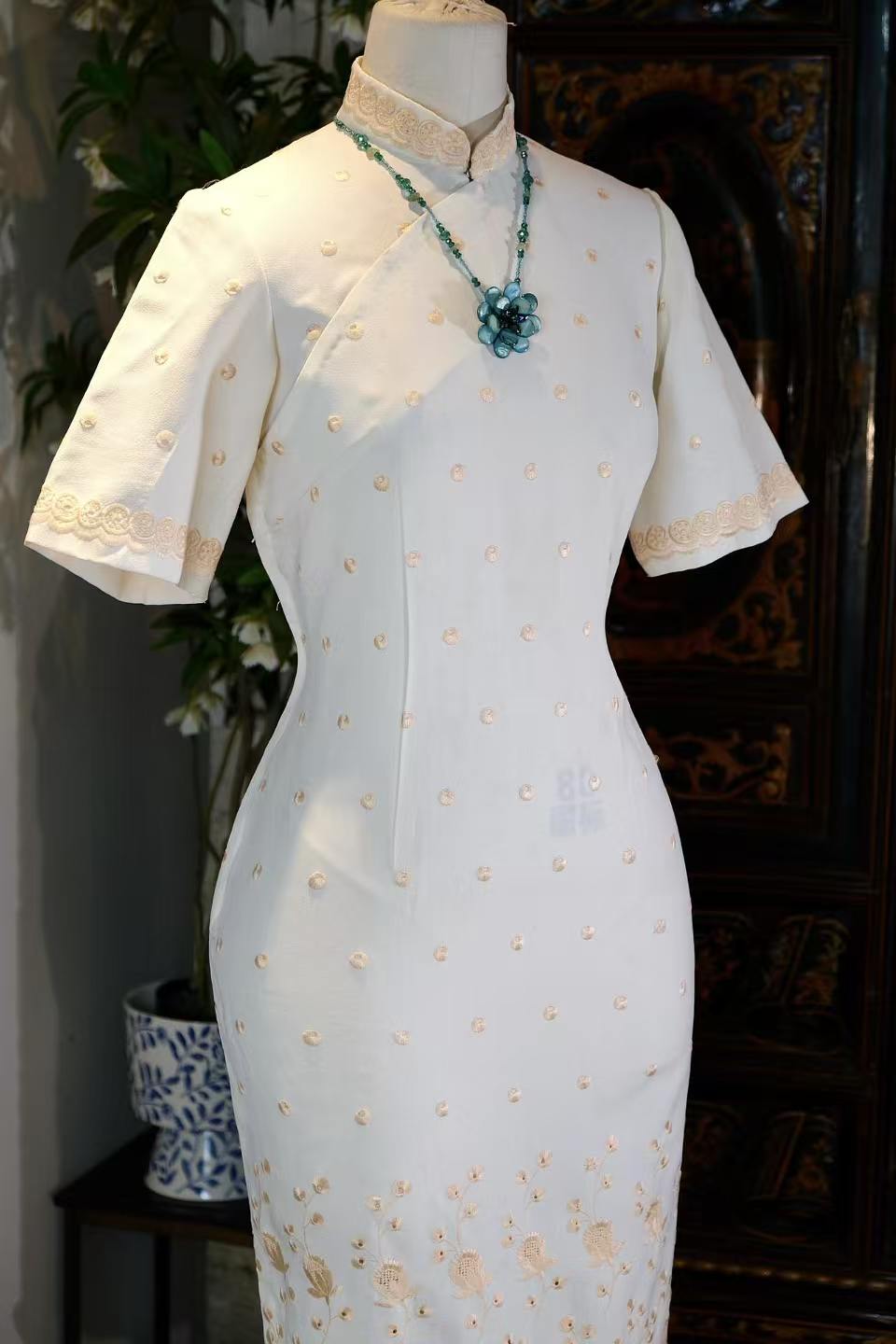
此件六十年代台湾产机绣旗袍,以象牙白为骨,通体缀以浅金机绣圆点,如星子散落夜空,暗合《诗经》“素以为绚兮”的审美意趣。针脚细密如春蚕吐丝,取“莲出淤泥而不染”之意,呼应文人“清雅自持”的精神追求。
裙摆处尤见匠心:机绣花卉自下而上渐次舒展,或含苞、或盛放,枝叶颗粒饱满如珠玉,暗藏《长物志》“虽由人作,宛自天开”的造境智慧。此类机绣工艺在六十年代台湾尚属前沿,既保留手工刺绣的细腻,又因机械精度而更显规整,是传统工艺与现代技术碰撞的珍贵标本。
二、旧衣故事:海峡西东的衣香鬓影
六十年代的台湾,旗袍仍是女性社交场合的“第二层肌肤”。这件旗袍的主人,或许是一位随迁至台的知识女性——她在台北的咖啡馆里穿着它赴约,衣摆扫过木质地板的轻响,与留声机里的周璇歌声交织;或在台南的庭院中,着此衣侍弄花草,阳光透过薄纱袖口,在腕间投下细碎的金斑。
彼时台湾纺织业初兴,此类机绣旗袍多出口创汇,存世量本就不多。加之六十年代末西式裙装冲击,旗袍逐渐退居“礼服”地位,能完整保存至今者,堪称“行走的纺织史”。
三、艺术风格:中西合璧的摩登宣言
此衣版型取法海派旗袍的“S型曲线”,收腰、放摆、高开衩,暗合西方“New Look”的审美潮流,却又以中式立领、斜襟固守东方气韵。机绣圆点的“波点”元素,实为五十年代迪奥“New Look”风靡全球后的余波,台湾设计师巧妙将其本土化,以金线替代彩色波点,更显含蓄贵气。
这种“中学为体,西学为用”的设计哲学,恰如张爱玲所言:“旗袍是理性的,它把女人的身体切割成几何图形,却又用曲线把图形缝合起来。”此衣正是这种“理性与浪漫”的绝佳注脚——机绣的规整是理性,花卉的灵动是浪漫;西式剪裁是理性,中式纹样是浪漫。
四、稀缺性考:不可复制的时代切片
在古董旗袍收藏界,六十年代台湾机绣旗袍的稀缺性有三:
- 工艺稀缺:彼时台湾机绣设备多依赖进口,能驾驭复杂纹样的工厂屈指可数,且机绣旗袍因“非全手工”曾被藏家轻视,导致存世量远少于同期上海手工旗袍。
- 历史稀缺:六十年代是台湾旗袍“最后的黄金期”,此后二十年,旗袍逐渐式微,此类兼具实用性与艺术性的日常款,比舞台装、礼服更具生活史价值。
- 品相稀缺:此衣历经半世纪仍保持面料挺括、绣线未脱,足见当年纺织工艺之精湛,堪称“民国旗袍向现代时装过渡”的活化石。
“衣不如新,人不如故”,但这件旗袍却因“旧”而更显珍贵——它不是博物馆里冰冷的展品,而是能穿在身上的历史。当指尖抚过那些机绣的圆点与花卉,仿佛触摸到六十年代台湾街头的风,听见留声机里飘出的《夜来香》,看见一位女子穿着它,在时光里优雅转身。
Measurements / Size Guide:
Bust / Waist / Hips: 90/90/100 cm
Total Length: 103 cm
Detailed Description:
[I. Patterns on Fabric: The Poetics of an Eastern Plain Canvas] Crafted in 1960s Taiwan, this machine-embroidered Qipao uses ivory white as its core bone, adorned throughout with light gold machine-embroidered polka dots. Scattering like stars across the night sky, it subtly echoes the aesthetic concept from the Classic of Poetry (Book of Songs): "Plainness brings out the splendor." The stitches are as dense and meticulous as silk spun by spring silkworms, invoking the lotus that "emerges from the mud unsullied"—a direct reflection of the literati's pursuit of pure, self-sustained elegance.
The artistry peaks at the hem: the machine-embroidered blossoms unfurl progressively from bottom to top. Budding or in full bloom, the foliage and stems are as plump and lustrous as pearls and jade, embodying the space-creating wisdom of the Treatise on Superfluous Things (Chang Wu Zhi): "Though made by human hand, it appears as if wrought by Heaven." This machine-embroidery technique was at the absolute vanguard of 1960s Taiwanese manufacturing, retaining the delicacy of hand-stitching while achieving a geometric precision unique to machinery—a precious specimen of traditional craft colliding with modern technology.
[II. Stories of the Antique: Glamour Across the Strait] In 1960s Taiwan, the Qipao remained a woman's "second skin" in social arenas. The original owner of this garment might well have been an educated woman who migrated to Taiwan. One could picture her wearing it to a rendezvous in a Taipei café, the hem sweeping softly against the wooden floor, intertwining with Zhou Xuan’s voice drifting from a gramophone. Or perhaps in a Tainan courtyard, tending to plants while the sunlight filtered through the sheer organza cuffs, casting dappled gold flecks upon her wrist.
At that time, Taiwan's textile industry was just emerging, and such machine-embroidered Qipaos were primarily produced for export to generate foreign exchange, leaving very few for the domestic market. With the onslaught of Western-style dresses in the late 1960s, the Qipao was gradually relegated to formal event-wear. A piece that has survived so flawlessly to this day is truly a "walking history of textiles."
[III. Artistic Style: A Modernist Manifesto of East-Meets-West] The silhouette adopts the classic "S-curve" of the Shanghainese-style Qipao—cinched waist, flared hem, and high side slits—subtly aligning with the global "New Look" trend of Western fashion, while firmly anchoring its Eastern aura through the traditional mandarin collar and diagonal closure (Xiejin). The machine-embroidered dots are a localized echo of Dior's mid-century aesthetic wave. Taiwanese designers ingeniously adapted this trend, replacing colored polka dots with metallic gold threads to exude a more restrained, patrician nobility.
This design philosophy of "Eastern essence as the core, Western utility as the means" perfectly illustrates Eileen Chang’s famous remark: "The Qipao is rational; it cuts a woman's body into geometric shapes, yet uses curves to stitch those shapes back together." This garment is the ultimate footnote to that union of rationality and romance—the mechanical precision of the embroidery is rational, while the vitality of the blossoms is romantic; the Western tailoring is rational, while the Eastern motif is romantic.
[IV. Rarity: An Irreplaceable Fragment of an Era] In the world of vintage Qipao collecting, the rarity of 1960s Taiwanese machine-embroidered pieces rests on three pillars:
Rarity of Craftsmanship: At the time, Taiwan's advanced embroidery machinery relied heavily on imports. Only a handful of factories could master such complex patterns. Furthermore, because they were "not entirely handmade," these pieces were historically overlooked by early collectors, resulting in a survival rate far lower than that of contemporary handmade Shanghai Qipaos.
Historical Rarity: The 1960s marked the "last golden age" of the Qipao in Taiwan. Over the subsequent two decades, the garment faded from daily life. Consequently, these everyday styles, which balance utility with art, hold far greater value for social history than stage costumes or evening gowns.
Pristine Preservation: Remaining structurally crisp with intact embroidery threads after half a century, this piece stands as a living fossil of the transition from the Republic of China Qipao to modern fashion.
"Clothes are preferred new, but people are preferred old," yet this Qipao grows more magnificent precisely because of its age. It is not a cold exhibit in a museum, but a piece of history you can wear. When your fingertips brush across those embroidered dots and blossoms, you can almost feel the breeze of a 1960s Taipei street, hear the strains of Ye Lai Xiang (The Evening Primrose) from the gramophone, and see a woman elegantly turning around in the mist of time.