深圳溯源
Couldn't load pickup availability
一、 纹样解析:从“抽象翎毛”到“具象神鸟”的升华
如果说前一套服饰中的孔雀是含蓄的符号,那么这件马甲上的孔雀则是喧宾夺主的视觉盛宴。
- 满绣孔雀图:整件马甲的核心在于胸前那幅巨大的苏绣孔雀开屏图。绣工采用了极高难度的“套针”与“施针”技法,丝线光泽流转,将孔雀羽毛的金属质感表现得淋漓尽致。孔雀头部昂扬,眼神灵动,尾羽呈扇形铺展,几乎占据了整个前胸。这种构图打破了传统服饰纹样的对称平衡,带来一种强烈的动态美和现代感。
- 色彩心理学:底色选用深沉如夜的黑缎,不仅是为了衬托孔雀羽毛的绚烂(蓝、绿、紫、金交织),更在视觉上营造出一种“暗夜流光”的神秘感。而在领口、襟边及下摆处,使用了淡紫色(藕荷色)的宽边宕条进行勾勒。紫色在中国传统文化中象征“紫气东来”,代表尊贵与祥瑞;在这里,它与黑色的搭配显得既摩登又典雅,完全脱离了俗艳,透出一种高级的冷艳气质。
二、 形制与工艺:海派时尚的极致演绎
这件马甲的剪裁与细节,是民国时期“海派”服饰文化的典型标本。
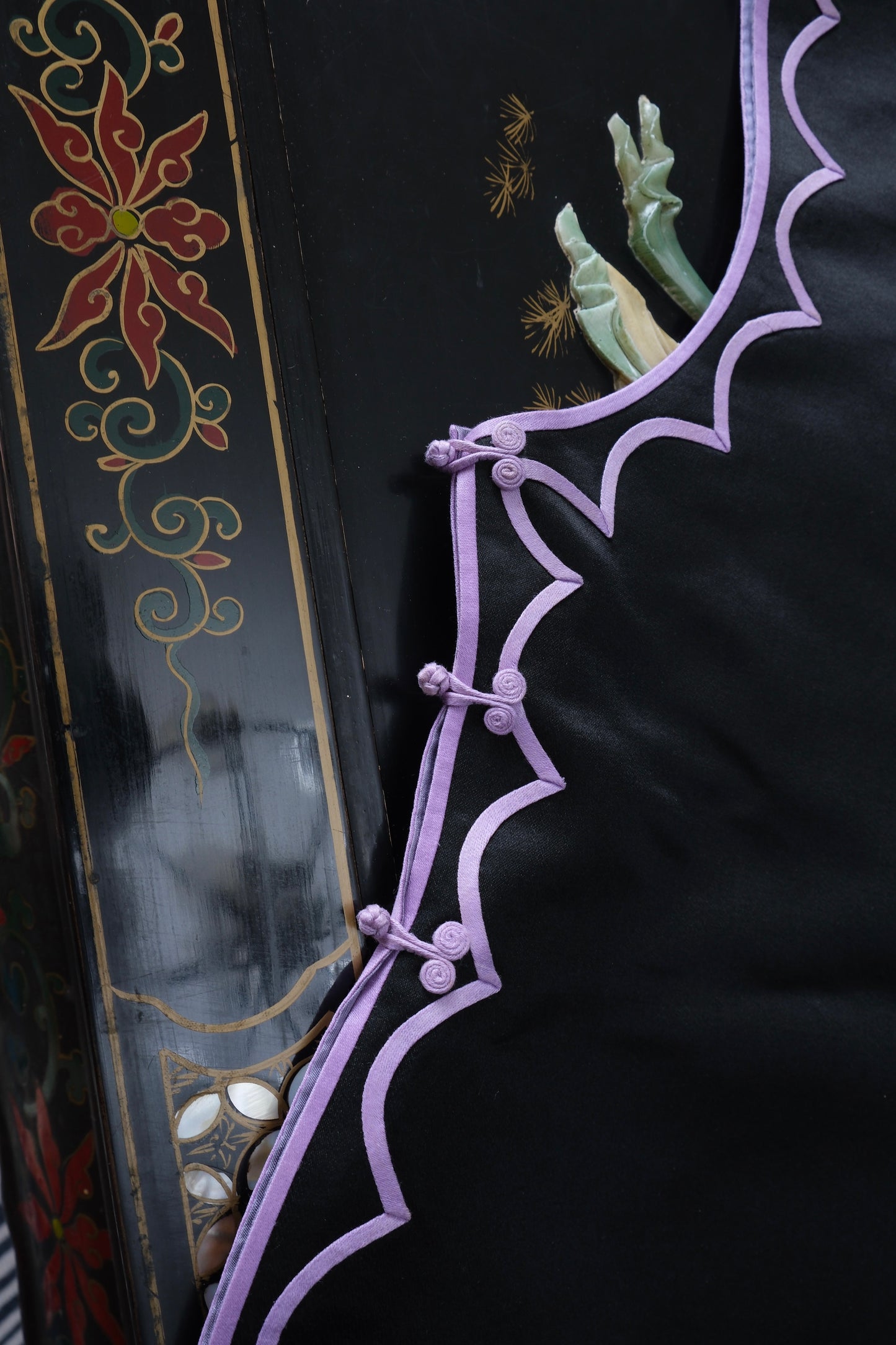
- 波浪形宕条与滚边:请注意其边缘的处理,并非传统的直线,而是采用了极具装饰艺术风格(Art Deco)影响的波浪形轮廓。这种流畅的曲线设计,柔化了黑色面料的沉重感,增加了女性的柔美韵律。淡紫色的宽滚边(宕条)不仅起到了加固作用,更像是一幅画框,将中间的刺绣完美地“装裱”起来。
- 精致的盘扣:领口至腋下的襟边,排列着数枚同样由淡紫色丝线缠绕而成的琵琶扣。这些盘扣制作精良,造型圆润,既是功能性的连接件,又是点缀在黑色画布上的精致音符。
- 倒大袖的遗韵:虽然这是一件无袖马甲,但其肩部的剪裁依然保留了“倒大袖”时期的宽松廓形特征,穿着时能很好地修饰肩部线条,内搭长袖旗袍或袄裙皆宜。
三、 历史回响:穿在身上的“富贵荣华”
在民国时期的婚嫁习俗或重大庆典中,女性往往会在倒大袖旗袍外罩一件这样的刺绣马甲,称之为“坎肩”或“背心”。
据《清稗类钞》记载,清代命妇礼服已有类似形制,而到了民国,这种服饰逐渐世俗化、时尚化。这件马甲上的孔雀,寓意“前程似锦”、“吉祥如意”。在那个新旧交替的年代,拥有一件如此重工的苏绣马甲,不仅是家庭财力的展示,更是女主人审美品位的宣示。
想象一下,百年前的某个夜晚,一位身着墨绿或宝蓝旗袍的名媛,外罩这件黑缎孔雀马甲,在灯光下缓缓走过。黑色的沉稳压住了场子,而胸前的孔雀随着她的呼吸仿佛真的在开屏颤动,紫色的镶边在暗处泛着幽光。这不仅仅是一件衣服,它是那个时代女性对于“美”的极致追求与自信表达。
四、 收藏价值:不可复制的时光孤品
这套藏品与前一件粉色素缎上袄形成了完美的互补:
- 一动一静:前者是日常的温婉,后者是典礼的华贵。
- 一简一繁:前者胜在剪裁与配色,后者胜在重工刺绣与气场。
这两件衣物共同构建了一个完整的民国女性衣橱切片。尤其是这件黑缎孔雀马甲,保存状况极佳,绣片无脱落,缎面光泽依旧,且紫色滚边未见明显褪色,实属传世孤品。它见证了苏绣工艺在近代服饰史上的巅峰时刻,也记录了一段关于东方美学如何走向现代的珍贵记忆。
If the peacock in the previous ensemble operated as a reserved and modest symbol, the peacock rendered upon this vest functions as a dominant, breathtaking visual feast.
The Fully Embroidered Peacock Matrix: The absolute core of the entire vest lies in the massive, fully embroidered scene of a peacock spreading its tail feathers across the front chest. The embroiderer utilized high-difficulty Tao-Zhen (interlocking satin stitch) and Shi-Zhen (proportional padding stitch) techniques of traditional Suzhou embroidery (苏绣). The shifting luster of the silk filaments perfectly captures the metallic depth of living peacock plumage. The peacock's head is proudly elevated with an alert, vital gaze, while its tail coverts expand in a spectacular fanned arc that occupies nearly the entire front chassis. This compositional layout breaks away from the rigid symmetry of traditional dress motifs, introducing a powerful sense of kinetic motion and modern dynamism.
The Chromatic Psychology: Selecting a deep black satin base as profound as the night does more than throw the brilliant coloration of the peacock plumage (an interlacing of vibrant blue, green, purple, and gold) into sharp relief; it builds a mysterious visual effect of "shimmering light within the dark." Concurrently, along the collar line, diagonal lapel, and lower hem, a wide decorative band (宕条) in a muted lavender (lotus-root pink) hue is used to map out the contours. In traditional Chinese culture, purple symbolizes "purple radiance spreading across the eastern sky" (“紫气东来”), representing elite nobility and auspicious fortune. Within this design, its pairing with the black base appears both modern and classically refined, entirely shedding any potential gaudiness to project an elevated, cold, and striking elegance.
The tailoring choices and fine details of this vest serve as a definitive baseline specimen of the iconic "Shanghai-style" (海派) apparel culture during the Republican era.
Wave-Form Decorative Bands and Piping: Close inspection of the edge finishes reveals that they depart from traditional linear paths, adopting instead a fluid, wave-form outline deeply influenced by the global Art Deco design movement. This undulating curve execution softens the heavy visual weight of the black satin, adding a soft rhythm to the female form. The lavender wide decorative band serves a dual purpose: structurally reinforcing the seam lines while functioning like a fine picture frame that beautifully "mounts" and presents the central embroidery panel.
Meticulous Pipa Closures: Positioned along the lapel running from the throat down to the underarm is a series of delicate Pipa frog closures (琵琶扣), meticulously wrapped using identical lavender silk threads. These closures are flawlessly rounded and balanced, functioning simultaneously as essential structural fasteners and as refined musical notes punctuated across a black satin canvas.
The Silhouette Legacy of the Inverted Sleeve: Although this garment is a sleeveless vest configuration, the construction across the shoulder girdle preserves the relaxed, generous structural width characteristic of the historical "inverted-sleeve" (倒大袖) window. When worn, it frames the shoulder lines beautifully, matching seamlessly over either long-sleeved qipaos or traditional jacket-and-skirt combinations (袄裙).
Within the wedding customs or major ceremonial celebrations of the Republican era, women routinely layered an embroidered vest of this caliber over their inverted-sleeve qipaos, classifying the garment type as a Kanjian (坎肩) or Beixin (背心).
According to documentation in The Classified Notes on the Qing Dynasty (《清稗类钞》), similar structural frameworks were already worn by titled noblewomen as ceremonial court robes during the imperial era. By the Republican period, this garment type gradually transitioned into secularized daily life and urban fashion spheres. The peacock on this vest carries the auspicious meaning of "a future as brilliant as embroidered silk" and "universal good fortune." In that era of rapid historical transition, possessing a heavily embroidered Suzhou-style vest of this technical grade was not merely an open broadcast of ancestral family wealth, but a firm declaration of the hostess's personal aesthetic refinement.
Picture a scene from a century ago: on a formal evening, an elite madam clad in a deep forest-green or royal-blue qipao, layered beneath this black satin peacock vest, moves gracefully under the warm glow of low chandeliers. The steady black base anchors the room, while the embroidered peacock across her chest appears to ripple and spread its tail with every breath she takes, as the purple piping gleams softly in the shadows. This is far more than a functional garment; it represents the ultimate pursuit of beauty and confident self-expression by the women of that generation.
This archival specimen establishes a perfect, symbiotic dialogue when paired alongside the previously analyzed solid pink satin inverted-sleeve top:
Dynamic vs. Static Balance: The pink satin top embodies the gentle, approachable restraint of everyday life, whereas this black satin vest commands the majestic splendor of high ceremonial galas.
Simplicity vs. Complexity Complexity: The former achieves its triumph through pure lines and minimalist color blocking, while the latter commands attention through heavy-gauge manual embroidery and an undeniable visual presence.
Together, these two distinct garments construct a complete, physical cross-section of an elite Republican-era female wardrobe. Most notably, this black satin peacock vest is preserved in an exceptional state of conservation: the embroidery threads remain tightly locked to the base matrix without splitting, the satin face retains its original structural luster, and the purple piping displays no visible atmospheric fading. It stands as a true transmitted masterpiece (传世孤品), documenting the absolute peak of Suzhou embroidery within modern costume history and preserving a rare archive of how Eastern aesthetics proudly stepped into the modern world.
Suyuan Archival Textile Registry — Documenting the material culture, preserving the technical lineage of ancestral craft.