深圳溯源
Couldn't load pickup availability
衣服尺寸:
胸围/腰围/臀围:90/78/98 厘米
衣长:122 厘米
细节描述:
【图案与工艺:光影交织的东方美学】
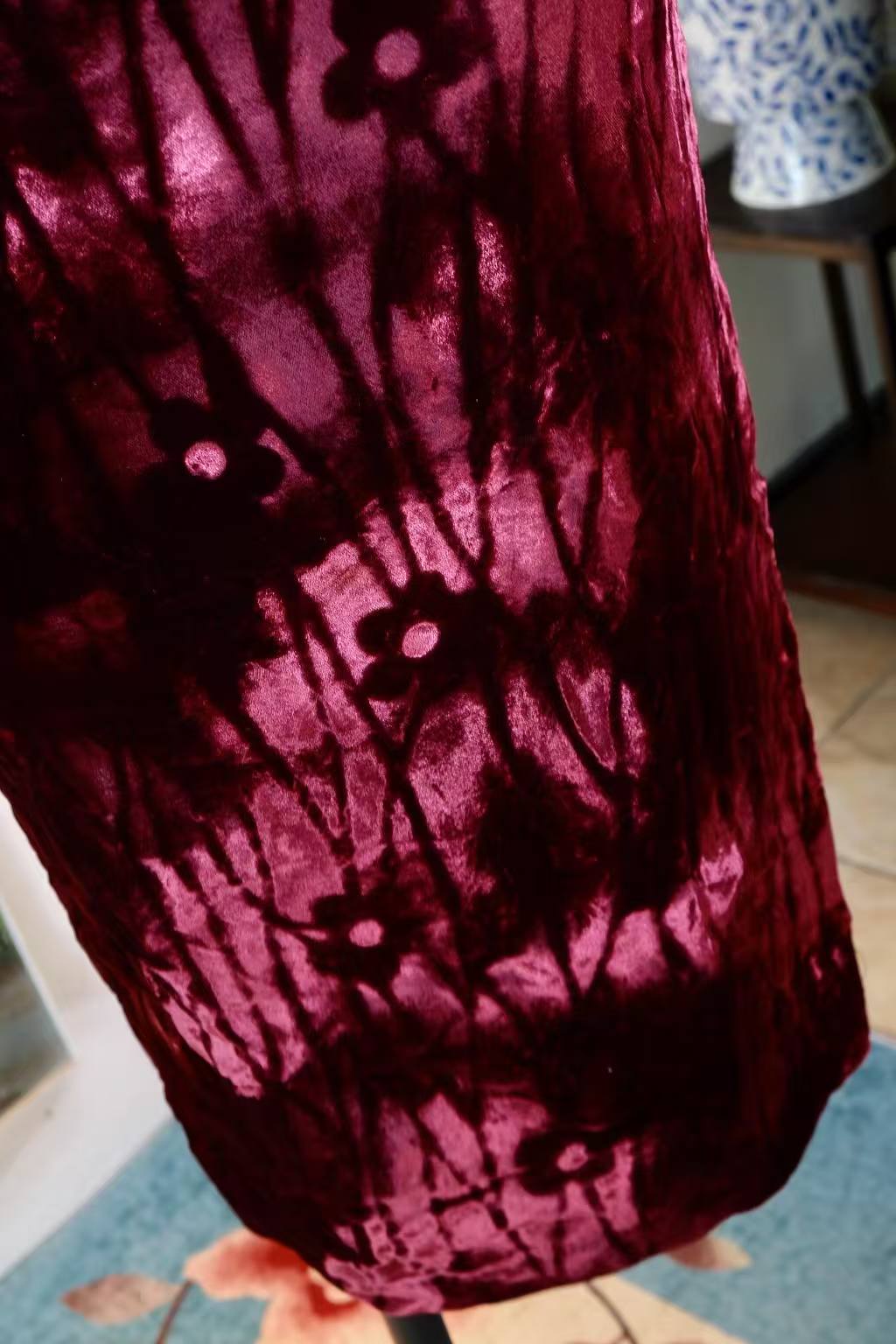
这件古董旗袍以日本进口金丝绒为面料,色泽如陈年葡萄酒般醇厚浓郁,在光线下流转着低调而奢华的金属光泽。其压花工艺堪称一绝:深紫底色上,隐约浮现出墨色花卉与枝蔓的纹样。这些图案并非简单的印染,而是通过高温压烫使绒面产生凹凸质感,形成一种“似有若无”的视觉层次。
花朵造型简约抽象,宛如宋代院体画中的折枝花卉,又带几分现代艺术的几何感;枝蔓线条流畅婉转,如同书法中的行草笔意,疏密有致地铺陈于衣身。这种“压花”技法在六十年代极为考究,既保留了丝绒的柔软垂坠,又赋予了面料雕塑般的立体肌理。当穿着者行走时,光线随身体起伏而变化,暗花便在明灭间“活”了过来,仿佛暗夜中悄然绽放的幽兰,含蓄而深邃。
【历史回响:大时代下的服饰迁徙】
这件旗袍诞生于上世纪六十年代的台湾,那是一个特殊的文化交汇期。彼时,台湾作为东亚时尚的重要中转站,汇聚了来自大陆的裁缝技艺、日本的纺织工业以及西方的审美思潮。
- 面料的跨国之旅: “日本进口金丝绒”见证了战后亚洲贸易的复苏。六十年代,日本纺织业凭借精湛的化纤与混纺技术崛起,这种高档丝绒因其挺括度和光泽感,成为当时港台名媛追逐的奢侈品。
- 剪裁的时代印记: 旗袍的剪裁继承了海派旗袍的精髓——收腰极高,强调女性的S型曲线,同时融入了西式立体剪裁的省道处理,使衣身更加贴合人体工学。立领依旧挺拔,但高度略微降低,袖口呈现七分或九分长度,露出纤细手腕,这是六十年代追求干练与优雅并存的典型特征。
它不仅仅是一件衣服,更是那个动荡年代里,人们试图在混乱中寻找秩序、在传统中拥抱现代的缩影。正如张爱玲所言:“对于不会说话的人,衣服是一种语言,随身带着的是袖珍戏剧。”这件旗袍,便是一出关于流离与重生的无声戏剧。
【艺术风格与稀缺性:不可复制的孤品】
从服装史的角度审视,这件作品具有极高的研究价值与收藏意义:
1. 材质的绝唱: 真正的老式金丝绒(Velvet)与现代仿丝绒有着本质区别。老料含丝量高或采用特殊醋酸纤维,手感温润如玉,且随着时间推移会产生独特的“包浆”感。如今,这种特定工艺的进口老料已近乎绝迹。
2. 审美的独特性: 不同于五十年代的繁复刺绣或七十年代的极简主义,六十年代的压花旗袍处于一种微妙的平衡点——既有传统的温婉,又有现代的冷峻。这种暗调的华丽,符合中国传统文人“绚烂之极归于平淡”的美学追求。
3. 保存的奇迹: 丝绒面料极难保存,易倒绒、易虫蛀。这件旗袍历经六十载岁月,绒毛依然丰满直立,色泽未见明显褪色,品相之完好,实属凤毛麟角。
结语:
《诗经》云:“青青子衿,悠悠我心。”衣裳不仅是蔽体之物,更是情感的寄托与身份的认同。这件六十年代的紫绒压花旗袍,如同一位沉默的老者,静静诉说着半个世纪前的风华绝代。它不属于快时尚的洪流,只属于那些懂得在时光深处凝视美的人。拥有它,便是拥有了一段凝固的历史,一份独属于你的、不可复制的东方雅韵。
Measurements / Size Guide:
Bust / Waist / Hips: 90/78/98 cm
Total Length: 122 cm
Detailed Description:
This vintage qipao utilizes premium imported Japanese panne velvet (kin-shirong) as its base canvas, yielding a coloration as rich and mellow as an aged vintage wine. Under changing light, it coaxes out a low-profile yet luxurious metallic luster across the pile. The precise craftsmanship of its embossed finishing (yahua) is nothing short of masterly: against the deep purple ground, ink-dark floral motifs and winding tendrils subtly surface. These patterns bypass basic superficial industrial printing; instead, they are engineered via high-temperature heat-press techniques that collapse select fibers to create a tangible structural depth, establishing a visual landscape of "half-present, half-hidden" illusion.
The floral configurations are minimalist and abstract, capturing the spirit of the delicate, broken-spray floral renderings (zhezhi) from Song Dynasty academy paintings, while flirting with the geometric discipline of modern art. The sweeping lines of the tendrils are fluid and calligraphic, mirroring the expressive momentum of running-cursive script (xingcao) as they layout across the torso with immaculate pacing. This embossing methodology was intensely sophisticated in the 1960s; it successfully retained the characteristic organic weight and soft, liquid drape of velvet while gifting the textile a sculptural, three-dimensional skin. As the wearer moves, light bends across the shifting planes of the physical form, causing the dark, subtle patterns to "animate" in the balance between light and shadow—resembling a rare orchid blooming in the deep recesses of the night, intensely disciplined yet deeply seductive.
This qipao was born during the 1960s in Taiwan, an era defined by a unique and intense cultural convergence. At that time, Taiwan functioned as a critical geopolitical and sartorial crossroads in East Asia, serving as a melting pot for displaced continental Chinese tailoring techniques, Japanese textile manufacturing infrastructure, and Western post-war design philosophy.
The Transnational Journey of the Textile: The utilization of "imported Japanese velvet" serves as physical evidence of the post-war recovery of Pan-Asian commercial trade. In the 1960s, the Japanese textile industry entered a golden era of innovation fueled by sophisticated synthetic fiber blending and finishing capabilities. This high-grade embossed velvet, celebrated for its rigid structural retention and shifting sheen, became an elite luxury commodity fiercely pursued by the high-society matrons of Hong Kong and Taipei.
The Chronological Imprint of the Silhouette: The pattern drafting of this garment fiercely inherits the structural core of classic Haipai (Shanghai-style) tailoring. The waistline is cinched extraordinarily high to accentuate an idealized, sweeping S-curve silhouette, yet it integrates precise Western three-dimensional darting (se省) to achieve a seamless, ergonomic contour against the body. The classic mandarin collar remains crisp and commanding, though engineered to a slightly lower, more comfortable height. The armscyes resolve into classic three-quarter or nine-quarter sleeves that terminate precisely to expose the slenderest architecture of the wrist—a signature mid-century marker of a woman demanding an aesthetic of synchronized capability and high elegance.
It stands not merely as an article of dress, but as a material microcosm of an era attempting to establish a pristine order amidst geopolitical dislocation, eagerly embracing modernity while safeguarding heritage. As Eileen Chang famously observed in A Chronicle of Changing Clothes, "To those who cannot speak, clothing is a form of speech; it carries with it a pocket-sized drama." This qipao represents the cinematic climax of that text—a silent theatrical performance archiving displacement and survival.
Examined through the strict lens of textile and fashion sociology, this archival piece commands exceptional documentary merit and connoisseurship value:
The Swan Song of Vintage Pile Weaves: Authentic mid-century velvet (velvet) possesses an entirely distinct material soul compared to contemporary synthetic reproductions. Vintage yardage of this caliber features a high silk ratio or incorporates specialized early acetate formulations, rendering a tactile hand-feel as warm and smooth as unblemished nephrite jade. Over decades of careful ownership, it develops a deep, inimitable "patina" (baojiang). Today, the technical parameters required to manufacture this imported mid-century yardage have been completely erased by industrial obsolescence.
The Singularity of Mid-Century Discipline: Moving away from the dense, heavy surface embroideries of the 1950s and avoiding the stark, minimalist reductionism of the late 1970s, the embossed qipaos of the 1960s strike a breathtaking structural equilibrium. It anchors traditional Eastern composure within a framework of cool, modern severity. This restrained, low-key manifestation of luxury beautifully honors the classical Chinese literati ideal: "splendor carried to its absolute zenith ultimately surrenders to sublime understatement" (xuanlan zhiji gui yu piandan).
A Miracle of Textile Conservation: Organic pile fabrics are notoriously fragile historical artifacts; they are hyper-susceptible to pile crushing, fiber baldness, and catastrophic moth degradation. For this garment to survive over sixty years of environmental exposure with its velvet pile standing perfectly erect, its dye transfer completely free of fading, and its structural integrity pristine is an extraordinary anomaly within vintage collection circles.
The Book of Songs (Shijing) famously muses: "Blue is the collar of your robe, deep is the longing in my heart." Clothing has never been a simple utility to shield the physical form; it is a profound physical vessel for emotional projection, taste, and cultural identity. This 1960s embossed purple velvet qipao stands like a poised, silent noblewoman in the deep corridors of time, whispering the collective memories of a magnificent generation. It exists completely outside the volatile torrents of fast fashion, waiting solely for the true connoisseur who understands how to gaze into the deep history of beauty. To hold it is to hold a frozen segment of history—a magnificent, personal monument to Eastern elegance.