溯源
Couldn't load pickup availability
【引言:时光的纹理】
张爱玲曾言:“衣服是一种言语,随身带着一种袖珍戏剧。”这件诞生于20世纪60年代的旗袍,便是一出无声的折子戏。它褪去了50年代初期的繁复堆砌,也未陷入70年代末的过度张扬,而是定格在了一种内敛而摩登的黄金平衡点上。
【面料与纹样:波斯的风,东方的骨】
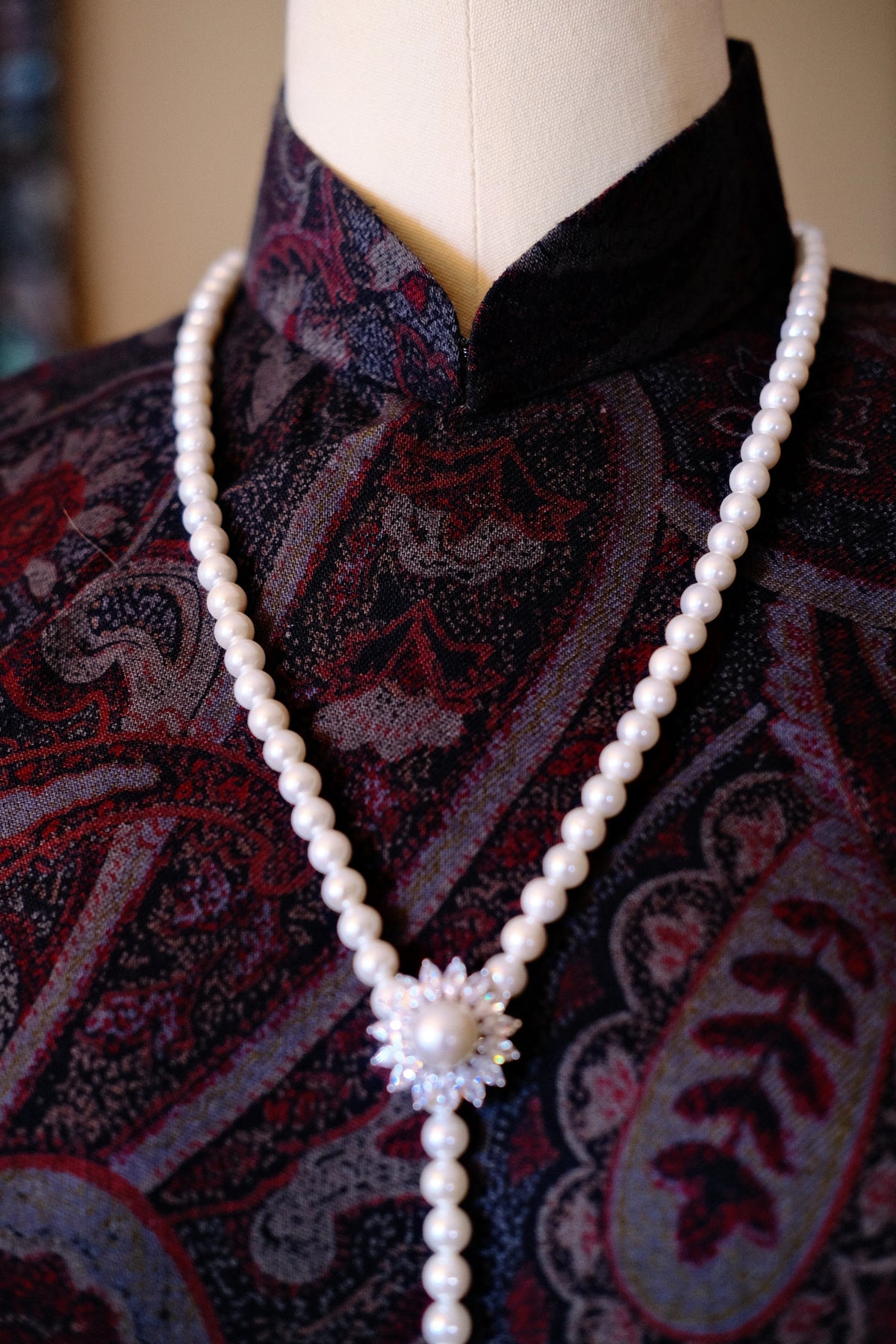
目光所及,最摄人心魄的莫过于这满身流淌的佩斯利(Paisley)纹样。
这种源自古波斯、形如“泪滴”或“腰果”的图案,在清代经由丝绸之路传入中国,被称为“火腿纹”或“洋花”。到了60年代,它已成为国际时尚界的宠儿。
在这件旗袍上,佩斯利纹样不再是简单的异域猎奇,而是被解构、重组,化作深紫与暗红交织的迷离幻梦。这种繁复的曲线美,恰好中和了羊毛面料原本的厚重感。精仿羊毛的运用,是那个时代纺织工业进步的佐证——它既保留了羊毛挺括、保暖的实用性,适应了当时女性走出家庭、步入社会的快节奏生活,又通过精细的织造工艺,呈现出如同丝绸般的光泽与垂坠感。
【版型与剪裁:海派风骨的最后一抹余晖】
从服装史的角度审视,这件旗袍的剪裁是典型的60年代海派改良风格。
请注意它的领口,依然恪守着传统的高立领规制,护住颈项的端庄;但视线向下,腰身的收省(Darts)处理得极为大胆且精准。这种立体剪裁手法,明显受到了西方迪奥“New Look”之后女装廓形的影响。它不再像传统平面剪裁那样遮掩身体,而是毫不吝啬地勾勒出女性胸腰臀的自然曲线。
袖长至手腕,线条流畅利落,没有多余的滚边与镶嵌,这种“做减法”的设计,恰恰体现了60年代现代主义审美对传统的重塑——删繁就简,由于克制,所以高级。
【配饰与意境:白璧无瑕的点睛之笔】
那一串长款的珍珠项链(Sautoir),是整套造型的灵魂所在。
在深色且花纹繁复的羊毛旗袍上,珍珠的温润光泽起到了极好的“透气”作用。它打破了深色面料可能带来的沉闷,拉长了视觉比例。珍珠的圆融与旗袍立领的严谨形成对比,仿佛是在严肃的秩序中,注入了一丝女性的柔情与浪漫。
【结语】
这不仅是一件御寒的衣物,更是一件关于“融合”的艺术品。它将波斯的古老图腾、西方的立体剪裁、中国的传统形制以及60年代特有的摩登精神,天衣无缝地缝合在一起。
穿着它的女子,想必是读过书、见过世面的。她行走在深秋的梧桐树下,衣褶间藏着旧时代的优雅,步伐里却踏着新时代的节拍。
所谓伊人,在水一方;锦衣华服,岁月留香。
Eileen Chang once observed: "Clothing is a language—a pocket drama carried on one's person." This Qipao, born in the 1960s, is precisely a silent, single-act vignette. Shedding the elaborate pile-ups of the early 1950s without yet descending into the excessive ostentation of the late 1970s, it remains anchored at a restrained and modern golden equilibrium.
Upon first glance, the most mesmerizing feature is the flowing cascade of Paisley motifs across the entire garment.
Originating in ancient Persia, these teardrop or cashew-shaped patterns traveled to China via the Silk Road during the Qing Dynasty, where they were vernacularly known as "ham patterns" or "foreign florals." By the 1960s, they had become darlings of the international fashion stage.
On this Qipao, the Paisley motif is no longer mere exoticism; it is deconstructed and reassembled into a dreamy, mesmerizing interweaving of deep purple and dark crimson. This complex, curvilinear beauty effortlessly neutralizes the inherent heaviness of woolen fabric. The use of fine-gauge wool stands as testament to the textile industry's progress during that era—preserving the structured, insulating practicality of wool to suit the fast-paced lives of women stepping out of the home and into society, while employing refined weaving techniques to achieve a luster and drape reminiscent of silk.
Viewed through the lens of fashion history, the tailoring of this Qipao is a quintessential specimen of 1960s Shanghai-style (Haipai) modified design.
Observe the neckline: it strictly adheres to the high standing collar convention of traditional tailoring, upholding the dignity of the throat. Yet casting one's gaze downward, the waist darting is executed with extraordinary boldness and precision. This three-dimensional cutting approach clearly reflects the influence of post-Dior "New Look" silhouettes in Western womenswear. Eschewing the body-concealing tendencies of traditional two-dimensional cutting, it unreservedly contours the natural curves of a woman's bust, waist, and hips.
The sleeves extend gracefully to the wrists with clean, fluid lines, entirely devoid of excessive piping or decorative inlay. This "subtractive" design perfectly exemplifies how 1960s modernist aesthetics re-shaped tradition—stripping away the superfluous to achieve high fashion through supreme restraint.
The long pearl necklace (Sautoir) serves as the defining soul of the ensemble.
Against the dark, intricately patterned woolen Qipao, the warm luster of the pearls provides an essential "breathable" element. It breaks any potential gloominess of the dark textile while elongating the wearer's vertical proportions. The organic roundness of the pearls contrasts with the rigorous structure of the Qipao collar, introducing a tender touch of feminine romance into an otherwise solemn order.
This is far more than a garment to ward off the cold; it is an artwork dedicated to the concept of "fusion." It seamlessly stitches together ancient Persian totems, Western structural draping, traditional Chinese forms, and the distinct modern spirit of the 1960s.
The woman who wore this was undoubtedly well-read and worldly-wise. As she walked beneath the autumn parasol trees, folds of fabric harbored the elegance of a bygone era, while her stride kept pace with the rhythm of a new age.
The beauty is over there, amidst the water's haze; brocades and fine silks carry the lingering fragrance of passing years.