深圳溯源
Couldn't load pickup availability
衣服尺寸:
胸围/腰围/臀围:// 厘米
衣长: 厘米
细节描述:
一、 纹样考释:朱砂与暗金的几何诗意
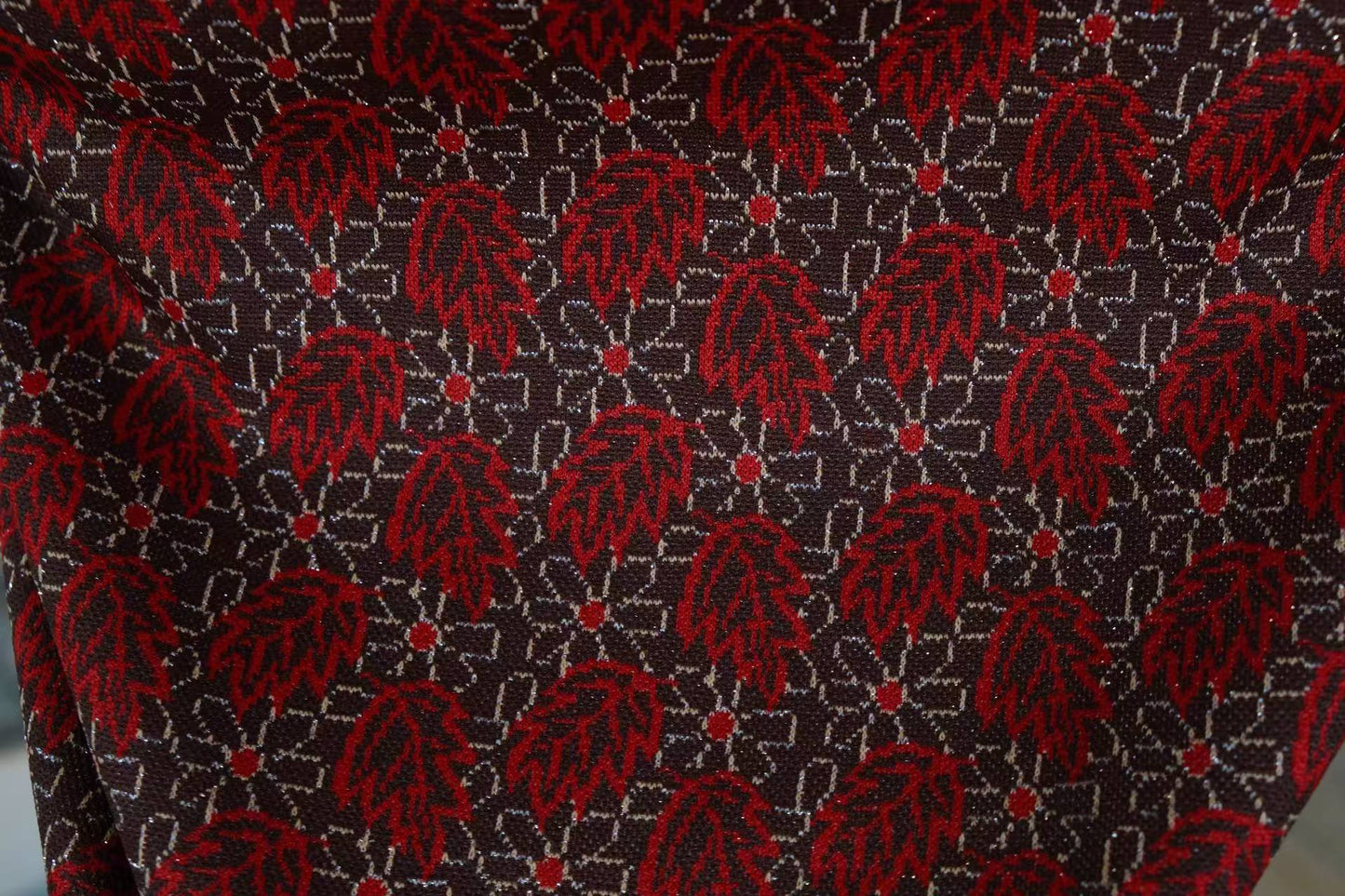
这件旗袍最引人入胜之处,在于其面料纹样的独特构成。它并非传统意义上具象的花鸟虫鱼,而是一种极具现代主义精神的抽象几何植物纹。
从微观视角审视,深褐色的底色如同陈年的普洱茶汤,沉稳而内敛。其上密布着朱砂红色的叶片状图案,这些叶片并非写实描绘,而是经过高度概括的符号化处理,呈现出一种类似蕨类或棕榈叶的舒展姿态。更妙的是,在红叶之间,穿插着由金银丝线交织而成的细密网格——这是一种典型的“龟背锦”或“方胜纹”的变体。
这种设计语言极其超前。红色的热烈被深沉的褐色压制,显得艳而不俗;而金色的网格则像是一道道精密的光栅,将原本可能显得杂乱的植物纹样规整化、秩序化。当光线流转时,织入面料的金银线会泛起微弱的哑光,仿佛秋夜月光洒落在红叶之上,既有东方的含蓄,又有西方的构成主义美感。
二、 剪裁与工艺:五十年代的“黄金比例”
从服装史的维度来看,这件旗袍精准地卡在了旗袍演变的“高光时刻”。
20世纪50年代的香港,是旗袍工艺的集大成时期。此时的旗袍已褪去了30年代的极度繁复和40战时的实用主义,进入了一种“雅致修身”的阶段。请注意观察其领口:这是一种极低的元宝领,仅高出颈根少许,既保留了中式立领的端庄,又极大地解放了颈部线条,展现出女性修长的天鹅颈,这是当时受好莱坞电影审美影响的典型特征。
袖型采用了当时流行的短宽袖,袖口微微外撇,不仅修饰了大臂线条,更增添了一份干练与利落。腰身的剪裁极为考究,利用针织羊毛面料特有的弹性与垂坠感,无需过多的省道(Darts)便能完美贴合人体曲线,呈现出如水波般流畅的S型轮廓。这种“软雕塑”般的穿着效果,正是针织面料区别于传统丝绸旗袍的独特魅力所在。
三、 历史回响:香江畔的流金岁月
张爱玲曾言:“对于不会说话的人,衣服是一种语言,随身带着的袖珍戏剧。”这件诞生于上世纪50年代香港的针织旗袍,便是一出关于“融合”与“新生”的戏剧。
彼时的香港,正处于东西方文化剧烈碰撞与交融的熔炉之中。一方面,大量来自上海的老师傅带来了精湛的苏绣与裁剪技艺;另一方面,西方纺织工业的进步使得羊毛针织、人造纤维等新材料开始进入高级成衣领域。这件旗袍,正是这一历史进程的实物见证。
它不再是深闺中只能静坐观赏的易碎品,而是适应了都市女性快节奏生活、兼具保暖与美观的现代时装。想象一下,在那个霓虹初上的年代,一位受过良好教育的新女性,身着此衣,外披一件羊绒大衣,穿梭于中环的写字楼或浅水湾的舞会之间。那织金的面料在室内的灯光下熠熠生辉,既有着中国传统女性的温婉底蕴,又不失摩登时代的独立自信。
四、 稀缺性综述:不可复制的时光标本
首先是材质的脆弱性。针织羊毛面料虽然穿着舒适,但极难保存。历经七十余载,大多数同类衣物早已出现虫蛀、变形或金线氧化发黑的现象。而这件藏品品相完好,织金光泽依旧,实属凤毛麟角。
其次是审美的断代。这种特定的“红褐配色+几何织金”风格,带有强烈的50年代时代印记。随后的60年代,随着迷你裙和太空风格的兴起,旗袍迅速边缘化,此类稳重而华丽的针织旗袍便逐渐退出了历史舞台。
这不仅是一件衣服,更是一段被封存的时光。它记录了那个特殊年代里,东方美学如何在西方技术的加持下,完成了一次华丽而优雅的转身。收藏它,便是收藏了一段关于美、关于技术、关于女性觉醒的流动的历史。
Measurements / Size Guide:
Bust / Waist / Hips: / / cm
Total Length: cm
Detailed Description:
The definitive triumph of this qipao resides in the highly unconventional graphic architecture of its textile pattern. Departing entirely from literal, two-dimensional ancestral renderings of celebratory flora or traditional imperial fauna, it proudly champions the avant-garde spirit of mid-century abstract modernist geometric-botanical iconography.
Examined through a meticulous macro-lens, the dark brown structural foundation functions like the concentrated depth of an aged vintage Pu'er tea soup—profoundly disciplined, heavy, and self-contained. Surfacing above this somber plane is a dense matrix of cinnabar red leaf motifs. These elements skip fine-line botanical realism altogether; they are heavily abstracted, distilled into graphic symbols that evoke the organic, unfolding silhouettes of ancestral ferns or palm fronds. The crowning stroke of genius, however, is the interstitial gridwork mapping out the space between the crimson foliage: a microscopic latticework meticulously interwoven from genuine gold and silver lamé wires—a sophisticated modernist evolution of the historical "tortoiseshell" (guibeijin) or "interlocking diamond" (fangsheng) motifs.
This structural arrangement delivers exceptional visual balance. The intense, fiery emotional character of the cinnabar red is heavily anchored by the deep, moody base brown, ensuring the colorway remains fiercely sophisticated without falling into vulgarity. Meanwhile, the metallic geometric grid operates like a high-precision optical grating—imposing a rigid, clean architectural order across what could have been a chaotic botanical cluster. When light sweeps across the garment, the woven gold and silver wefts breathe with a quiet, diffuse luster, mimicking the phenomenon of autumn moonlight breaking over wet leaves. It effortlessly unites ancestral Eastern mystery with the structural discipline of Western Constructivism.
Examined through the rigorous lens of pattern-drafting history, this garment captures the absolute high-light era of mid-century technical tailoring.
During the 1950s, Hong Kong operated as the supreme global capital for haute couture qipao engineering. The garment had successfully shed the heavy, excessive decorative encrustations of the 1930s and bypassed the sparse, utilitarian minimalism enforced by 1940s wartime scarcity, stepping into an era defined by immaculate, high-intellectual tailoring (yazhi xiushen).
The Hollywood Mandarin Collar: The neckline features a notably low Yuanbao collar (yuanbao ling), rising only marginally above the base of the throat. While it fiercely guards the formal dignity of classic Chinese framing, it completely frees the anatomy of the neck line, creating the illusion of an elongated, graceful swan neck—a design line heavily informed by post-war Hollywood cinematic style codes.
The Expatriate Bell Sleeve: The sleeves are cut into the era's signature short, slightly widened bell silhouette, angling outward precisely at the hem. This choice dramatically softens the line of the upper arm such that it introduces an active, sharp modernity.
The Knit Wool Ergonomics: The architecture of the waistline is exceptionally rare. Utilizing the natural, fluid elasticity and heavy, organic drape of a premium knit wool canvas, the master tailor managed to sculpt the fabric tightly against the figure with minimal reliance on aggressive structural darting (Darts). The textile moves in perfect synchronization with the body to present a clean, uninterrupted hourglass S-curve silhouette. This "soft sculpture" effect represents the ultimate material departure from stiff, traditional woven silks, defining the unique ergonomic appeal of vintage knit utility wear.
As Eileen Chang famously noted in her seminal costume sociology text A Chronicle of Changing Clothes, "To those who cannot speak, clothing is a form of speech; it carries with it a pocket-sized drama." This 1950s knit wool specimen serves as precisely that—a silent, wearable theater archiving a historic chapter of cultural migration and technological birth.
During this mid-century chapter, Hong Kong operated as a vibrant cultural crucible. Following the mass migration of elite master tailors from old Shanghai, the city inherited centuries of peerless Suzhou embroidery mechanics and absolute pattern-drafting discipline. Concurrently, rapid developments in Western post-war textile manufacturing flooded the commercial markets with radical new mediums: high-grade industrial wool knits, engineered blends, and early luxury synthetics. This qipao stands as the literal material monument to that cross-continental intersection.
It completely detached the qipao from its historical identity as a delicate, high-maintenance luxury piece reserved solely for sedentary aristocratic interiors. Instead, it emerged as a highly functional, thermally insulating, and visually commanding article of modern metropolitan sportswear built for the accelerated pace of post-war urban life. Imagine a highly educated, independent modern woman navigating this piece through the neon-lit corridors of Central's financial districts or an elegant reception at Repulse Bay, shielded by a heavy cashmere overcoat. The light-reactive metallic lattice would shimmer beneath the interior fixtures—vividly projecting the warmth of traditional heritage alongside the unyielding confidence of a modern global citizen.
Within the global connoisseurship and vintage garment preservation community, this specimen commands exceptional historic merit across specific dimensions:
Material Volatility: Knit wool is an organic, highly vulnerable textile medium. Over seven decades, the vast majority of 1950s knit specimens suffered catastrophic pest damage (moth-eating), structural warping/stretching, or severe metallic oxidation that turned the gold wefts black. For this artifact to survive in immaculate, structural condition with its luster unblemished is an extraordinary anomaly.
Aesthetic Discontinuity: This explicit pairing of a deep red-brown color block with geometric lamé knitwork represents a highly specific, time-locked 1950s design language. By the arrival of the 1960s, the explosive global ascent of the Western mini-skirt and Space Age fashion movements rapidly pushed the qipao to the periphery of daily wear, permanently retiring heavy knit luxury variants from global production lines.
This is far more than an article of historic dress; it is a segment of history preserved in wool and gold. It documents the exact historical coordinate where Eastern aesthetic philosophy, backed by the evolution of Western textile technology, completed an elegant, fiercely modern evolution. To preserve this garment is to preserve a primary source document detailing the dawn of modern female autonomy and cross-cultural trade along the Pacific Rim.