深圳溯源
Couldn't load pickup availability
衣服尺寸:
胸围/腰围/臀围/衣长:100/84/108/106 厘米
细节描述:
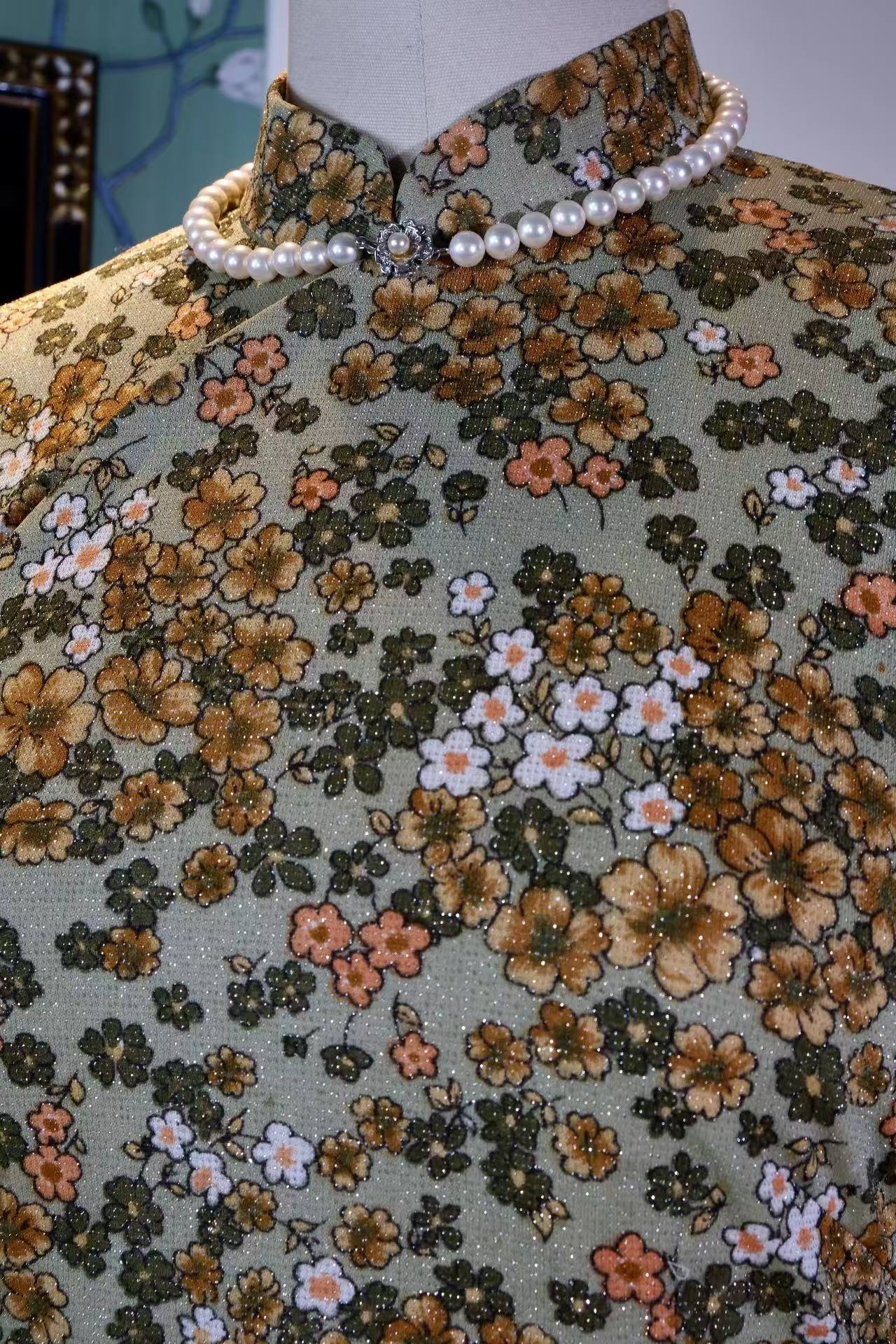
一、图案:繁花织就的“童趣”诗境
这件旗袍的面料,是上世纪六十年代意大利进口的“织银童趣”纹样。浅绿底色如江南春水般温润,其上密布着金棕、橙粉、素白三色小花——大花舒展如蝶翼,花瓣边缘晕染着暖调光泽;小花簇拥似星子,与深绿枝叶交织成错落的韵律。更妙的是面料中暗藏的银线,光线流转间,银丝如晨露般闪烁,让整片花海有了“流动的呼吸感”。这种“童趣”并非稚拙,而是以繁复却不杂乱的构图,复刻了六十年代欧洲纺织业对“自然主义”的浪漫诠释:花朵大小错落如童谣节奏,色彩明快却不艳俗,恰似张爱玲笔下“葱绿配桃红”的参差对照,在东方旗袍的形制里,织进了西方工业美学的精致与灵动。
二、故事:跨洋而来的“衣”脉传承
六十年代的台湾,正处在传统与现代的碰撞期。彼时,欧美纺织技术通过贸易流入东亚,意大利的“织银”工艺(将金属丝线与棉麻混纺,既保留织物柔软,又赋予华贵光泽)被台湾匠人巧妙吸纳——他们以本土审美重构外来面料,用立领、斜襟、收腰的旗袍形制,为异域花纹注入东方气韵。这件旗袍或许曾属于一位台北的女教师:她穿着它走过牯岭街的旧书摊,在师范学院的讲堂上讲解《诗经》里的“桃之夭夭”,银线在讲台灯光下若隐若现,如同知识女性的含蓄锋芒;又或许是某位商贾夫人的晚宴战袍,在圆山大饭店的水晶灯下,裙裾摆动间,意大利的织银工艺和中式剪裁相映成趣,成为东西方文化交融的鲜活注脚。如今,它静立于展架之上,每一道褶皱都藏着半个世纪的风尘:从米兰的纺织工坊到台北的裁缝铺,从主人的青春韶华到如今的博物馆级藏品,它不仅是衣物,更是冷战时期东亚时尚全球化的一段“活化石”。
三、艺术与稀缺性:当“织银”遇见“旗袍”的绝唱
从艺术史维度看,这件旗袍的价值在于“跨界融合”的不可复制性。意大利的“织银童趣”面料,本是欧洲战后“新风貌”(New Look)潮流的产物——强调女性曲线与自然元素的结合;而台湾匠人将其转化为旗袍时,保留了西式面料的光泽感,却以中式剪裁强化了“含蓄的性感”:立领护住颈项的端庄,收腰凸显身形的婉约,短袖设计则呼应了六十年代全球女装“解放身体”的趋势。这种“西材中用”的创作,比单纯的传统丝绸旗袍更具时代张力,也比纯西式连衣裙多了文化根脉。
稀缺性更体现在“物”的存续上:六十年代的织银面料因工艺复杂(银线易氧化、混纺难度大),存世量极少;而台湾产的此类旗袍,多为私人定制,鲜少批量生产。加之岁月侵蚀,能保存至今且品相完好的,堪称“可穿着的文物”。正如沈从文在《中国古代服饰研究》中所言:“服饰是穿在身上的历史。”这件旗袍,既是意大利纺织工业的黄金见证,也是台湾时尚转型期的微观标本,其艺术价值早已超越“衣物”本身,成为研究二十世纪中叶东西方文化交流的“实物文献”。
四、引经据典:从《长恨歌》到“新风貌”的审美对话
白居易写杨贵妃“风吹仙袂飘飘举,犹似霓裳羽衣舞”,旗袍的飘逸与之异曲同工;而这件旗袍的“织银”光泽,又让人想起迪奥1947年“新风貌”系列中对“奢华面料”的追求——只不过,东方的奢华是“藏”在银线里的含蓄,西方的奢华是“显”于廓形的张扬。当意大利的工业美学遇上台湾的手工温度,当六十年代的全球风尚凝于一件旗袍,它便成了跨越时空的审美对话载体:我们既能从繁花中读到《诗经》“有女同车,颜如舜华”的古典意象,又能从织银里触摸到战后欧洲重建时期的乐观精神。这种“多重文化编码”,正是古董衣最迷人的地方——它不只是被观赏的物件,更是能唤醒集体记忆、连接不同文明的“时光密钥”。
结语:这件旗袍,是六十年代地球另一端吹来的风,是台湾匠人指尖的温度,是无数女性生命故事的容器。当我们凝视它时,看到的不仅是一件衣服,更是一段被织物封存的、关于美、关于交流、关于存在的永恒叙事。
Measurements / Size Guide:
Bust / Waist / Hips / Total Length: 100/84/108/106 cm
Detailed Description:
The primary visual vector of this specimen relies on an imported 1960s Italian jacquard motif, historically categorized as a "whimsical silver-woven" floral pattern. The pale green ground evokes the warm, translucent quality of springtime waters, acting as a serene field for a dense constellation of golden-brown, orange-pink, and matte white blossoms. The larger floral elements unfold with the kinetic tension of butterfly wings, their petal perimeters shifting through warm, lustrous gradients. Meanwhile, the smaller blossoms cluster tightly like distant stars, interlocking with deep green branch-and-leaf networks to establish a complex, contrapuntal rhythm across the fabric plane.
The defining technical execution of this textile is the strategic core-spinning of fine silver filigree into the weave. Under shifting illumination, these silver filaments glint like morning dew, imparting a dynamic sense of breathing motion to the floral landscape. Far from being simplistic, this whimsical aesthetic reflects the sophisticated romantic naturalism that swept through mid-century European textile design. The varied scaling of the blossoms establishes a playful, song-like cadence, while the coloration remains vibrant without succumbing to vulgarity. This structural juxtaposition closely mirrors the nuanced, asymmetrical contrasts—reminiscent of Eileen Chang's literary pairings of vibrant greens and peach pinks—effectively stitching the precision of Western post-war industrial design directly into the classical morphology of the Eastern qipao.
The historical biography of this artifact documents a critical window of socio-cultural friction and cosmopolitan hybridization in 1960s Taiwan. During this era, advanced European textile technologies migrated into East Asian trading ports. The Italian technique of metallurgy weaving—which intricately blended metallic wires with organic cotton and linen matrices to yield a textile that preserved structural suppleness while projecting an aristocratic sheen—was aggressively internalized by Taiwanese artisans. These regional makers recontextualized the foreign yardage through a local aesthetic lens, utilizing the tall Mandarin collar, diagonal closure (pajin), and disciplined waist-reduction darts of the qipao to anchor the exotic botanical graphics within an Eastern spiritual framework.
To reconstruct its social life-cycle, this specimen may have belonged to an educated woman of the Taipei civic elite—perhaps a university instructor navigating the historic book stalls of Kuling Street or lecturing on the classical botanical metaphors of the Book of Songs (Shi Jing). Under lecture hall illumination, the intermittent flash of the silver filaments would mirror the reserved brilliance of the mid-century intellectual woman. Alternatively, it may have operated as an aesthetic armor for high-society galas beneath the crystal chandeliers of the Grand Hotel, where the motion of the side slits allowed the Italian weaving mechanics and Chinese tailoring lines to perform a synchronized cross-cultural dance.
Preserved in pristine condition, the garment serves as a micro-fossil of globalized East Asian fashion routes during the mid-twentieth century. Its historical trajectory bridges the industrial looms of Milan, the bespoke artisan tailoring houses of Taipei, and its current status as an irreplaceable institutional document.
From the perspective of dress history, the value of this qipao resides in the absolute irreproducibility of its design synthesis. The imported Italian silver-woven textile was fundamentally a byproduct of the post-war European New Look paradigm, which emphasized the dramatic alignment of anatomical curves with organic, natural motifs. When the Taiwanese artisan class translated this material into the qipao form, they fiercely retained the optical luxury of the Western textile while deploying Eastern pattern drafting to enforce a highly disciplined, "reserved sensuality."
The tall Mandarin collar strictly frames the throat with severe dignity, the engineered waist darts trace the fluid contours of the biological form, and the sleeveless configuration directly references the global mid-century trend toward physical liberation. This specific material application—using Western industrial luxury yardage to execute an Eastern structural form—generates a far greater historical tension than standard silk qipaos, while maintaining a deeper cultural anchor than contemporary Western shifts or day dresses.
The structural scarcity of this artifact is further defined by the severe attrition rate of its constituent materials. Mid-century silver-woven textiles are notoriously fragile; the metallic filaments are highly vulnerable to localized atmospheric oxidation, and the complex fiber blend poses significant stabilization challenges over a sixty-year timeline. Furthermore, Taiwanese garments of this specific caliber were almost exclusively executed as bespoke, single-run commissions for private clients rather than mass-produced ready-to-wear apparel. To encounter a specimen that survives with its structural integrity and metallic luster completely uncompromised is an absolute anomaly.
As the eminent textile historian Shen Congwen noted in Researches on Ancient Chinese Costumes: "Clothing is history worn upon the body." This qipao operates simultaneously as a monument to the golden age of Italian industrial weaving and a micro-specimen of Taiwan’s transitional fashion landscape, establishing its status as an elite primary source for the study of mid-century global trade and cultural exchange.
To cross-reference this garment with classical literature, one recalls the sweeping imagery of Bai Juyi’s Song of Everlasting Regret (Chang Hen Ge), describing the ethereal, wind-swept motion of celestial vestments—a kinetic grace shared by the fluid drape of this qipao's hemline. Concurrently, the metallic brilliance of the silver-woven ground speaks directly to the material luxury demanded by Christian Dior's 1947 New Look manifesto. Yet, where the Western expression of luxury was structural, expansive, and extroverted, this Eastern iteration is fundamentally introverted—deliberately concealing its opulence within the fine grain of the silver threads.
When European industrial aesthetics intersect with the manual warmth of Taiwanese tailoring, the garment transcends its functional utility to operate as a complex site of multi-layered cultural coding. Within its floral arrangements, the eye can read the classical metaphors of the Book of Songs—"This girl with whom I travel, her face is like the hibiscus flower"—while simultaneously touching the profound socio-economic optimism of post-war European reconstruction through the resilience of the silver weave. It is precisely this density of meaning that defines the magic of premier antique apparel: it ceases to be a static object of display and functions instead as a temporal key capable of unlocking shared historical memory across distinct civilizations.
This qipao remains a physical vessel for the global currents of the 1960s—capturing the industrial winds blowing from the opposite side of the hemisphere, the precise touch of the Taiwanese artisan’s hands, and the lived biographies of the women who inhabited it. To analyze this specimen is to look beyond the superficial limits of fiber and form, uncovering instead an unyielding, brilliantly preserved material narrative concerning beauty, transnational exchange, and the poetry of human existence.