溯源
Couldn't load pickup availability
衣服尺寸:
胸围/腰围/臀围/衣长:94/80/98/100 厘米
细节描述:
这件上世纪五十年代的香港产古董旗袍时,它不仅仅是一件衣物,更像是一位穿越时空的优雅名伶,静默地诉说着那个东西方文化在香港激烈碰撞、璀璨融合的黄金时代。
一、 衣上繁花:暗香浮动中的“织银”绝唱
这件旗袍的纹样,堪称五十年代港派美学的杰出代表。
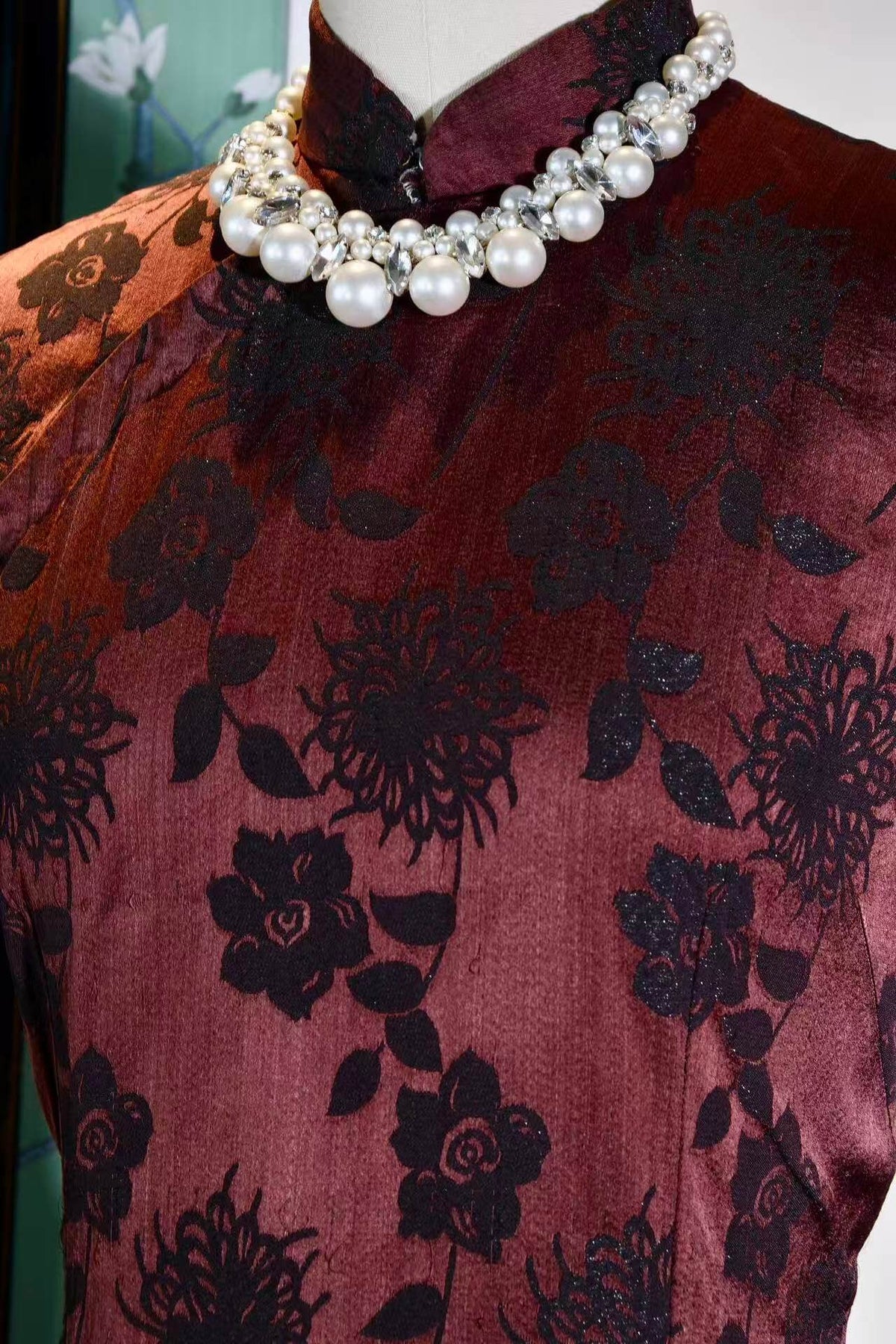
* 花卉纹样与布局:衣身上布满了深色花卉剪影。大朵盛开的大丽花与小簇的玫瑰错落有致,花茎蔓生,叶片扶疏。不同于清代旗袍“图必有意、意必吉祥”的繁复堆砌,这里的折枝花卉图案采用了西式艺术的构图手法,打破了绝对的对称,呈现出一种活泼而舒展的现代感。
* 面料工艺:奢华的“织银”:最为人称道的是其面料——意大利进口的织花缎,并采用了“织银”工艺。在传统织造中,将银色或金属丝线直接织入面料的经纬之间。这使得花朵的轮廓和阴影在光线的流转下,呈现出若隐若现的银色暗光。它不像亮片那般张扬夺目,却拥有一种内敛而高级的华贵,宛如月光洒落在深秋的花园里,极具视觉张力。
* 色彩美学:底料采用了暖色调的赤陶红或铁锈红,与深紫黑色的花卉剪影形成微妙的对比。这种配色既保留了传统东方的典雅与沉稳,又透露出受西方影响的热烈与现代气息。
二、 裁缝风华:五十年代“港工”的极致曲线
这件旗袍的诞生,源于一段特殊的历史背景。
1949年后,大批江浙沪一带的顶尖红帮裁缝南迁至香港,带来了最纯正的海派旗袍剪裁技艺。与此同时,西方以迪奥(Dior)为代表的“New Look”风潮,极力推崇女性的沙漏型曲线。这两股力量在五十年代的香港相遇,孕育出了旗袍史上的又一个高峰——港工旗袍(港派旗袍)。
* 西式立体剪裁:这件旗袍采用了极其考究的西式省道设计,特别是胸省和腰省的精准拼接,完美勾勒出了穿着者“尖胸、细腰、丰臀”的沙漏身形。
* 改良的细节:领子是当时流行的稍高立领,配以圆润的厂字襟,袖口设计简洁。为了强调腰臀比,下摆收紧,整体廓形呈现出优美的宝瓶型,完美展现了当时都市女性自信、摩登的身体美学。
三、 绝代风华:从东方名媛到银幕传奇
引经据典,在张爱玲的散文和亦舒的小说中,我们总能读到那个年代女性对旗袍的深深执念。在50年代的香港,旗袍不仅是日常服饰,更是中上阶层女性出入宴会、派对乃至职场的重要“战袍”。
亦舒在小说《胭脂》中曾这样描绘当时的风尚:“她穿着镂空天鹅绒旗袍和高跟鞋,站在人群里。”这件织花缎旗袍,正是那种场合下的绝佳选择。想象一下,在上世纪五十年代香港繁华的夜总会或高级酒店里,一位女士身着此裙,胸前搭配一条璀璨的多层巴洛克珍珠项链(Baroque Pearl Necklace),手持一把檀香扇。
当她在舞池中随着爵士乐缓缓摇曳时,织银的花卉在灯光下闪烁着低调而神秘的光泽,随着她婀娜的曲线,整个人宛如一幅流动的水墨画,又如同一首无声的爵士乐。这不仅是一件衣服,更是那个时代女性独立、优雅、兼具东方神韵与西方性感的终极表达。
如今,这件历经岁月洗礼的旗袍,依然保留着当年的绝世风华,是收藏家眼中不可多得的艺术瑰宝。
Measurements / Size Guide:
Bust / Waist / Hips / Total Length: 94/80/98/100 cm
Detailed Description:
When looking at this vintage Hong Kong-crafted cheongsam from the 1950s, it is far more than a mere piece of clothing; it resembles an elegant, time-traveling prima donna, silently narrating that golden era when Eastern and Western cultures collided intensely and merged brilliantly in Hong Kong.
I. Blossoms upon the Garment: The "Silver-Woven" Swan Song Amid Floating Secret Fragrance
The motifs on this cheongsam stand as an outstanding representative of 1950s Hong Kong-style aesthetics.
Floral Motifs and Composition: The body of the dress is covered with silhouettes of dark flora. Large blooming dahlias and small clusters of roses are arranged with artful variation, with trailing stems and luxuriant leaves. Unlike the dense, repetitive stacking of Qing Dynasty cheongsams where "every pattern must hold meaning, and every meaning must be auspicious," the broken-branch floral motifs here utilize Western artistic composition, breaking away from absolute symmetry to display a lively, expansive sense of modernity.
Fabric Craftsmanship: Sumptuous "Silver-Woven" Craft: Most praised is its fabric—imported Italian brocade satin crafted using the "silver-woven" technique. In traditional weaving, silver or metallic threads are directly interwoven into the warp and weft of the fabric. This causes the contours and shadows of the flowers to reveal faint, shimmering silver under shifting light. It lacks the clamor of sequined shine, possessing instead a restrained, high-level opulence, akin to moonlight falling across a late-autumn garden with intense visual tension.
Color Aesthetics: The base fabric uses warm terracotta red or rust red, creating a subtle contrast with the deep purple-black floral silhouettes. This palette retains traditional Eastern elegance and composure while revealing a passionate, modern aura influenced by the West.
II. Master Tailor’s Elegance: The Ultimate Curves of 1950s "Hong Kong Craft"
The birth of this cheongsam stems from a unique historical backdrop.
After 1949, large numbers of top-tier "Hongbang" tailors from the Jiangsu, Zhejiang, and Shanghai regions migrated south to Hong Kong, bringing with them the purest Shanghai-style cheongsam tailoring techniques. Concurrently, the Western "New Look" wave led by Dior highly championed women's hourglass figures. These two forces met in 1950s Hong Kong, nurturing another peak in cheongsam history—"Hong Kong-crafted cheongsams" (Hong Kong-style cheongsams).
Western Three-Dimensional Tailoring: This cheongsam employs extraordinarily sophisticated Western dart construction, particularly through the precise piecing of bust and waist darts, perfectly contouring the wearer's hourglass figure with a "pointed bust, slender waist, and full hips."
Modified Details: The collar features the moderately high standing collar popular at the time, paired with a rounded slanted placket (Chang Zi Jin) and clean cuff designs. To emphasize the waist-to-hip ratio, the hemline tapers inward, giving the overall silhouette a graceful treasure-vase contour that flawlessly showcases the confident, modern physical aesthetics of urban women of that era.
III. Peerless Grace: From Eastern Socialites to Screen Legends
Drawing from literary allusions, in the essays of Eileen Chang and the novels of Yi Shu, we always read of women's deep obsession with cheongsams during that era. In 1950s Hong Kong, the cheongsam was not only everyday attire, but a crucial "power gown" for upper-middle-class women attending banquets, parties, and even workplaces.
Yi Shu once described the trend of that time in her novel Rouge: "She stood in the crowd, wearing a burnout velvet cheongsam and high heels." This brocade satin cheongsam was precisely the ultimate choice for such occasions. Imagine, in a bustling nightclub or luxury hotel in 1950s Hong Kong, a lady dressed in this gown, paired across her chest with a dazzling, multi-layered Baroque Pearl Necklace and holding a sandalwood fan.
As she gently swayed to jazz music on the dance floor, the silver-woven blossoms flickered with a quiet, mysterious luster beneath the lights. Following her fluid curves, her entire persona resembled a flowing ink painting or a silent piece of jazz music. This is not merely an item of clothing, but the ultimate expression of a woman’s independence, elegance, Eastern charm, and Western allure during that era.
Today, having survived the washing of time, this cheongsam still retains its peerless elegance of bygone days, standing as a rare artistic treasure in the eyes of collectors.