深圳溯源
Couldn't load pickup availability
衣服尺寸:
胸围/腰围/臀围/衣长:86/72/94/113 厘米
细节描述:
在时光的褶皱里,总有一些织物能抵御岁月的侵蚀,将一段风华绝代的历史悄然封存。这件诞生于上世纪七十年代的香港古董旗袍,便是一枚凝固了香江流金岁月的琥珀。它不仅仅是一件衣裳,更是一首用丝线编织的、关于东方美学与现代意识觉醒的无声诗篇。
【纹样之诗:隐逸的繁华】
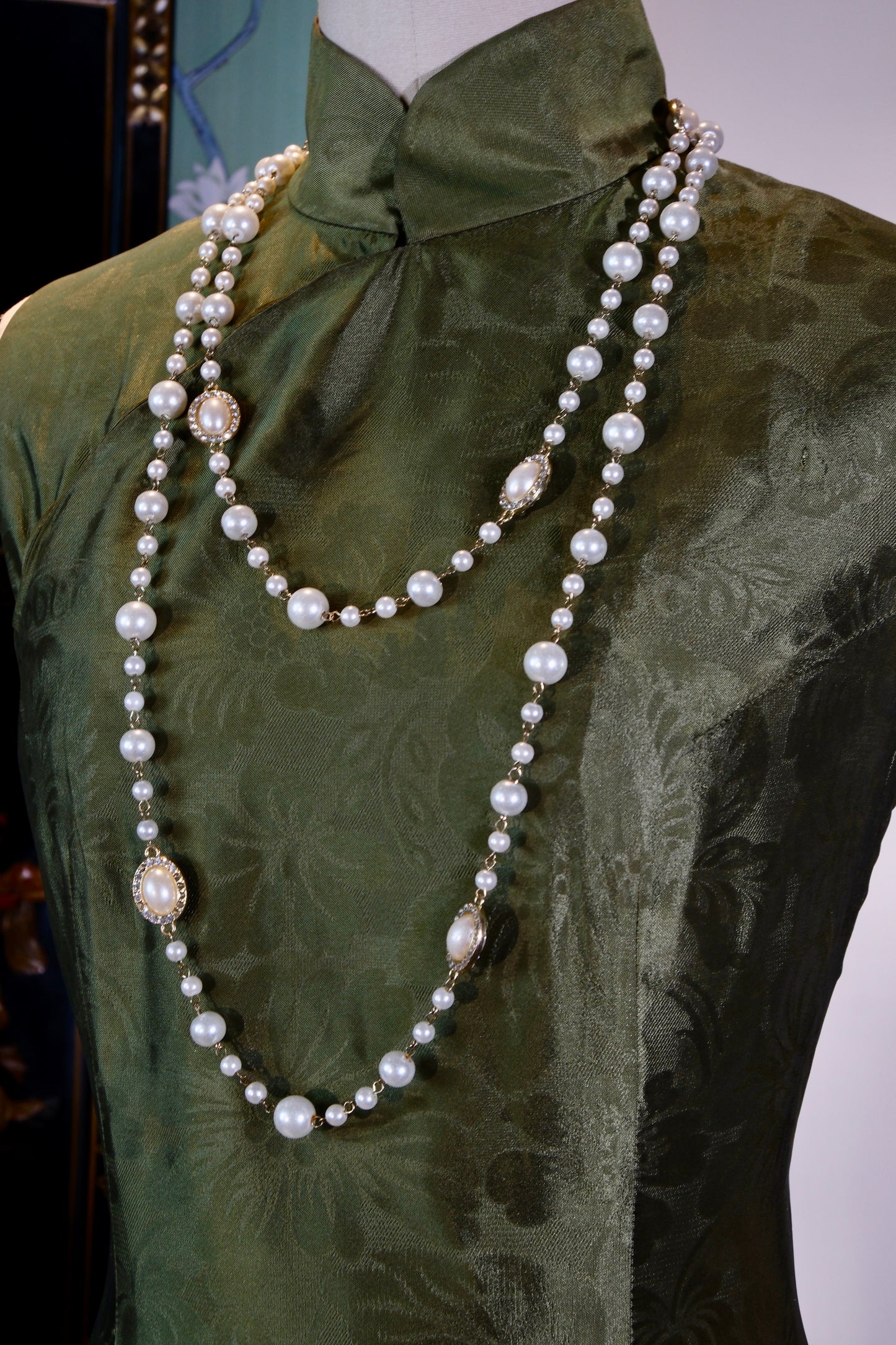
凝视衣身,仿佛置身于烟雨朦胧的江南庭院。面料采用的是极为考究的暗纹提花工艺,这是一种“由于光而见,隐于暗处”的高级审美。图案并非张扬的大红大绿,而是以同色系的丝线织就出缠枝莲与秋菊交织的纹样。
莲,出于淤泥而不染,象征着君子之高洁;菊,傲霜斗雪,寓意着隐士之淡泊。这两种传统意象在七十年代的香港相遇,被赋予了新的生命力。它们在光影的流转中若隐若现,如同水墨画中的留白,讲究的是“气韵生动”。这种纹样不喧哗,却有着直抵人心的力量,正如那个时代的香港女性,外表温婉柔顺,内心却有着如藤蔓般坚韧的生命力。
【剪裁之变:时代的廓形】
从服装史的维度审视,这件旗袍正处于一个微妙的转折点。它保留了传统中式立领的端庄与斜襟的含蓄,但在腰身的处理上,明显受到了西方立体剪裁的影响,线条更加利落、挺拔。
七十年代的香港,经济腾飞,女性开始大规模步入职场与社会舞台。她们不再满足于仅仅作为被观赏的客体,而是追求行动的自由与效率。因此,这件旗袍的下摆开衩适度,既保留了行走的优雅,又摒弃了繁复的拖沓。它是“海派文化”在香江的延续与升华,见证了女性身体从束缚走向解放的过程。每一道省道(Dart)的缝合,都是对女性曲线美的理性重塑,也是那个时代独立精神的具象化表达。
【稀缺之证:绝响的技艺】
《考工记》云:“天有时,地有气,材有美,工有巧,合此四者,然后可以为良。”这件旗袍正是“天时地利人和”的产物。
在那个工业化尚未完全吞噬手工温度的年代,香港的裁缝师傅们仍坚持使用老式织机进行提花织造。这种工艺极其繁复,一旦出错便前功尽弃,且产量极低。随着后来成衣工业的爆发式增长,这种耗时耗力的传统提花面料逐渐退出历史舞台,成为了真正的“绝响”。
如今,当我们抚摸着这略带凉意却又温润如玉的丝绸,我们触摸到的不仅是顶级的面料,更是那段不可复制的工匠时光。它存世量稀少,品相完整,每一处针脚都透露着那个时代特有的严谨与精致。
【结语】
张爱玲曾说:“衣服是一种言语,随身带着一种袖珍戏剧。”这件七十年代的暗纹提花旗袍,就是一出永不落幕的经典戏剧。它穿越了半个世纪的风尘,静静地伫立在这里,等待着另一位懂它、惜它的主人,续写这段关于美、关于历史、关于东方韵味的传奇。
拥有它,便是拥有了一段可以穿在身上的艺术史。
Measurements / Size Guide:
Bust / Waist / Hips / Total Length: 86/72/94/113 cm
Detailed Description:
Within the intricate folds of time, certain textiles possess an extraordinary capacity to resist structural erosion, quietly archiving a bygone era of absolute refinement. This antique qipao, crafted in Hong Kong during the 1970s, exists precisely as a piece of amber that has permanently frozen the golden history of the Fragrant River (Xiangjiang). It transcends its utilitarian identity as a garment to stand as a silent poem woven from premium silken threads—a material chronicle of Eastern aesthetics navigating the dawn of modern consciousness.
Gazing upon the body of this garment feels akin to stepping into a misty, rain-soaked Jiangnan courtyard. The material substrate implements a highly sophisticated, meticulous damask jacquard (anwen tihua) technique—an execution rooted in an elite aesthetic philosophy where motifs are "revealed exclusively by light, yet remaining cloaked in shadow."
The design strictly eschews loud, commercially vulgar reds or bright greens, opting instead to weave interlocking lotus blossoms and autumn chrysanthemums utilizing monochromatic silk strands. Within the traditional Chinese cultural lexicon, the lotus rises unblemished from the mud, symbolizing noble purity, while the chrysanthemum braves the frost, denoting the tranquil composure of the recluse.
When these two classic motifs intersected in 1970s Hong Kong, they were endowed with a vibrant new vitality. Shifting and blending under directed illumination, they echo the calculated use of negative space (liubai) in Chinese ink wash paintings, placing an absolute premium on lifelike spiritual resonance (qiyun shendong). This pattern layout refuses to clamor for attention, yet commands a profound visual weight—perfectly mirroring the mid-century Hong Kong woman, who maintained a gentle, poised exterior while harboring a fiercely resilient internal strength.
Examined through the academic lens of dress history, this qipao sits at a highly nuanced, critical point of structural transition. While it firmly retains the stately decorum of the traditional high standing collar and the modesty of the asymmetric diagonal closure, the pattern drafting across the waist and hips shows the undeniable discipline of Western three-dimensional tailoring—yielding a silhouette that is significantly cleaner, sharper, and more erect.
During the 1970s, Hong Kong experienced a massive economic takeoff, prompting women to enter the corporate workforce and public social spheres on an unprecedented scale. They were no longer content to exist merely as passive objects of aesthetic admiration; they demanded physical mobility, efficiency, and self-directed agency. Consequently, the side slits of this qipao are engineered to a highly disciplined, moderate height—preserving an elegant stride while completely shedding impractical, restrictive length.
It stands as the ultimate continuation and refinement of the Shanghai legacy (Haipai) adapting to postwar Hong Kong, capturing the precise historical moment when the female anatomical form transitioned from social restriction to self-expression. Every line of structural darting (省道) is a calculated, rational calibration of the female form, acting as a physical manifestation of the decade's rising independent spirit.
As the ancient foundational text The Book of Artisans (Kao Gong Ji) profoundly dictates: "Heaven holds its seasons, Earth commands its climate, materials possess inherent beauty, and craftsmanship yields ingenuity. It is only when these four elements converge harmoniously that a masterwork can be realized." This qipao represents the absolute manifestation of that perfect temporal and material alignment.
During that unique historical window before manual warmth was entirely swallowed by industrial mass automation, Hong Kong master tailors resolutely insisted on utilizing vintage mechanical looms to execute jacquard weaving. This specialized technique was incredibly labor-intensive and unforgiving; a single missed thread could instantly compromise an entire panel, resulting in an exceptionally low absolute output. As the subsequent ready-to-wear factory boom exploded, these time-consuming, structurally heavy traditional textiles were rapidly pushed off the commercial stage, cementing their status as a lost art.
Today, when our fingertips brush against this silk—possessing a cool, refreshing initial touch that quickly settles into a jade-like, warm hand-feel—we are interacting with far more than premium textile engineering; we are touching a segment of irreproducible human time. Surviving in pristine archival condition with an extraordinarily low absolute survival rate, every single hidden stitch bears witness to the rigorous discipline and refinement unique to its era.
Eileen Chang famously observed: "Clothes are a language, a pocket theater carried upon the body." This 1970s damask jacquard qipao functions as an eternal, classic drama that refuses to lower its curtain. Having journeyed beautifully through half a century of historical dust, it hangs in magnificent silence, waiting for a true connoisseur who deeply comprehends and fiercely protects its material narrative to step into its form and continue this timeless legend of Eastern grace.
To steward this piece is to hold a living, touchable segment of material art history.