深圳溯源
Couldn't load pickup availability
衣服尺寸:
胸围/腰围/臀围:86/78/94 厘米
衣长:96 厘米
细节描述:
在服装史的浩瀚长河中,某些衣物不仅是蔽体之物,更是凝固的历史切片。这件诞生于上世纪五十年代台湾的豆绿色机绣旗袍,便是这样一件承载着时代记忆与工艺美学的珍品。它以温婉的色调、精巧的肌理与独特的时代印记,诉说着那个特殊年代里,中华服饰文化在宝岛的传承与创新。
一、图案与肌理:机绣工艺下的“暗香浮动”
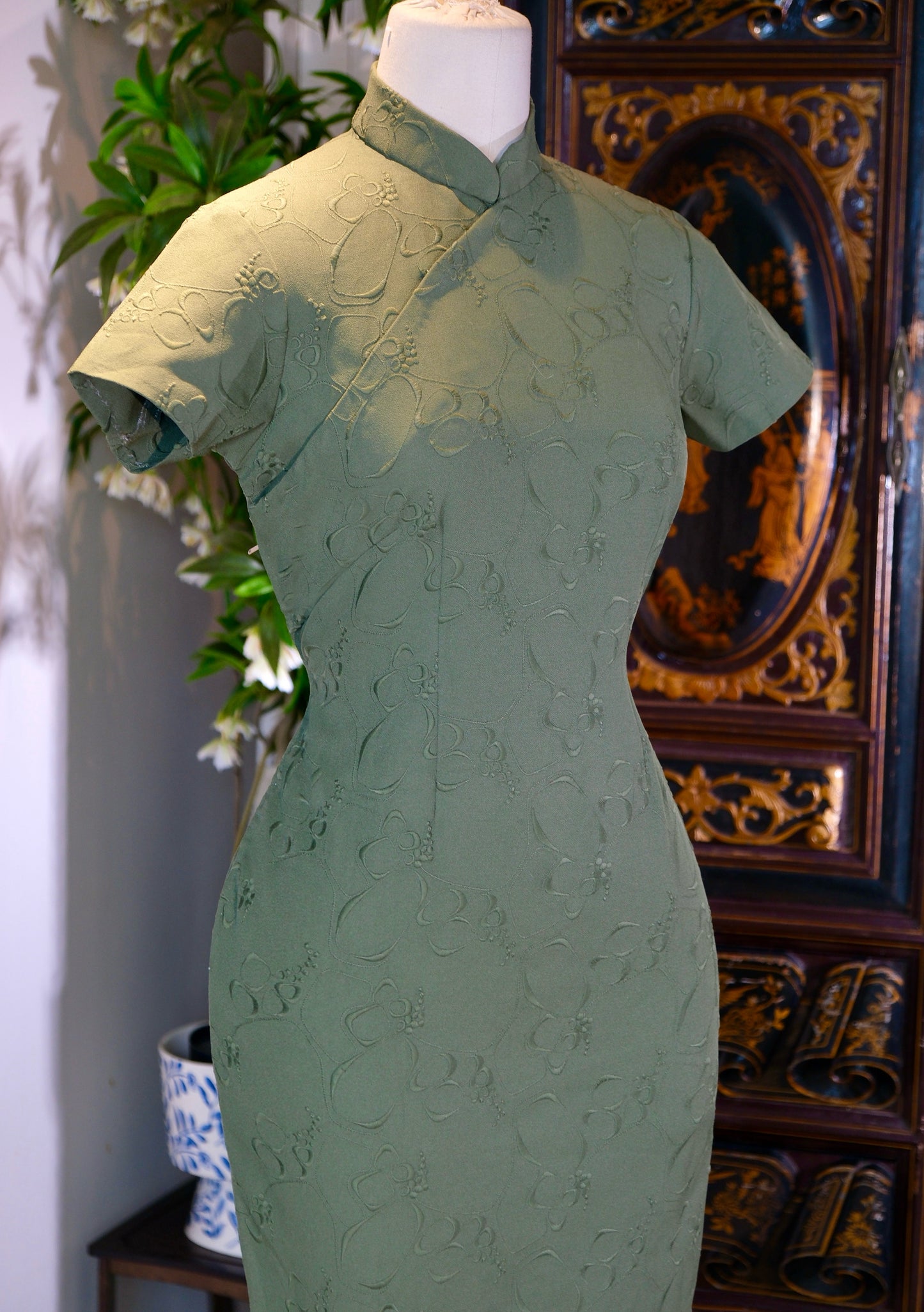
这件旗袍最引人注目的,莫过于其通体覆盖的机绣肌理图案。与传统的手工刺绣不同,五十年代的台湾旗袍正处于从手工向半机械化生产的过渡期。机绣工艺的出现,使得图案的重复性与规整度大大提高,但这件旗袍的机绣并未流于呆板,反而巧妙地利用了机械的精密性,创造出一种独特的“浮雕式”肌理效果。
细观其图案,主体为抽象化的缠枝花卉纹样,线条流畅婉转,似藤蔓缠绕,又如云气流动。花朵形态简约,花瓣以圆润的弧线勾勒,花蕊处点缀以细小的点状绣线,整体呈现出一种“似花非花”的朦胧美感。这种图案设计,既承袭了中国传统纹样中“缠枝莲”“卷草纹”的吉祥寓意(象征生生不息、福寿绵长),又在造型上融入了现代艺术的抽象思维,体现了五十年代台湾服饰设计中“传统与现代交融”的特点。
尤为精妙的是,机绣的针脚并非平铺直叙,而是通过疏密变化与线迹的起伏,在豆绿色的底料上形成了若隐若现的凹凸肌理。光线流转间,图案仿佛有了呼吸,时而如月下竹影,时而如水面涟漪,正应了宋代诗人林逋“疏影横斜水清浅,暗香浮动月黄昏”的意境。这种“肌理美学”,是机器工艺与艺术审美的完美结合,也是五十年代台湾旗袍区别于同时期上海、香港旗袍的重要特征——它少了几分海派的华丽繁复,多了几分岛居的清新雅致。
二、时代叙事:宝岛衣香的流徙与新生
这件旗袍的诞生,与上世纪五十年代台湾的社会背景密不可分。1949年前后,随着国民政府迁台,大量大陆移民(包括裁缝师傅、纺织工人)涌入台湾,带来了上海、北京等地的旗袍制作技艺。同时,台湾本土的纺织业在战后逐渐复苏,日本殖民时期遗留的机械技术与本地原料(如棉、麻、丝)相结合,催生了独特的“台湾旗袍”风格。
五十年代的台湾,物质尚不丰裕,旗袍的制作更注重实用性与耐久度。这件旗袍选用的是台湾本土生产的棉质或混纺面料,质地挺括而透气,适合亚热带气候。豆绿色的染料,可能来自当时台湾常见的植物染料(如薯莨、黄栀子),色泽温润自然,经岁月沉淀后更显古朴。机绣工艺的运用,既降低了手工成本,又保证了图案的美观,是那个年代“节约而不失体面”的生活智慧的体现。
值得注意的是,这件旗袍的剪裁虽遵循传统旗袍的立领、斜襟、短袖、收腰等元素,但腰身的收窄程度较为适中,裙摆长度及膝下,既保留了东方女性的曲线美,又兼顾了行动的便利性——这恰是五十年代台湾女性社会角色转变的缩影:她们开始走出家庭,参与社会活动,旗袍也从“深闺礼服”逐渐向“日常便装”过渡。
三、艺术风格:简约中的东方禅意
从艺术风格来看,这件旗袍体现了五十年代台湾美学的“简约主义”倾向。与三十年代上海旗袍的浓墨重彩、四十年代香港旗袍的中西合璧不同,五十年代台湾旗袍更注重“留白”与“意境”。豆绿色的底色,如同宋代青瓷的釉色,温润内敛;抽象的机绣图案,不事雕琢却暗藏玄机,恰似中国文人画中的“写意”笔法——以形写神,以少胜多。
这种风格,与当时台湾的文化氛围息息相关。迁台的文人学者(如胡适、林语堂等)带来了大陆的文化传统,而本土的闽南文化、客家文化又与之交融,形成了一种“去繁就简、返璞归真”的审美取向。这件旗袍的设计,正是这种文化心态的物质载体:它不追求外在的奢华,而注重内在的气韵;不强调图案的具象,而追求意境的传达。正如明代文震亨在《长物志》中所言:“宁古无时,宁朴无巧,宁俭无俗”,这件旗袍的“古”“朴”“俭”,恰恰成就了它的“雅”。
四、稀缺性与收藏价值:时光淬炼的孤品
作为一件“古董旗袍”,其稀缺性体现在多个层面:
- 时代稀缺:五十年代台湾旗袍存世量极少。由于当时的经济条件与保存意识,许多旗袍或被改制,或因岁月侵蚀而损毁。这件旗袍保存完好,面料无明显褪色,机绣图案清晰,实属难得。
- 工艺稀缺:五十年代台湾的机绣工艺,是特定历史时期的产物。随着后来全自动刺绣机的普及,这种半机械、半人工的“肌理绣”逐渐消失,其工艺细节已成为服装史研究的珍贵样本。
- 文化稀缺:这件旗袍见证了1949年后中华服饰文化在台湾的传承与创新,是“两岸文化同源”的实物佐证。它不仅是一件衣物,更是一段“衣香鬓影”的流徙史,承载着离散与重生的集体记忆。
对于收藏者而言,这件旗袍的价值不仅在于其物质形态,更在于它所蕴含的历史信息与艺术魅力。正如法国哲学家罗兰·巴特所言:“服装是一种符号系统”,这件旗袍的每一个针脚、每一寸肌理,都在诉说着五十年代台湾的社会风貌、工艺水平与审美情趣。它是可以穿在身上的“历史文献”,是可以触摸的“东方美学”。
五、结语:让时光在衣香中流转
这件豆绿色机绣旗袍,如同一位从旧时光中走来的女子,温婉、内敛、带着淡淡的书卷气。它不张扬,却自有力量;不华丽,却韵味悠长。当我们凝视它时,仿佛能看到五十年代台北街头的梧桐树影,能听到缝纫机“嗒嗒”的声响,能感受到那个年代人们对美的执着与对生活的热爱。
在快时尚泛滥的今天,这样一件承载着历史与工艺的古董旗袍,更显珍贵。它提醒我们:真正的时尚,从不是转瞬即逝的潮流,而是经时光淬炼后依然熠熠生辉的文化基因。愿这件旗袍,能在新的时代里,继续书写属于它的“翠影流芳”。
Fragrance in Emerald Shadows: A Temporal Narrative of a 1960s Taiwanese Machine-Embroidered Qipao
Measurements / Size Guide:
Bust / Waist / Hips: 86/78/94 cm
Total Length: 96 cm
Detailed Description:
In the vast river of costume history, certain garments are not merely coverings for the body but are frozen slices of history. This bean-green machine-embroidered Qipao, born in 1950s Taiwan, is such a treasure, carrying generational memories and industrial aesthetics. With its gentle hues, exquisite textures, and unique temporal imprints, it recounts the inheritance and innovation of Chinese clothing culture on the island during that specific era.
The most striking feature of this Qipao is the machine-embroidered texture covering the entire body. Unlike traditional hand embroidery, Taiwanese Qipaos of the 1950s were in a transition period from manual to semi-mechanized production. The emergence of machine embroidery greatly increased the repeatability and regularity of patterns. However, the embroidery on this piece is far from rigid; instead, it skillfully utilizes mechanical precision to create a unique "relief-style" textural effect.
Observing the pattern closely, the main motif consists of abstracted interlocking floral designs, with smooth and winding lines resembling entwined vines or flowing clouds. The flower shapes are minimalist, with petals outlined in rounded arcs and stamens accented with tiny dotted embroidery threads, presenting a hazy beauty of "appearing as flowers yet not flowers." This design inherits the auspicious meanings of traditional Chinese motifs like "interlocking lotus" and "scrolling grass" (symbolizing endless life and longevity) while integrating the abstract thinking of modern art, reflecting the "fusion of tradition and modernity" in 1950s Taiwanese fashion design.
Particularly ingenious is that the stitches are not flat; through variations in density and the rise and fall of thread paths, they form a subtle, undulating texture on the bean-green base. As light shifts, the patterns seem to breathe—at times like bamboo shadows under the moon, at others like ripples on a water surface—echoing the poetic imagery of the Song Dynasty poet Lin Bu: "Sparse shadows slant across the clear, shallow water; floating fragrance wafts in the moonlit twilight." This "textural aesthetic" is a perfect marriage of mechanical craft and artistic sensibility, a key feature distinguishing 1950s Taiwanese Qipaos from those of Shanghai or Hong Kong of the same period—it possesses less of the glamorous complexity of the Shanghai style and more of the fresh elegance of island living.
The birth of this Qipao is inseparable from the social background of 1950s Taiwan. Around 1949, with the Nationalist government's relocation to Taiwan, a large number of mainland immigrants—including master tailors and textile workers—poured into the island, bringing the Qipao-making techniques of Shanghai and Beijing. Simultaneously, Taiwan's local textile industry gradually recovered after the war, combining mechanical technology left from the Japanese colonial period with local raw materials (such as cotton, hemp, and silk) to catalyze the unique "Taiwanese Qipao" style.
In 1950s Taiwan, material goods were not yet abundant, so Qipao production emphasized practicality and durability. This piece uses locally produced cotton or blended fabric, which is crisp and breathable, suitable for a subtropical climate. The bean-green dye may have come from plant dyes common in Taiwan at the time (such as Dioscorea cirrhosa or Gardenia), offering a warm, natural color that grows more primitive and charming with age. The use of machine embroidery lowered labor costs while ensuring aesthetic appeal—a manifestation of the "frugal yet decent" lifestyle wisdom of that era.
Notably, while the tailoring follows traditional elements like the mandarin collar, diagonal closure, short sleeves, and fitted waist, the narrowing of the waist is moderate and the skirt length reaches below the knee. This preserves the curved beauty of the Oriental female form while allowing for ease of movement—a microcosm of the shifting social roles of Taiwanese women in the 1950s as they began to leave the domestic sphere and participate in social activities.
From an artistic perspective, this Qipao embodies the "minimalist" tendency of 1950s Taiwanese aesthetics. Unlike the intense colors of 1930s Shanghai Qipaos or the East-meets-West fusion of 1940s Hong Kong pieces, the 1950s Taiwanese style focuses more on "white space" and "mood." The bean-green base color is like the glaze of Song Dynasty celadon—warm and restrained. The abstract machine embroidery, unadorned yet full of hidden depth, resembles the "freehand" brushwork in Chinese literati painting—capturing the spirit through form and achieving more with less.
This style was closely related to the cultural atmosphere of Taiwan at the time. Relocated scholars (such as Hu Shih and Lin Yutang) brought mainland cultural traditions, which merged with local Southern Fujian and Hakka cultures to form an aesthetic orientation of "discarding complexity for simplicity and returning to authenticity." The design of this Qipao is a physical carrier of this cultural mindset: it does not pursue external luxury but emphasizes internal aura; it does not stress the literalness of the pattern but the transmission of mood. As Wen Zhenheng stated in Treatise on Superfluous Things during the Ming Dynasty: "Better ancient than trendy, better simple than ingenious, better frugal than vulgar." The "ancientness," "simplicity," and "frugality" of this Qipao are precisely what achieve its "elegance."
As a "vintage Qipao," its rarity is manifested on multiple levels:
Temporal Rarity: Very few Taiwanese Qipaos from the 1950s survive. Due to the economic conditions and lack of preservation awareness at the time, many were either remodeled or destroyed by age. This piece is perfectly preserved, with no significant fading and clear embroidery, making it a rare find.
Craftsmanship Rarity: The machine embroidery of 1950s Taiwan is the product of a specific historical period. With the later popularization of fully automatic embroidery machines, this semi-mechanical, semi-manual "textured embroidery" gradually disappeared, making its technical details a precious sample for the study of costume history.
Cultural Rarity: This Qipao witnessed the inheritance and innovation of Chinese clothing culture in Taiwan after 1949 and serves as physical evidence of the "common cultural origin across the strait." It is not just a garment but a history of dispersal and rebirth, carrying collective memories.
For collectors, the value of this Qipao lies not only in its physical form but also in the historical information and artistic charm it contains. As French philosopher Roland Barthes said, "Clothing is a system of signs." Every stitch and every inch of texture in this Qipao speaks of the social landscape, technical level, and aesthetic taste of 1950s Taiwan. It is a "historical document" that can be worn and a "tangible Oriental aesthetic."
This bean-green machine-embroidered Qipao is like a woman walking out of the past—gentle, restrained, and carrying a faint scholarly air. It is not flamboyant, yet it possesses its own power; it is not glamorous, yet its charm is long-lasting. When we gaze upon it, we can almost see the shadows of plane trees on the streets of 1950s Taipei, hear the "clatter" of the sewing machine, and feel the love for life and persistence in beauty of the people of that era.
In today's world of rampant fast fashion, such a vintage Qipao, steeped in history and craftsmanship, is even more precious. It reminds us that true fashion is never a fleeting trend but a cultural gene that continues to shine after being tempered by time. May this Qipao continue to write its own "emerald shadows and lasting fragrance" in this new era.