深圳溯源
Couldn't load pickup availability
衣服尺寸:
胸围/腰围/臀围/衣长:110/110/118/115 厘米
细节描述:
一、 纹样考释:流动的抽象诗意
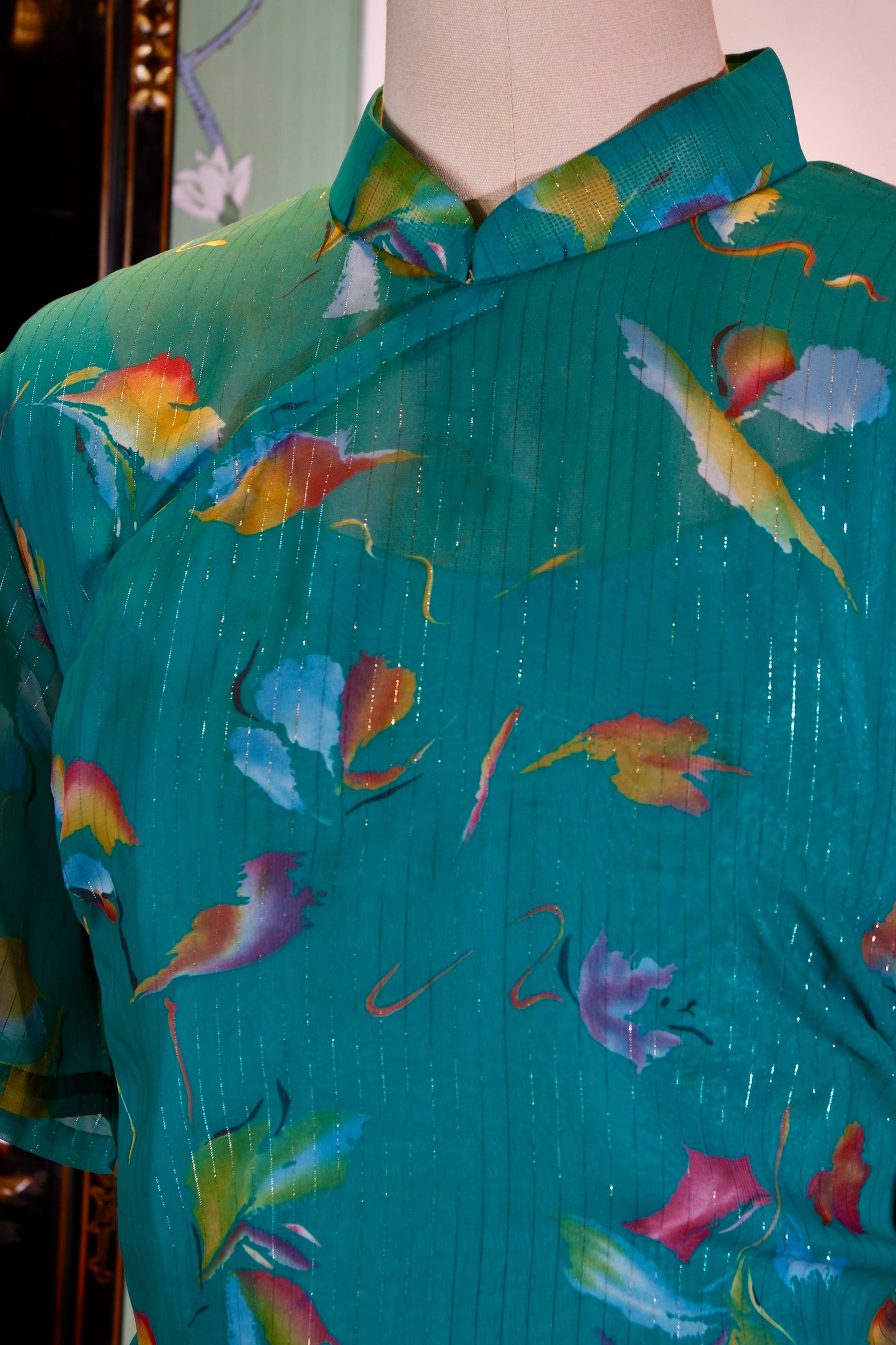
此件旗袍之面料,乃上世纪五十年代意大利进口之织银提花绸。其图案并非传统具象之花鸟,而是一种极具现代主义色彩的“抽象表现”。
观其纹样,底色如深潭碧水,幽蓝中透着孔雀绿的深邃。其上散布的彩色斑块,似是被风吹散的羽毛,又像是印象派画笔下光影斑驳的睡莲。这些色块以橙黄、紫罗兰与天青色交织,边缘晕染自然,毫无匠气。它们打破了传统旗袍纹样的对称与规整,呈现出一种“无序中的有序”。这种设计语言,在当时的西方艺术界正对应着抽象表现主义的兴起,而在东方语境下,则暗合了宋代瓷器中“窑变”那种不可预测的自然之美。每一片色彩都仿佛在织物上呼吸,随着穿着者的步态流转,宛如翠鸟掠过水面,惊起一滩鸥鹭。
二、 剪裁与工艺:西风东渐的摩登注脚
从服装史的角度审视,这件作品是五十年代香港“海派余韵”与“西式改良”完美融合的标本。
- 挖胸设计的隐喻: 领口处采用了当时极为前卫的“挖胸”剪裁。这一细节极其精妙,它既保留了中国传统立领的含蓄与端庄,又在锁骨下方留出一方肌肤的“透气感”。这在保守与开放之间找到了一种微妙的平衡,是那个时代都市女性追求身体解放与审美自由的无声宣言。正如张爱玲在《更衣记》中所言:“对于不会说话的人,衣服是一种语言,随身带着一种袖珍戏剧。”这件旗袍,便是那出戏剧中最精彩的一幕独白。
- 织银工艺的奢华: 面料中隐约可见的竖向银丝线条,不仅增加了织物的挺括度,更在光线下产生流动的光泽。这种意大利进口的织银技术,在当时属于极高等级的奢侈品面料,通常只见于高级定制或名媛的晚宴装束。银线的介入,使得原本柔软的丝绸拥有了金属般的质感,象征着战后经济复苏时期,人们对未来与财富的向往。
三、 历史叙事:衣香鬓影中的稀缺孤品
这件旗袍不仅仅是一件衣物,它是一段被封存的时光。
五十年代的香港,正处于文化身份重塑的关键期。大量的上海裁缝与资本南下,将精致的海派旗袍技艺带到了香江,并与西方的审美趣味发生了剧烈的化学反应。这件旗袍正是诞生于这样一个黄金时代。它身上的每一寸织银,都记录着那个年代名利场的觥筹交错;它那抽象的印花,折射出东西方文化碰撞时的火花。
引经据典而言,《诗经·卫风》有云:“有匪君子,如切如磋,如琢如磨。”这件古董衣的珍贵,在于其“琢磨”之功。历经七十余载岁月洗礼,其织银未氧化发黑,印花未褪色黯淡,版型依旧挺括如初,实属凤毛麟角。在当下的古董衣收藏市场中,如此品相完好、风格独特且兼具中西美学特征的“挖胸”款旗袍,已不仅是服饰,更是可穿戴的博物馆级艺术品。
它等待着那位懂得欣赏这份“残缺与完美并存”之美的藏家,续写这段关于美、关于时间、关于文化的传奇。
Measurements / Size Guide:
Bust / Waist / Hips / Total Length: 110/110/118/115 cm
Detailed Description:
The fabric of this qipao consists of luxury silver-brocade jacquard silk imported from Italy during the 1950s. Its pattern completely moves away from traditional, representational depictions of flowers and birds, opting instead for an "abstract expression" heavily saturated with modernist character.
Gazing upon the design, the background color resembles deep, still pool water, revealing a profound depth of peacock green within its dark blue tones. The colored patches scattered across it look like feathers dispersed by the wind, or the mottled light and shadow of water lilies under an Impressionist paintbrush. Intertwining orange-yellow, violet, and azure blue, these color blocks blend naturally along their edges without a trace of artificiality. They break away from the symmetry and regularity of traditional qipao motifs, presenting an "order within disorder." This design language directly mirrors the rise of Abstract Expressionism in the Western art world of the time, while in an Eastern context, it subtly aligns with the unpredictable, natural beauty of "transmutation glazes" (yaobian) found in Song Dynasty ceramics. Every patch of color seems to breathe upon the textile; shifting gracefully with the wearer's stride, it mimics a kingfisher skimming across a water surface, startling a bank of nesting waterbirds.
Examining the garment from the perspective of apparel history, this piece stands as a perfect specimen of the fusion between the remaining elegance of Shanghai-style tailoring (Haipai) and Western-style modifications in 1950s Hong Kong.
The Metaphor of the Keyhole Design: The neckline utilizes a "keyhole" cut (挖胸) that was considered extremely avant-garde at the time. This exquisite detail preserves the modesty and decorum of the traditional Chinese standing collar, while leaving an open breath of skin just below the collarbones. Finding a delicate balance between conservatism and openness, it serves as a silent declaration of body liberation and aesthetic freedom pursued by urban women of that era. As Eileen Chang noted in Reflections on Clothing (更衣记): "For those who cannot speak, clothes are a language, a pocket theater carried upon the body." This qipao represents the most brilliant soliloquy in that pocket theater.
The Luxury of Silver Brocade Craftsmanship: The vertical silver threads faintly visible throughout the fabric not only increase the crisp structure of the textile, but also produce a fluid luster under the light. This Italian imported silver-weaving technique belonged to the highest tier of luxury garment fabrics of the period, typically reserved for haute couture or the evening attire of upper-class socialites. The introduction of silver threads grants a metallic texture to the originally soft silk, symbolizing a yearning for the future and prosperity during the postwar economic recovery.
This qipao is far more than a mere item of apparel; it is a frozen fragment of time.
In the 1950s, Hong Kong was at a critical turning point in reshaping its cultural identity. A large number of Shanghai tailors and capital migrated south, bringing exquisite Shanghai-style qipao craftsmanship to Hong Kong, where it triggered a powerful chemical reaction with Western aesthetic tastes. This qipao was born exactly during this golden age. Every inch of its silver brocade records the clinking glasses of mid-century high society; its abstract print reflects the sparks generated by the collision of Eastern and Western cultures.
To quote classical literature, The Book of Songs (诗经·卫风) states: "Look at that elegant gentleman — like cutting and filing, like carving and polishing." (有匪君子,如切如磋,如琢如磨。) The preciousness of this antique garment lies precisely in this standard of meticulous workmanship. Having weathered the baptism of over seventy years of time, its silver threads have not oxidized or blackened, its print has not faded or dulled, and its structural silhouette remains as crisp as ever, making it an absolute rarity. In today's vintage clothing collection market, a "keyhole-neckline" qipao in such pristine condition, with such unique styling, and embodying both Eastern and Western aesthetic traits is no longer just apparel—it is a piece of wearable, museum-grade art.
It waits for a collector who understands how to appreciate this beauty where preservation meets the passage of time, continuing this legend of beauty, time, and culture.