深圳溯源
Couldn't load pickup availability
衣服尺寸:
胸围/腰围/臀围/衣长:98/86/106/106 厘米
细节描述:
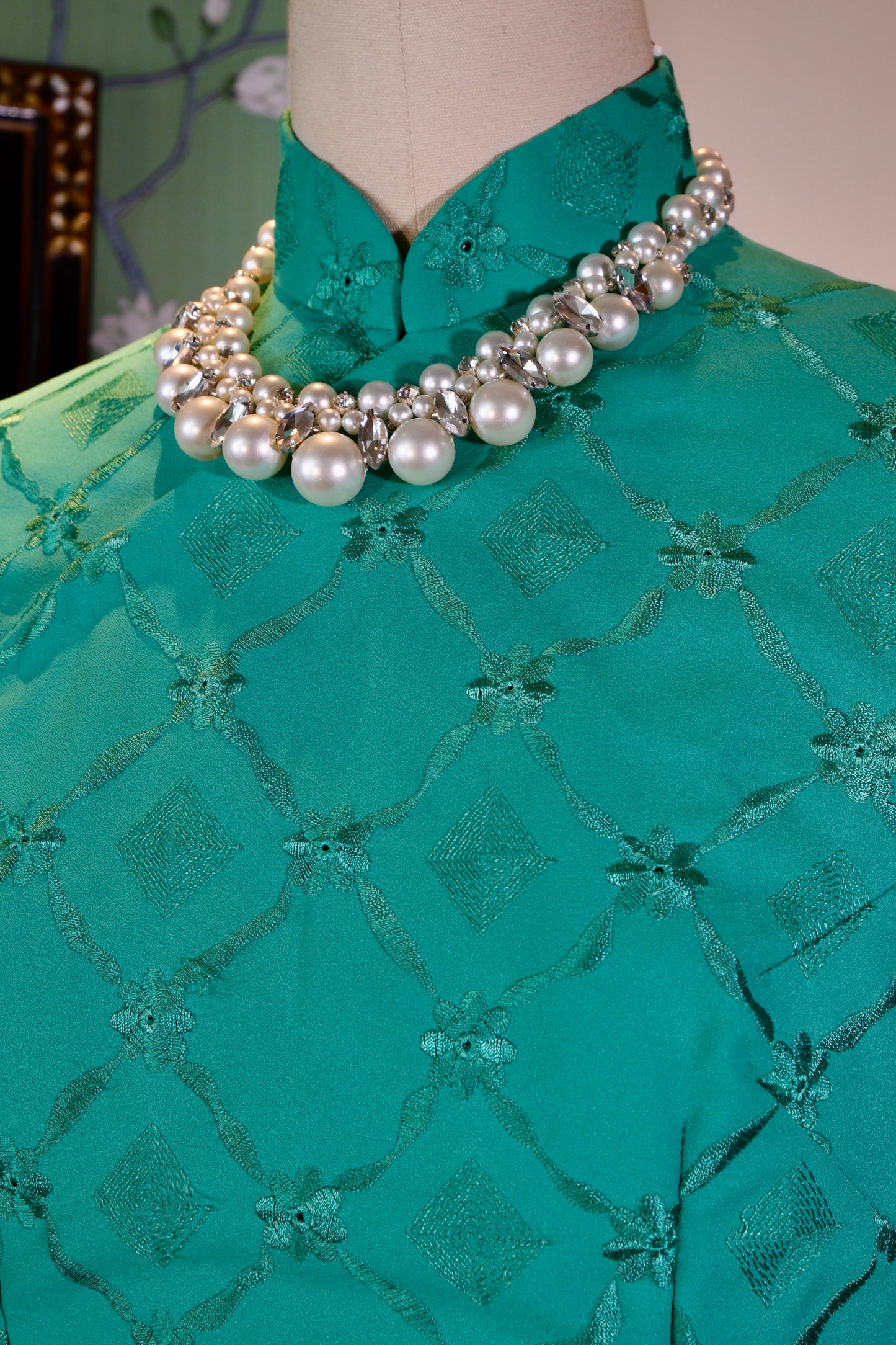
一、图案描述:经纬之间的几何诗意
这件旗袍最引人入胜之处,在于其面料上独特的机绣几何纹样。不同于传统旗袍常见的具象花鸟或龙凤图腾,它采用了一种极具现代构成主义美感的菱形网格(Diamond Lattice)布局。
- 骨架与填充: 每一个菱形格并非简单的线条勾勒,而是由类似“回纹”或简化藤蔓的刺绣线条交织而成,象征着连绵不断、生生不息。在菱形的中心节点处,绣有精致的四瓣小花(形似梅花或十字花),这种设计既保留了中式纹样的吉祥寓意,又带有西方装饰艺术(Art Deco)的秩序感。
- 工艺质感: 仔细观察细节图,可以看出这是典型的六十年代台湾产机绣工艺。那时的机器刺绣尚未完全工业化冷漠,仍保留着一种温润的手工感。丝线的光泽度极高,在翠绿色的底布上呈现出微妙的深浅变化,仿佛宝石镶嵌其中,既有浮雕般的立体感,又不失丝绸原本的流动光泽。
二、历史溯源:海岛风华与摩登时代的缩影
若要读懂这件衣裳,便需回到那个特殊的时空坐标——1960年代的台湾。
那是张爱玲笔下“乱世中的安稳”逐渐沉淀为日常的时代。随着国民政府迁台,上海的裁缝技艺与西方的审美风尚在台湾这座海岛上发生了奇妙的化学反应。这件旗袍正是这一时期“海派遗风”与“台式改良”完美融合的见证。
- 剪裁的演变: 此时的旗袍已褪去了三四十年代那种极度夸张的S型曲线和繁复的滚边,转而追求简洁、利落、实用。无袖的设计(Sleeveless cut)是为了适应亚热带的气候,同时也受到当时好莱坞女星(如奥黛丽·赫本)着装风格的影响,展现出女性肩颈线条的自信与独立。
- 色彩的隐喻: 这种高饱和度的孔雀绿(Peacock Green)或称松石绿,是六十年代非常流行的颜色。它既呼应了中国传统山水画中“青绿山水”的高古意境,又符合波普艺术兴起时对鲜艳色彩的追逐。它代表着一种从战乱中走出后,对生命力与繁荣的渴望。
“旗袍的紧身,不仅仅是为了展示女性的曲线,更是一种对身体规训的解放与重塑。” —— 引自服装史研究视角
在那个年代,能穿上这样一件用料考究、做工精良的机绣旗袍的女性,往往是受过良好教育、出入于外交场合或高级社交圈的“新女性”。她们不再是被深锁闺阁的传统妇人,而是能够从容应对现代社会节奏的独立个体。
三、艺术风格与稀缺性:不可复制的工业美学
为何说这件古董衣具有极高的收藏价值?
1. 绝版的“过渡期”工艺: 六十年代的台湾纺织业正处于腾飞前夜,这种高品质的机绣面料在当时属于奢侈品。随着后来化纤面料的普及和快时尚的兴起,这种讲究针法密度、配色雅致的老式机绣工艺已基本失传。现在的机器刺绣往往过于呆板,缺乏这种“似是而非”的手作灵气。
2. 保存完好的时光标本: 丝绸极其娇贵,历经六十载岁月,这件旗袍依然色泽鲜亮,没有明显的脆化或虫蛀,实属罕见。这得益于当年优质的真丝底料以及主人精心的呵护。它不仅仅是一件衣服,更是一个被封存的时间胶囊。
3. 中西合璧的审美典范: 它没有盲目复古,也没有全盘西化。立领(Mandarin Collar)坚守了东方的含蓄与尊严,而修身剪裁与几何纹样则拥抱了世界的摩登。这种平衡感,是当代设计师苦苦追寻却难以复刻的“黄金时代”气质。
结语
这件翠绿色的古董旗袍,静默无言,却道尽了半个世纪的风华。它不仅是一段关于美的记忆,更是一部穿在身上的断代史。对于收藏家而言,拥有的不仅是一件衣裳,更是那个优雅、精致且充满希望的六十年代灵魂。
Measurements / Size Guide:
Bust / Waist / Hips / Total Length: 98/86/106/106 cm
Detailed Description:
The most captivating aspect of this qipao lies in the highly distinct machine-embroidered geometric motifs across its fabric surface. Completely charting a course away from the representational flower-and-bird or dragon-and-phoenix totems frequently observed in conventional qipaos, it adopts a diamond lattice layout deeply imbued with a modern Constructivist aesthetic.
Structural Framework and Infill: Rather than simple linear delineations, each diamond cell is formed by the interlocking embroidery lines of fretwork (huiwen) or highly simplified trailing vines, symbolizing unending continuity and unceasing life. At the central node of each diamond grid is embroidered a delicate four-petaled floret resembling a plum blossom or a cruciform flower. This layout successfully preserves the auspicious metaphors of traditional Chinese patterns while projecting the rigorous sense of order characteristic of Western Art Deco.
Textural Quality of the Craft: Looking closely at the detailed imagery reveals the classic hallmarks of 1960s Taiwanese machine embroidery. The mechanical stitching of that specific era had not yet succumbed to a cold, completely industrialized monotony, fiercely retaining a warm, hand-crafted sensibility. The silk threads possess an exceptionally high luster, executing subtle, shifting tonal variations against the primary emerald green background substrate. The effect resembles precious gemstones encrusted into the textile, displaying a relief-like three-dimensional depth without sacrificing the original, fluid sheen of the silk.
To fully comprehend this garment, one must return to the specific temporal and spatial coordinates of Taiwan in the 1960s.
It was an era when the "stability in times of chaos" famously written of by Eileen Chang gradually precipitated into daily life. Following historical migrations, the supreme tailoring techniques of Shanghai converged with Western style trends on the island of Taiwan, generating a marvelous aesthetic alchemy. This qipao stands as a primary physical document of that perfect synthesis between the lingering legacy of the Shanghai style (Haipai) and Taiwanese modification.
The Evolution of the Silhouette: The qipao of this window had shed the fiercely exaggerated S-curves and heavy, complex pipings characteristic of the 1930s and 1940s, pivoting instead toward clean, crisp lines and practical utility. The sleek, sleeveless cut was engineered to accommodate the sub-tropical climate of the island while simultaneously absorbing the styling cues of Hollywood film icons from that era, such as Audrey Hepburn. It confidently showcases the independent shoulder and neck contours of the modern woman.
Metaphors of Color: This highly saturated peacock green or turquoise green was an exceptionally fashionable hue during the 1960s. It simultaneously echoes the ancient, loftily remote mood of "blue-green landscapes" (qinglv shanshui) found in traditional Chinese paintings while aligning with the chase for vibrant coloration that defined the rise of Pop Art. It represents a collective yearning for vitality and prosperity after stepping out from the shadows of conflict.
"The tight fit of the qipao is not merely meant to display a woman's biological curves; it is a liberation and reshaping of bodily discipline." — From a Dress History Research Perspective
In that era, a woman capable of wearing a machine-embroidered qipao constructed from such exquisite materials and meticulous workmanship was almost exclusively a well-educated "new woman" frequenting diplomatic functions or elite social circles. They were no longer traditional housewives locked deep within inner chambers, but independent individuals capable of effortlessly navigating the fast-paced rhythm of modern society.
Why does this specific antique garment command such an exceptional premium for collectors?
Discontinued "Transitional Phase" Craftsmanship: The textile industry of Taiwan during the 1960s sat on the absolute eve of an economic takeoff, and high-quality machine-embroidered fabric of this caliber was an absolute luxury item at the time. With the subsequent omnipresence of synthetic fibers and the ascendancy of fast fashion, this old-school machine-embroidery technique—which demanded immense stitch density and elegant color calibration—has become a lost art. Modern machine embroidery is universally rigid and mechanical, completely lacking this "imperfectly precise" hand-crafted spirit.
A Pristinely Preserved Temporal Specimen: Silk is an inherently delicate, fragile organic material. Having journeyed across sixty years of time, this qipao retains its original saturated coloration and remains entirely free from obvious fiber brittleness or moth damage, which is an absolute anomaly. This state of preservation is a direct credit to the premium quality of the real silk base substrate used back then, as well as the meticulous stewardship of its original owner. It is not merely a piece of apparel, but a sealed time capsule.
A Model Paradigm of East-West Synthesis: The drafting of this garment neither blindly replicated antiquity nor completely surrendered to total Westernization. The standing Mandarin collar firmly guards Eastern dignity and modesty, while the slim fit and geometric patterning openly embrace global modernism. This precise sense of equilibrium is a "golden age" temperament that contemporary designers chase relentlessly yet find nearly impossible to replicate.
This emerald green antique qipao hangs in magnificent silence, yet it narrates half a century of cultural wind and cloud. It stands not only as an archived memory of material beauty but as a wearable chronological history. For the connoisseur, to possess this piece is to possess more than a garment—it is to hold the elegant, refined, and deeply hopeful soul of the 1960s.