花间晨露:民国廿年浅粉双宫真丝刺绣晨袍
一、衣上蔷薇:双宫真丝的“粗粝温柔”
这件民国二十年代的浅粉双宫真丝晨袍,以“花间晨露”之姿,将加拿大“老钱”家族的温柔与东方刺绣的细腻凝于经纬。晨袍主体采用浅粉色双宫真丝,经纬间流淌着“晨雾初散”的柔光——不同于普通丝绸的平滑,双宫真丝特有的“竹节纹”肌理,如“岁月留痕”般自然起伏,恰合《长物志》“宁拙无巧,宁朴无华”的造物哲学。这种真丝需以“双茧并织”之法,将两枚蚕茧的丝线同时缫制,方能织出“粗粝中见温柔,朴拙中藏精致”的独特质感。
衣襟、袖口与下摆的蔷薇刺绣,以粉、绿、蓝三色丝线绣成,每一朵花都需匠人以“劈丝分线”的绝技,将丝线劈为十六分之一,方能绣出“花瓣如凝脂,花叶如翡翠”的细腻。刺绣的针法借鉴了苏绣“平针”与“打籽绣”的结合,却又以“西方式写实”重构了传统蔷薇的形态——花瓣的渐变如“晨露沾衣”,花叶的卷曲如“春风拂面”,恰如《诗经》所言“桃之夭夭,灼灼其华”。
二、腰间流苏:棋盘格丝带的“几何诗意”
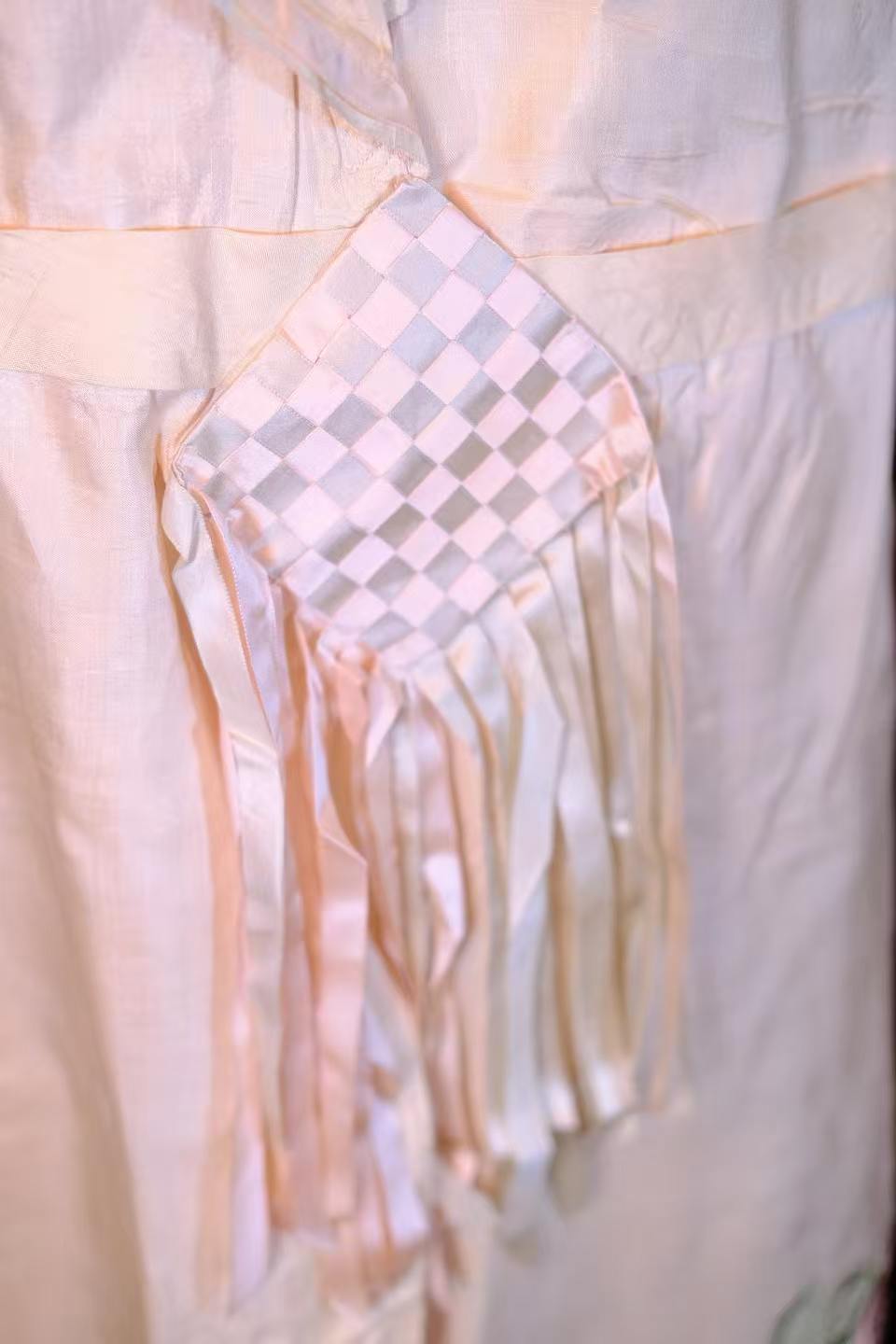
腰间的棋盘格丝带,是这套晨袍的“点睛之笔”。丝带以粉白双色丝线编织成“棋盘格”纹,每一格都需匠人以“经纬交织”的耐心,将丝线的柔软与几何的硬朗完美融合,形成“一柔一刚,一圆一方”的对比。丝带的流苏,以同色丝线垂坠成“雨丝”之态,暗合“润物细无声”的东方意境,却又以“西方式垂坠”保留了传统流苏的优雅感。
三、百年旧梦:从温哥华唐人街到蒙特利尔“晨露花园”
这套晨袍的主人,正是前文所述加拿大“老钱”家族的闺秀。二十年代,她或许在蒙特利尔的“晨露花园”中,以此晨袍搭配前文的金属织金旗袍惊艳四座:双宫真丝的粗粝肌理衬得她肤色胜雪,蔷薇刺绣的细腻如“花间晨露”,棋盘格丝带的流苏随步伐轻扬如“春风拂面”。
四、艺术孤品:跨文化的“衣冠孤本”
此晨袍的珍稀,在于它是“跨文化时尚”的活化石。全球存世的民国双宫真丝晨袍不足百件,而“浅粉双宫真丝+蔷薇刺绣+棋盘格丝带+流苏”的组合,更是孤品中的孤品。双宫真丝需江南织造局“以双茧为骨,以竹节为魂”的织造技艺,蔷薇刺绣则需中国绣娘“以线为墨,以针为笔”的刺绣功夫,棋盘格丝带则需西方工匠“以丝为骨,以格为形”的编织技艺,三者结合,成就了“衣以载道”的跨文化杰作。
五、结语:穿在身上的“花间晨露”
当指尖拂过衣襟的蔷薇刺绣,仿佛能触摸到百年前蒙特利尔的“晨露花园”——那是东方刺绣的细腻,是西方几何的诗意,是加拿大“老钱”家族在异域的温柔与坚韧。这套晨袍,是“离散美学”的衣冠孤本,亦是民国女性在传统与现代之间,以衣为笔,写下的“花间晨露”般的温柔诗篇。
Morning Dew Among Flowers: A Republic of China Year 20 (1930s) Pale Pink Shantung Silk Embroidered Morning Gown
I. Roses Upon the Garment: The "Coarse Tenderness" of Shantung Silk
This pale pink Shantung silk morning gown from the 1920s and 1930s takes the posture of "morning dew among flowers," condensing the tenderness of a Canadian "old money" family and the delicacy of Eastern embroidery within its warp and weft. The main body of the gown utilizes pale pink Shantung (douppioni) silk, with a soft light of "morning mist just dispersing" flowing through its threads. Distinct from the smooth flatness of ordinary silk, the unique "slub" texture of Shantung silk rises and falls naturally like "traces left by time," perfectly aligning with the design philosophy from The Treatise on Superfluous Things (Chang Wu Zhi): "Rather clumsy than artful; rather simple than showy." This type of silk must be reeled from two silkworms spinning a single cocoon simultaneously, a method that weaves a distinct texture where "tenderness is found amid coarseness, and refinement is hidden within simplicity."
The rose embroidery along the lapel, cuffs, and hem is crafted with pink, green, and blue silk threads. Each blossom requires the artisan's supreme mastery of splitting silk threads into sixteenths to achieve a delicacy where "petals appear like congealed fat, and leaves resemble jade." The embroidery needlework draws inspiration from the combination of Suzhou embroidery's "satin stitch" and "seed stitch," yet reconstructs the form of traditional roses through "Western-style realism"—the gradient of the petals resembling "morning dew dampening the clothes," and the curling of the leaves evoking "a spring breeze brushing the face," precisely as The Book of Songs (Shi Jing) describes: "The peach tree is young and elegant, brilliant are its flowers."
II. Tassels Around the Waist: The "Geometric Poetry" of a Checkerboard Ribbon
The checkerboard ribbon around the waist is the crowning touch of this morning gown. The ribbon is woven from pink and white silk threads into a "checkerboard" pattern. Each single square requires the artisan's patience through "the interweaving of warp and weft" to flawlessly merge the softness of the silk thread with the crispness of geometry, creating a contrast of "one soft and one rigid, one round and one square." The tassels of the ribbon drape down like "falling rain," subtly channeling the Eastern poetic ideal of "moistening things silently," yet retaining the elegance of traditional tassels through a "Western-style drape."
III. Century-Old Dreams: From Vancouver's Chinatown to Montreal's "Morning Dew Garden"
The owner of this morning gown was precisely a lady from the aforementioned Canadian "old money" family. In the 1920s and 1930s, she might have stunned the crowd in a "Morning Dew Garden" of Montreal, pairing this morning gown with the previously mentioned metallic woven-gold dress: the coarse texture of the Shantung silk making her skin appear as fair as snow, the delicacy of the rose embroidery resembling "morning dew among flowers," and the tassels of the checkerboard ribbon swaying gently with her steps like "a spring breeze brushing the face."
IV. Artistic Masterpiece: A Cross-Cultural "Unique Fashion Chronicle"
The rarity of this morning gown lies in its status as a living fossil of "cross-cultural fashion." Fewer than a hundred Shantung silk morning gowns from the Republic of China era survive worldwide, and the combination of "pale pink Shantung silk + rose embroidery + checkerboard ribbon + tassels" makes this a unique piece among unique pieces. The Shantung silk required the craftsmanship of the Jiangnan Weaving Bureau "using double cocoons as the bone and slubs as the soul"; the rose embroidery required the embroidery skills of Chinese needlewomen "using thread as ink and the needle as a pen"; and the checkerboard ribbon required the weaving skills of Western artisans "using silk as the bone and squares as the form." The fusion of these three elements achieves a cross-cultural masterpiece where "the garment carries the culture."
V. Conclusion: "Morning Dew Among Flowers" Worn on the Body
When fingertips brush across the rose embroidery of the lapel, it feels as though one can touch the "Morning Dew Garden" of Montreal from a century ago—reflecting the delicacy of Eastern embroidery, the geometric poetry of the West, and the tenderness and resilience of a Canadian "old money" family in a foreign land. This morning gown is a unique fashion chronicle of "diaspora aesthetics," and a tender poem akin to "morning dew among flowers" written by women of the Republic of China era, using garments as their pen, between tradition and modernity.