深圳溯源
Couldn't load pickup availability
衣服尺寸:
胸围/腰围/臀围:96/84/98 厘米
衣长:108 厘米
细节描述:
蓝白经纬间的抽象哲思
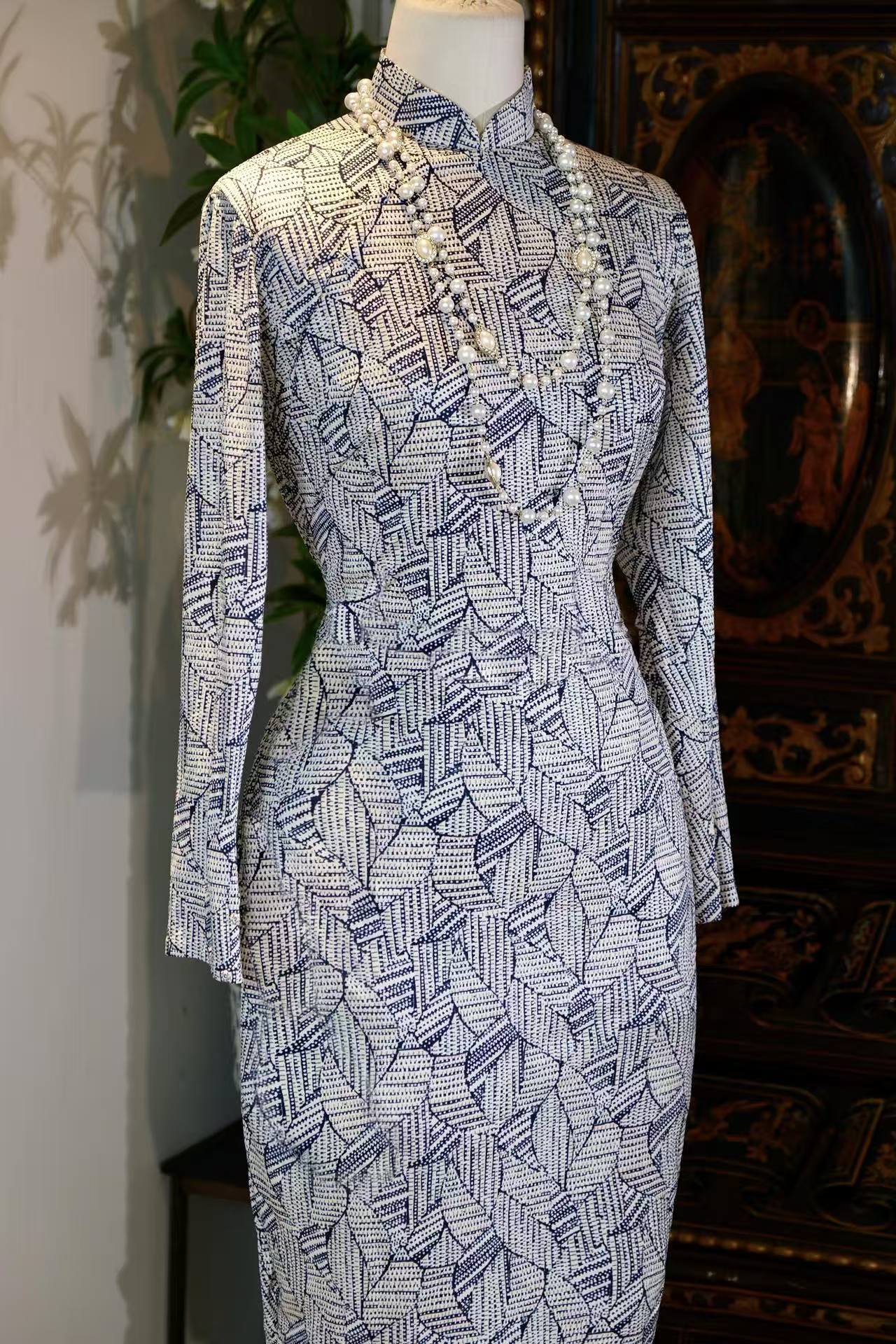
这件旗袍的面料图案,堪称六十年代现代主义美学的缩影。它以靛蓝与月白为经纬,通过不规则的几何块面交织,形成如《周易》所言“参伍以变,错综其数”的视觉韵律。细观其纹:
- 短线条与点状肌理构成的“编织感”,似传统竹编工艺的抽象化转译,暗合《考工记》“天有时,地有气,材有美,工有巧”的造物智慧;
- 菱形与斜线的错落排布,打破传统旗袍纹样的对称规制,呼应包豪斯学派“形式追随功能”的理性精神,却又在蓝白对比中透出宋瓷“雨过天青云破处”的东方意境。
这种“传统肌理+现代构成”的设计,恰如艺术史家贡布里希所言:“艺术的进步,是图式与修正的永恒对话。”
海峡彼岸的旗袍新章
六十年代的台湾,是传统与现代碰撞的熔炉。彼时,大陆移民携旗袍文化渡海而来,而西方现代艺术思潮亦随经济开放涌入。这件旗袍便诞生于这样的语境:
- 工艺上,它保留中式旗袍的立领、斜襟、开衩,却在剪裁上更贴合人体曲线,暗合当时台湾纺织业“引进日本技术,改良本土工艺”的浪潮;
- 文化上,它是“离散美学”的载体——正如学者王德威所言:“台湾的文学(艺术)是‘原乡’与‘异乡’的双重变奏。”蓝白几何纹既是对江南蓝印花布的遥望,亦是对西方抽象表现主义的回应,成为一代人“在传统中找根,在现代中寻路”的精神注脚。
艺术与稀缺:时间的孤本
这件旗袍的稀缺性,藏于三重维度:
- 时代孤本:六十年代台湾纺织业虽盛,但此类融合“东方意象+西方构成”的设计,多为小众定制,存世量极少;
- 工艺绝响:面料上的几何纹需经“先织后印”的复杂工序,而今这种传统提花与现代印染结合的技艺,已随老纺织厂的关闭濒临失传;
- 文化标本:它是冷战时期东亚文化交融的“活化石”,正如《台北人》中描写的“金大班的最后一夜”——旗袍的每一次褶皱,都藏着那个时代的离散与新生。
当你凝视这件旗袍,便是在凝视一段被蓝白经纬编织的历史:它是六十年代台湾女性的“身体宣言”,是现代主义与东方美学的“无声对话”,更是时间留给我们的、不可复制的艺术孤本。
Measurements / Size Guide:
Bust / Waist / Hips: 96/84/98 cm
Total Length: 108 cm
Detailed Description:
[The Abstract Philosophy of Blue and White Interlace] The fabric pattern of this Qipao is a masterclass in 1960s modernist aesthetics. Utilizing indigo and lunar white as its warp and weft, it weaves irregular geometric planes to create a visual rhythm reminiscent of the I Ching (Book of Changes): "intermingling for variation, interlacing for numbers." A closer look reveals its intricate details:
The "woven texture" formed by short lines and stippled patterns acts as an abstract translation of traditional bamboo weaving, echoing the artisan wisdom from the Kao Gong Ji (Book of Artificers): "Heaven has its seasons, Earth has its climate, materials have their beauty, and craftsmanship has its skill."
The staggered arrangement of diamonds and diagonals breaks away from the symmetrical constraints of traditional Qipao patterns. This mirrors the rational spirit of the Bauhaus school's "form follows function," yet exudes the poetic Eastern serene aesthetic of Song Dynasty ceramics—resembling "the color of the sky after rain through a rift in the clouds."
This fusion of "traditional texture and modern composition" perfectly embodies what art historian Ernst Gombrich once noted: "The progress of art is an eternal dialogue between schema and correction."
[A New Chapter of the Qipao Across the Strait] The 1960s in Taiwan was a melting pot where tradition clashed with modernity. During this era, immigrants brought the Qipao culture across the strait, while Western modern art movements surged in alongside economic openness. This Qipao was born from exactly this cultural context:
In Craftsmanship: It retains the traditional Chinese mandarin collar, diagonal closure (Xiejin), and side slits, but adopts a silhouette that contours more closely to the human form. This reflects the mid-century trend in Taiwan’s textile industry of "importing technology while refining native craftsmanship."
In Culture: It serves as a vessel for the "aesthetic of diaspora." As scholar David Der-wei Wang observed, "Taiwanese literature and art are a dual variation of 'homeland' and 'foreign land'." The blue-and-white geometric pattern is both a nostalgic gaze backward toward the blue calico prints of Jiangnan and a contemporary response to Western Abstract Expressionism. It stands as a spiritual footnote for a generation "seeking roots in tradition while forging a path in modernity."
[Art & Rarity: A Timeless Specimen of History] The rarity of this piece is rooted in three distinct dimensions:
A Unique Historical Specimen: Although Taiwan's textile industry boomed in the 1960s, designs fusing "Eastern imagery with Western composition" were restricted to niche, custom orders. Very few have survived.
A Extinct Craftsmanship: The geometric pattern required a complex "weave-first, print-later" process. Today, this specific technique of combining traditional jacquard weaving with modern textile printing has nearly vanished with the closure of old mid-century mills.
A Cultural Fossil: It stands as a living fossil of East Asian cultural exchange during the Cold War era. Much like the world captured in Kenneth Pai’s Taipei People—specifically The Last Night of Madam Chin—every fold of this Qipao contains the diaspora, memories, and rebirth of that generation.
To gaze upon this Qipao is to look at history woven into blue and white threads. It is a "bodily manifesto" of 1960s Taiwanese women, a silent dialogue between Modernism and Eastern aesthetics, and an irreplaceable artistic masterpiece left to us by time.