深圳溯源
Couldn't load pickup availability
衣服尺寸:
胸围/腰围/臀围:86/78/92 厘米
衣长:99 厘米
细节描述:
这件诞生于上世纪六十年代的香港古董旗袍,以欧洲进口斜纹羊毛为骨,以波浪襟为魂,是中西服饰美学在战后黄金年代碰撞出的璀璨结晶。它没有盘扣的繁复装饰,却以极简的线条与精准的剪裁,诠释了“无饰之饰”的高级美学——正如《道德经》所言“大音希声,大象无形”,真正的优雅,往往藏于克制与留白之中。
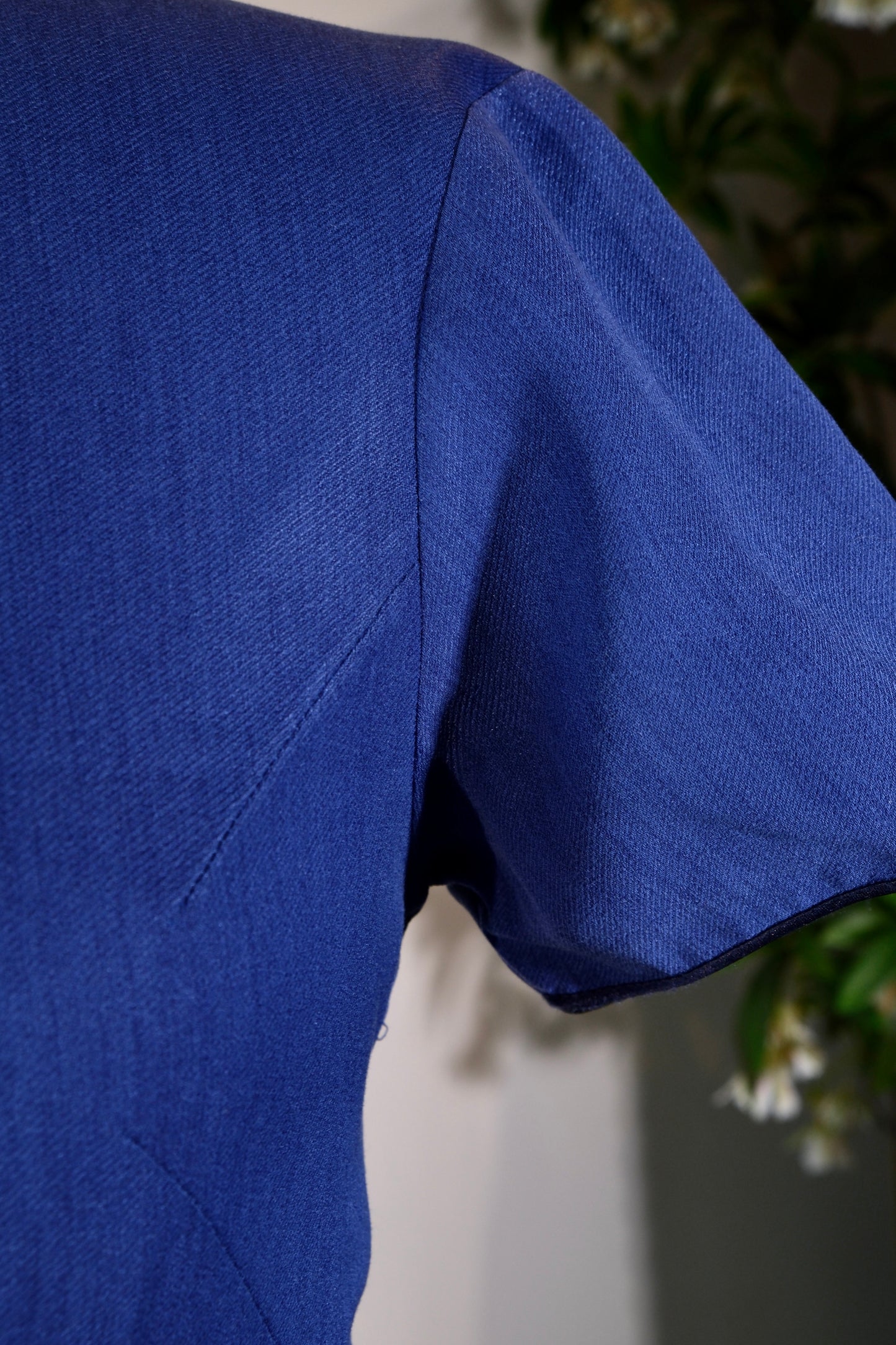
通体宝蓝色调如深海静流,面料肌理在光线下泛着温润的光泽,仿佛将时光的沉淀织入每一根纱线。波浪襟自立领处蜿蜒而下,如云水般柔韧地贴合身形,既承袭了传统旗袍的东方神韵,又融入了西式立体剪裁的现代感,使曲线自然流露而不张扬。这种“去符号化”的设计,正是六十年代现代主义思潮在东方服饰中的诗意回响——以形传神,以简驭繁。
它不仅是衣物,更是一段历史的见证。彼时香港作为东西方文化交汇的熔炉,裁缝师们将西方高级时装的结构逻辑与中式工艺的细腻针法融为一体,创造出兼具实用与诗意的“港式旗袍”。张爱玲曾言:“衣服是一种语言,随身带着一种袖珍戏剧。”这件旗袍,便是那个时代都市女性独立、自信、追求精致的无声宣言——它不靠盘扣点睛,却以流畅的轮廓与沉静的色彩,诉说着一个时代的审美自觉与文化自信。
其稀缺性,源于多重不可复制的历史条件:欧洲斜纹羊毛在当时属奢侈品级面料,进口成本高昂;波浪襟工艺复杂,需经验丰富的师傅手工缝制,如今已鲜有传承;历经六十载岁月仍能保存完好者凤毛麟角,尤其无任何破损、褪色或改制痕迹,实属难得。从服装史角度看,它是研究二十世纪中叶亚洲时尚全球化进程的重要实物证据,具有不可替代的文献价值与艺术高度。
Measurements / Size Guide:
Bust / Waist / Hips: 86/78/92 cm
Total Length: 99 cm
Detailed Description:
This antique Hong Kong qipao, materialized during the 1960s of the last century, implements premium imported European twill wool as its structural skeleton and an undulating wave-line front closure (Baolangjin) as its spiritual soul, standing as a brilliant crystal precipitated from the collision of Eastern and Western apparel aesthetics during the post-war golden era. It entirely banishes the complex ornamentation of traditional frog closures (Pankou), choosing instead to rely on high-minimalist lines and absolute pattern-drafting precision to interpret the elevated aesthetic of "motif-free ornamentation." This flawlessly actualizes the philosophical dictum from the Tao Te Ching: "The loudest sound is left unvoiced; the grandest form remains formless." True elegance, within this paradigm, resides permanently within the boundaries of disciplined restraint and strategic negative space (Liubai).
The overarching garment is bathed in a profound sapphire blue palette that commands the presence of a quiet undercurrent in the deep sea. The structural texture of the twill wool matrix catches the light to yield a warm, disciplined luster, as if the very sedimentation of time had been meticulously woven into every individual strand of yarn. The wave-line front closure winds gracefully down from the base of the high standing collar, contouring to the silhouette with the supple resilience of floating clouds and moving water. This design vector simultaneously inherits the signature Eastern charm of the traditional qipao while seamlessly incorporating the modern, ergonomic discipline of Western three-dimensional tailoring—allowing the organic curves of the anatomy to manifest naturally without a trace of ostentatious exposure. This "de-semiotized" layout serves as a highly poetic response to the mid-century modernist movement expanding through Eastern apparel engineering: communicating spiritual presence through physical form, and overruling complexity via absolute reduction.
This garment functions far beyond its definition as a basic piece of clothing to serve as a primary physical witness to an epoch. During this historical window, operating as a high-intensity melting pot of Eastern and Western cultural vectors, Hong Kong’s master tailoring guilds merged the structural logic of Western haute couture with the microscopic hand-stitching methodologies of traditional Chinese craftsmanship. Through this cross-pollination, they birthed the iconic "Hong Kong-Style Qipao" (Gangshi Qipao)—a silhouette balancing pragmatic utility with profound poetic depth. The celebrated author Eileen Chang once immortalized the concept: "Clothes are a language; what one carries with them is a pocket drama." This specific qipao stands as the silent, unyielding manifesto of that generation’s metropolitan women—independent, self-reliant, and fiercely dedicated to refined living. It bypasses the need for a focal frog closure to command attention, relying solely on its fluid contours and quiet, serene colorway to declare an epochal aesthetic awakening and absolute cultural confidence.
The absolute scarcity of this curated specimen is anchored by multiple historical vectors that are entirely irreproducible today:
The Luxury Status of the Matrix: Premium European twill wool occupied an elite luxury echelon within the mid-century textile market, commanding astronomical import tariffs and logistics costs.
The Extinction of the Baolangjin Technique: The engineering of an undulating wave-line front closure is intensely complex, requiring veteran master artisans to meticulously hand-sew and mold the curves—a specialized manual lineage that has effectively vanished from contemporary tailoring guilds.
The Miraculous State of Preservation: Traversing six decades of natural timeline, physical specimens that remain flawlessly intact are exceptionally rare—appearing as true phoenix feathers and unicorn horns. That this piece exhibits zero structural tearing, zero chemical fading of the dyes, and absolute freedom from subsequent alteration marks it as an extraordinary curatorial find.
From the analytical perspective of costume history, this qipao operates as an indispensable piece of primary physical evidence for mapping the globalization of Asian fashion during the mid-twentieth century, holding irreplaceable documentary value and commanding a magnificent artistic height.