深圳溯源
Couldn't load pickup availability
衣服尺寸:
胸围/腰围/臀围/衣长:90/80/96/112 厘米
细节描述:
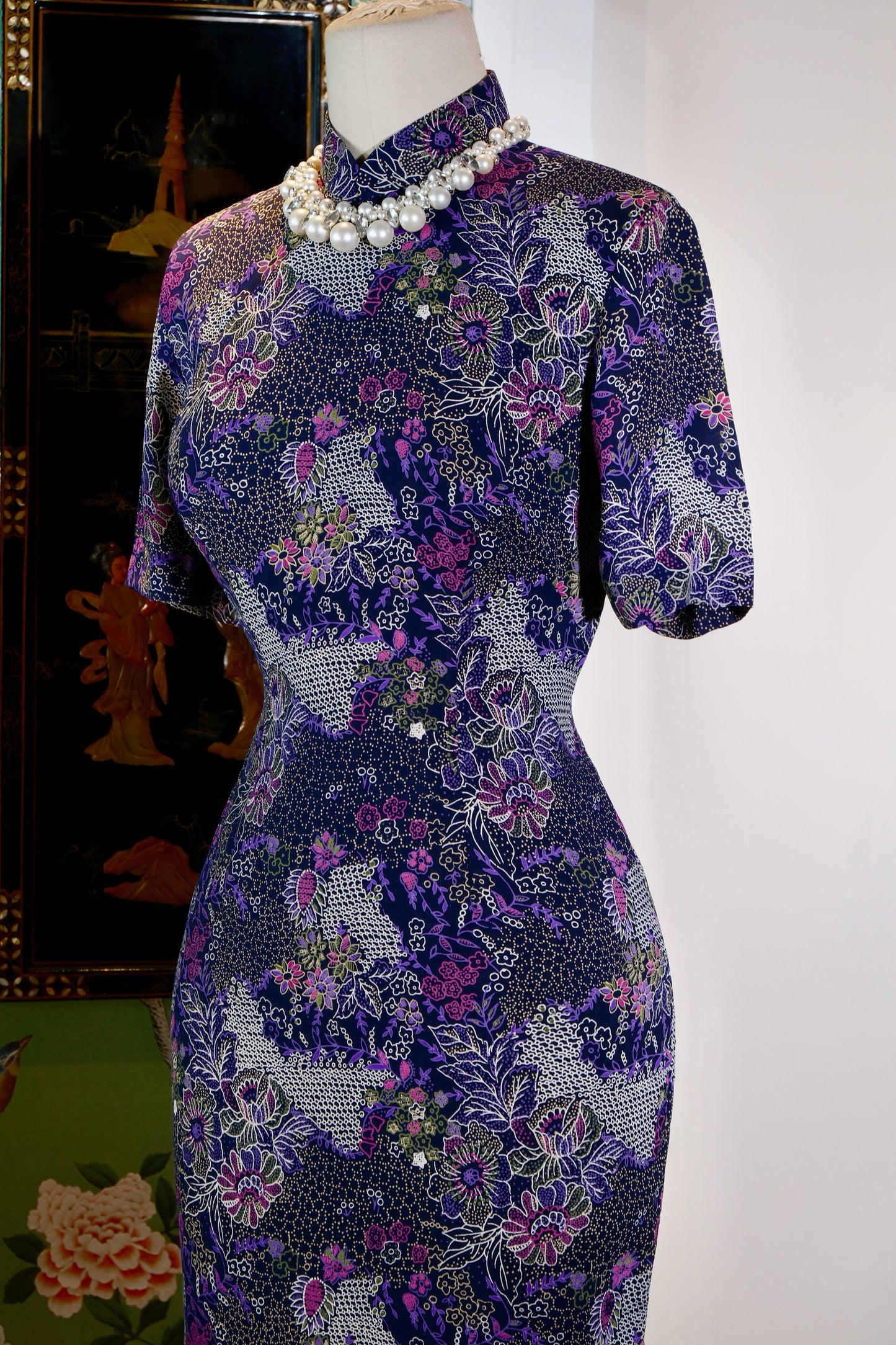
这件旗袍的纹样,是一场跨越文化的视觉盛宴。面料之上,以深邃的靛蓝为底色,交织着浓郁的紫罗兰与亮眼的洋红。其图案并非传统中式具象的花鸟,而是呈现出一种极具现代感的“抽象表现主义”风格。
细看之下,白色的线条勾勒出类似蕨类植物或热带花卉的轮廓,笔触狂放而不失法度,宛如中国书法中的草书笔意被解构后重组。其间穿插着细密的点状纹理(类似蜡染的防染效果)和几何网格,这种繁复的层次感,既有东方园林的幽深意境,又带有西方波普艺术的前卫张力。它不像是在描绘具体的花园,更像是在捕捉光影在繁花间跳跃的瞬间,是一种“似花非花,似雾非雾”的朦胧美。
【古董衣的故事与历史背景】
时光回溯至上世纪六十年代的台湾,那是一个东西方文化剧烈碰撞与交融的黄金时代。彼时的台北,被誉为“小上海”,不仅承接了来自大陆的精湛剪裁技艺,更率先吹受了欧美时尚的风潮。
这件旗袍正是那个时代的缩影。不同于五十年代海派旗袍的严谨与端庄,六十年代的台湾旗袍开始大胆尝试新面料与新廓形。这件衣服选用了轻盈透气的雪纺,这在当时是极为奢侈且前卫的选择,标志着女性从厚重的织锦缎中解放出来,追求更自由、更舒适的穿着体验。
我们可以想象,在那个没有空调的年代,一位受过良好教育、 perhaps 在外交场合或高级沙龙中穿梭的女性,身着此裙。当她在舞池中旋转,或在圆山饭店的露台上小憩,雪纺面料随风轻扬,那抽象的紫色花纹便如流动的梦境。它不仅是一件衣服,更是那个时代女性自信、摩登与优雅精神的载体。它见证了台湾纺织业的腾飞,也记录了华人时尚走向国际化的关键一步。
【艺术风格与稀缺性解析】
从学术角度审视,这件藏品具有极高的研究价值与收藏意义。
1. 风格的独特性:
张爱玲曾在《更衣记》中写道:“各人住在各人的衣服里。”这件旗袍所展现的,正是六十年代特有的“国际化视野”。它打破了传统旗袍纹样“必吉祥、必具象”的桎梏,采用了类似印尼蜡染或西方抽象画的构图。这种“中西合璧”并非简单的拼接,而是将东方的气韵生动融入西方的色彩构成中,体现了极高的审美品位。
2. 工艺的不可复制性:
在印花技术上,这种多色套印且保持色彩饱和度的工艺,在当年的工业条件下成本极高。随着老一代印染工匠的离去和纺织技术的迭代,这种带有特定时代“颗粒感”和手工温度的面料已近乎绝迹。
3. 稀缺性:
雪纺材质虽美,却极难保存。历经六十载岁月,大多数同类衣物或因虫蛀、或因氧化脆化而损毁。能像这件一样,色泽依然艳丽如初,面料未见明显破损,且版型完整保留当年风韵的,实属凤毛麟角。它不仅仅是一件衣裳,更是一段被封存的、鲜活的时尚历史。
【结语】
这不仅是一袭旗袍,更是一首穿在身上的紫色散文诗。它等待着那位懂它、惜它的新主人,续写下一个六十年的风华绝代。
Measurements / Size Guide:
Bust / Waist / Hips / Total Length: 90/80/96/112 cm
Detailed Description:
The motif of this qipao presents a cross-cultural visual feast. Set against a deep, melancholic indigo background, the textile substrate interweaves rich violet with vibrant magenta. Rather than featuring conventional, representational Chinese flora or fauna, the pattern projects a highly modernist "Abstract Expressionist" style.
On close inspection, crisp white lines sketch contours reminiscent of ferns or tropical flora. The brushstrokes are wild yet disciplined, mimicking the deconstructed and reassembled movement of Chinese cursive calligraphy. Interspersed among these lines are dense, dot-like textures—evocative of the resist-dye effects seen in batik—and geometric grids. This intricate layering achieves both the deep, scenic atmosphere of an Eastern garden and the avant-garde tension of Western Pop Art. Rather than depicting a literal garden, it captures the fleeting moment of light and shadow dancing through blossoms, rendering a hazy, dreamlike beauty that is "at once flower and mist, yet neither."
Journey back to 1960s Taiwan—a golden era where Eastern and Western cultures collided and merged with extraordinary intensity. Taipei during this period, often styled as a "Little Shanghai," not only inherited the pinnacle of tailoring craftsmanship from the mainland but also stood at the vanguard of absorbing fashion trends from Europe and America.
This qipao is a definitive epitome of that era. Diverging from the rigorous formality and stately decorum of 1950s Haipai (Shanghai-style) qipaos, Taiwanese qipaos of the 1960s began to boldly experiment with novel textiles and silhouettes. This garment implements a lightweight, breathable chiffon—an exceptionally luxurious and progressive fabric choice for its day. It signaled a liberation of the female form from heavy, restrictive brocades in pursuit of a freer, more comfortable wearing experience.
One can easily envision a highly educated woman—perhaps navigating diplomatic circles or elite salons—wearing this piece in an era before widespread air conditioning. As she spun across a ballroom floor or rested on the terrace of the Grand Hotel, the chiffon would catch the breeze, sending the abstract purple patterns flowing like a moving dream. It transcended its utilitarian identity as clothing to exist as a physical vessel of the confidence, modernity, and grace of mid-century women. It stands as a witness to the rapid ascent of Taiwan's textile industry and records a critical step in the internationalization of Chinese fashion.
From an academic perspective, this archival piece holds immense research value and collectible significance.
The Uniqueness of Style: Eileen Chang once observed in Reflections on Clothing: "Each of us lives within our own clothes." What this qipao reveals is the highly specific "cosmopolitan vision" unique to the 1960s. It completely breaks free from the traditional qipao convention where motifs were strictly auspicious and representational, adopting a composition reminiscent of Indonesian batik or Western abstract painting instead. This fusion of East and West is no mere superficial patchwork; it seamlessly dissolves Eastern spiritual resonance into Western color composition, reflecting an exceptionally refined aesthetic sensibility.
The Irreproducible Nature of the Craftsmanship: In terms of textile printing, executing this multi-color overprinting technique while maintaining deep color saturation was incredibly costly under the industrial conditions of the era. With the passing of older generations of dye masters and the rapid iteration of textile technologies, fabrics carrying this specific mid-century "grain" and manual warmth have virtually vanished from modern production.
Archival Scarcity: While chiffon is structurally breathtaking, it is notoriously difficult to preserve. Over more than sixty years of history, the vast majority of similar organic garments have been lost to fiber degradation, pest damage, or structural oxidation. For a piece to survive into the present day with its colors remaining as vibrant as ever, its delicate fabric free of significant damage, and its original tailoring beautifully intact, makes it an absolute anomaly. It is far more than a garment; it is a living, preserved segment of fashion history.
This is not merely a qipao, but a wearable purple prose-poem. It quietly waits for a true connoisseur who understands and cherishes its narrative, ready to write its next sixty years of timeless grace.