深圳溯源
Couldn't load pickup availability
衣服尺寸:
胸围/腰围/臀围:90/74/94 厘米
衣长:120 厘米
细节描述:
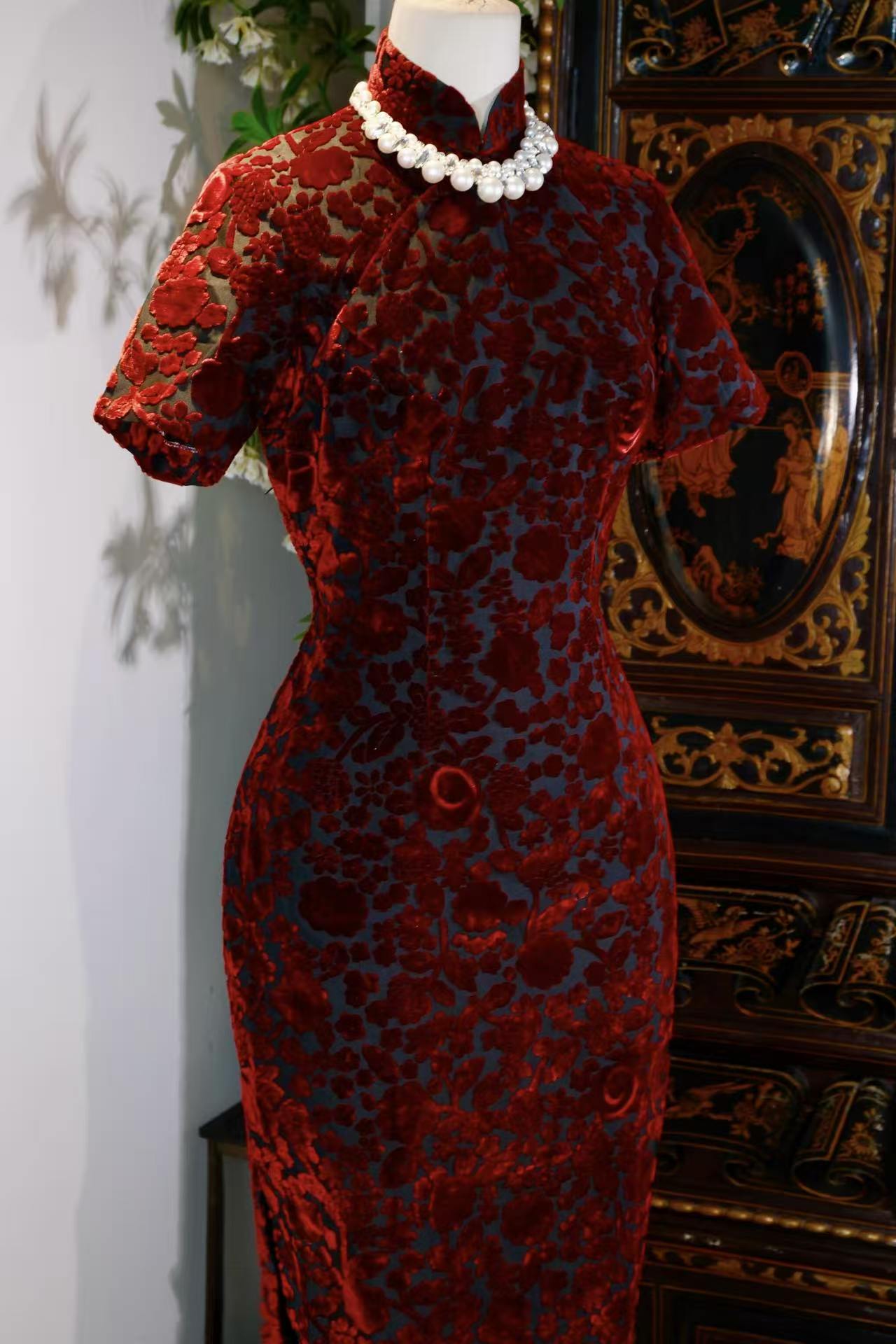
此件上世纪六十年代台湾产烧花丝绒旗袍,非仅衣裳,实为时代之诗、匠人之魂、女性之志的织物载体。其面料以“烧花”绝技雕琢——丝绒底布经热力或化学蚀刻,绒毛局部脱落,形成凹凸如浮雕的花卉纹样,再辅以立体玫瑰与缠枝牡丹,层次分明,光影流转,恍若织锦入梦。图案布局疏密有致,既承清代“富贵不断头”之吉祥寓意,又融1960年代台湾“新中式”对自然主义与女性曲线的礼赞,是传统与现代在布料上的温柔和解。
从服装史观之,此袍乃“海派改良”在台湾的在地化结晶。1949年后,江浙裁缝携上海旗袍之收腰、高开衩、立领东渡,结合本地气候与审美,发展出更轻盈、更注重肌理与装饰的风格。烧花丝绒因工艺繁复、成本高昂,多用于重要场合或定制礼服,存世稀少,尤以保存完好者更为珍贵,堪称“可穿的文物”。
《礼记·深衣》云:“古者深衣,盖有制度,以应规、矩、绳、权、衡。”此旗袍虽非古制,却以现代剪裁回应传统“合度”精神——立领挺括如松,腰线收束如柳,下摆微张如莲,既显身段之柔美,亦藏仪态之端庄。其红黑配色,暗合《周礼·考工记》“赤与黑,玄纁之色也”,象征尊贵与庄重;丝绒之温润光泽,则如《楚辞·招魂》所言“纂组绮缟,结琦璜些”,尽显织物之华美与匠心。
此衣不仅是一件衣裳,更是一段历史的织物注脚:它承载着迁徙者的乡愁、匠人的技艺、时代的审美,以及女性在动荡年代中对自我表达与尊严的坚持。今日观之,犹可触摸那个年代的体温与呼吸——是艺术,是文物,更是活着的文化记忆。
Measurements / Size Guide:
Bust / Waist / Hips: 90/74/94 cm
Total Length: 120 cm
Detailed Description:
This burnout velvet qipao produced in Taiwan during the 1960s of the last century transcends its classification as an article of clothing to stand as a definitive textile carrier of generational poetry, artisan soul, and female ambition. Its fabric chassis is sculpted through the absolute mastery of the "burnout" technique—where the velvet ground fabric undergoes thermal or chemical etching to cause localized pile dissolution, generating raised and recessed floral motifs resembling reliefs, further augmented by three-dimensional roses and winding peony branches to establish distinct structural layers and shifting illumination that feels like woven brocade entering a dreamstate. The compositional layout of the patterns is perfectly balanced in density, simultaneously inheriting the auspicious classical metaphor of "endless prosperity and continuous lineage" (富贵不断头) from the Qing Dynasty, while integrating the mid-1960s Taiwanese "New Chinese Style" celebration of naturalism and female curves—marking a gentle reconciliation between tradition and modernism upon the textile ground.
Appraised under costume history metrics, this garment stands as the localized crystallization of the "Shanghai-style modified qipao" (海派改良) within Taiwan. Post-1949, custom tailors from the Jiangsu and Zhejiang regions traveled east across the strait to Taiwan, bringing along the characteristic waist reduction, high side-slits, and standing collars of the Shanghai qipao; by fusing these elements with local climatic conditions and aesthetic preferences, they developed a lighter style that placed greater emphasis on textile texture and decoration. Because burnout velvet demanded highly complex processing methods and immense manufacturing costs, it was heavily reserved for prominent social functions or custom haute couture, rendering surviving specimens exceptionally scarce and making those preserved in flawless state uniquely valuable—operating effectively as "wearable cultural relics."
The Book of Rites · Deep Robes records: "In antiquity, the deep robes strictly followed internal structural rules, aligning precisely with the compass, the square, the plumb-line, and the balance." Although this qipao departs from ancient structural templates, it relies on modern pattern drafting to answer the traditional spirit of "appropriate measure" (合度)—the standing collar remains crisp and upright like a pine tree, the waist line is drawn tight like a slender willow branch, and the lower hem opens subtly like a lotus blossom, simultaneously magnifying the fluid grace of the physique while anchoring an absolute dignity of posture. Its crimson-and-black color pairing covertly aligns with the text The Rites of Zhou · Artificers' Record: "Crimson and black correspond to the shades of the heavens and the earth," symbolizing ultimate nobility and solemn gravity; meanwhile, the warm, muted luster of the velvet pile mirrors the lines from The Verses of Chu · Summons of the Soul: "Woven ribbons and patterned white silks, adorned with exquisite jade ornaments," completely manifesting the magnificent luxury and deep artisan devotion of the textile.
This garment functions not merely as an article of clothing, but as a tangible textile footnote to a historical timeline: it archives the deep nostalgia of a migrated population, the technical lineage of master craftsmen, the aesthetic lens of a generation, and the fierce insistence of women on self-expression and human dignity during a transformative era. Gazing upon it today, one can still physically touch the bodily warmth and respiration of that timeline—it operates as a work of fine art, a historical relic, and a living piece of cultural memory.