深圳溯源
Couldn't load pickup availability
衣服尺寸:
胸围/腰围/臀围:// 厘米
衣长: 厘米
细节描述:
【器物考据:经纬里的东西方交响】
此件旗袍,乃上世纪五十年代(1950s)之遗珍。彼时,香港作为远东时尚之都,正经历着“海派”与“西式”剪裁的激烈碰撞与完美融合。这件作品便是那个黄金时代的缩影——它虽产自香港裁缝之手,其面料却源自遥远的意大利。这种“意产港制”的组合,在当时的高端定制界极为罕见,象征着战后全球化贸易初兴时的奢华与精致。
【纹样赏析:暗夜繁花,流光溢彩】
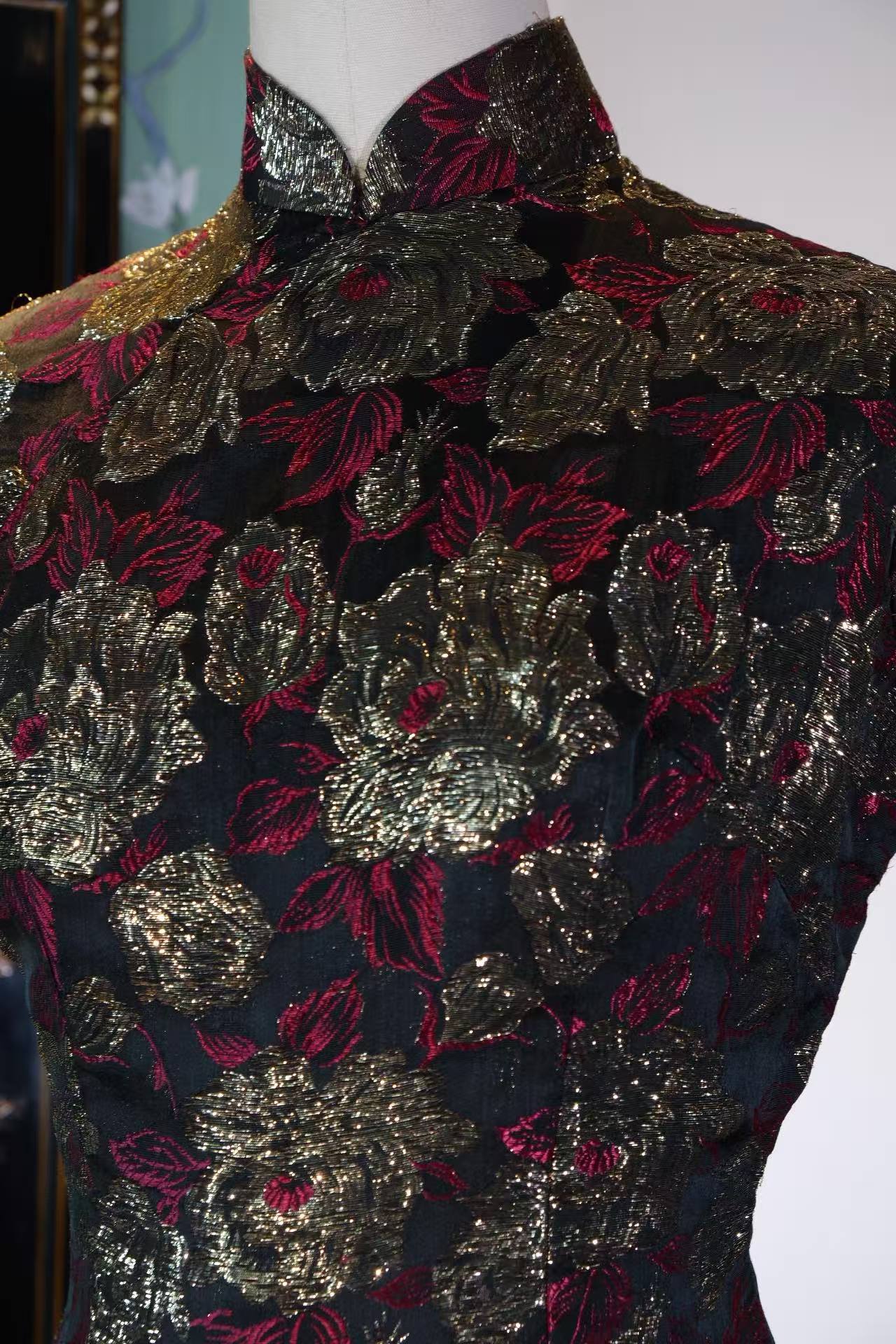
观其衣身,宛如步入一座夜光下的秘密花园。
- 底色: 选用深邃如墨的黑色底料,沉稳而神秘,如同中国水墨画中的留白,为后续的绚烂提供了极致的衬托。
- 提花工艺: 采用了极高难度的织金提花技术。金色的丝线并非简单的平织,而是通过复杂的经纬交织,呈现出浮雕般的立体感。在光影流转间,金线闪烁,似流动的液态金属。
- 花卉图案: 主体纹样为盛开的牡丹与缠枝莲叶。牡丹雍容华贵,花瓣层层叠叠,以暗金与古铜色交织,尽显“国色天香”之态;穿插其间的叶片则以酒红色(Burgundy)丝线勾勒,红黑金的三色搭配,既有西方巴洛克艺术的浓烈张力,又不失东方古典的端庄雅致。这种配色方案,既避免了纯金色的俗艳,又打破了黑色的沉闷,极具视觉冲击力。
【形制之美:中西合璧的黄金时代】
从形制上看,这是一件标准的五十年代改良旗袍。
- 立领与盘扣: 保留了传统的高耸元宝领,紧贴颈部线条,含蓄而禁欲,彰显东方女性的内敛气质。
- 西式剪裁: 然而,视线向下,则是完全西化的立体剪裁。收腰极度明显,省道(Darts)的运用使得衣物如同第二层皮肤般贴合身体曲线,胸、腰、臀的比例被修饰得淋漓尽致。这种“东方的领,西方的身”,正是张爱玲笔下那个“各各都是乱世佳人”的年代特有的审美——既要有传统的骨相,又要有现代的皮囊。
【文化互文:锦衣夜行,岁月鎏金】
《诗经·秦风》有云:“锦衣狐裘,颜如渥丹。”古人对于华美衣饰的追求,从未停止。而这件旗袍,恰似现代版的“锦衣”。它不仅是一件衣服,更是一段被封存的历史。
在五十年代的香港,能穿上这样一件意大利进口面料制成的旗袍的女子,非富即贵,或是当时社交场上的名媛。她或许曾在某个灯火辉煌的舞厅里,伴随着周璇的歌声翩翩起舞;或许曾在某个午后的茶餐厅里,优雅地端起一杯奶茶。那酒红色的叶片,像是陈年的红酒,醉人而迷离;那金色的花朵,像是旧时光里的荣耀,永不褪色。
【稀缺性综述:不可复制的孤品】
随着时间的推移,这种重工织金面料因保存难度大(金线易氧化、断裂),且当年的产量本就稀少,如今能见到品相如此完好、光泽依旧的古董旗袍,实属凤毛麟角。市面上的仿制品往往只得其形,难具其神——那种经过七十年岁月沉淀后,面料自然泛出的温润光泽与厚重质感,是任何现代工业流水线都无法复刻的艺术瑰宝。
结语:
这不仅是一件衣裳,更是一首穿在身上的诗,一段关于美、关于时间、关于东西方文化交融的永恒记忆。收藏它,便是收藏了一段流金岁月。
Measurements / Size Guide:
Bust / Waist / Hips: / / cm
Total Length: cm
Detailed Description:
This archival garment stands as a magnificent, pristine survivor from the 1950s. During this mid-century chapter, Hong Kong operated as the premier fashion capital of the Far East, experiencing an intense, brilliant collision where traditional Haipai (Shanghai-style) craftsmanship met post-war Western structural pattern-drafting. This specific piece is the ultimate monument to that golden era: while it was custom-engineered by the hands of an elite Hong Kong master tailor, the textile itself was sourced from historic mills in Italy. This rare "Italian canvas, Hong Kong construction" alliance represents the pinnacle of luxury commerce at the dawn of the post-war global trade renaissance.
To gaze upon the canvas of this qipao is to step into a nocturnal, secret sanctuary. The composition balances dark mystery with high-relief metallurgy through three core artistic choices:
The Foundation Ground: The background utilizes a deep, matte jet-black textile. Functioning much like the deliberate negative space (liubai) in an ancestral Chinese ink washing, this endless black provides the ultimate high-contrast stage for the brilliant, shimmering motifs surfacing above it.
The Architecture of the Brocade: The textile relies on an incredibly complex woven gold brocade (织金 / metal-weft jacquard) technique. The golden threads bypass simple flat weaving; instead, they are driven by intricate warp-and-weft intersections to create a sculptural, high-relief three-dimensional density. Under shifting artificial lights, the metallic threads refract continuously, mimicking the behavior of liquid gold flowing across the anatomy.
The Botanical Iconography: The primary motifs feature majestic peonies (mudan) interlaced with winding lotus foliage (chanzi lian). The opulent peony petals—symbolizing sovereign beauty and moral wealth—are rendered in a sophisticated blend of antique gold and deep bronze threads. Winding between them, the leaves are sharply outlined in a rich, saturated burgundy red silk thread. This tri-tone palette (black, gold, and wine-red) delivers the intense, emotional tension of Western Baroque art while safeguarding the immaculate composure of Eastern classicism.
Examined through the strict framework of pattern archaeology, this garment stands as a textbook specimen of the 1950s modernized, improved qipao (gailiang qipao):
| Structural Component | Design Lineage & Technical Execution | Cultural Metaphor |
| The Mandarin Neckline | High-standing, stiffly interlined Yuanbao collar (yuanbao ling) with matching hand-turned frog closures (pankou). It fits tightly against the neck geometry. | Traditional Eastern restraint, modesty, and aristocratic poise. |
| The Bodice Architecture | Complete integration of Western three-dimensional darting (se省). Deep bust and waist darts contour the textile tightly against the figure. | Post-war Western modernity; a celebration of the anatomical hourglass silhouette. |
This seamless synthesis—an ancestral Eastern collar anchoring a westernized, sculptured body—is the definitive physical manifestation of the mid-century era famously captured in Eileen Chang's literature. It honors a classic, historical skeleton while housing a completely modern, confident spirit.
The ancient Book of Songs (Shijing) famously muses: "Clad in magnificent embroidered silk robes over fine fox furs, her countenance radiates like unblemished cinnabar." The pursuit of sublime wearable art has always been an ideological sanctuary for the connoisseur. This 1950s specimen stands as the absolute mid-century reincarnation of that historic jinyi (splendid silk apparel).
In the high society of 1950s Hong Kong, a woman capable of commissioning a custom qipao from imported Italian metallic brocade belonged to the absolute socioeconomic elite. One can easily visualize this piece cutting through the ambient light of a glamorous ballroom, moving in perfect rhythm to a nostalgic jazz melody, or resting elegantly inside a mid-century teahouse. The burgundy silk foliage carries the deep weight of an aged vintage wine, while the golden blossoms freeze the glory of a bygone era, refusing to let it fade into the fog of time.
Within the global connoisseurship community, a 1950s heavy-weight woven gold qipao of this caliber occupies a realm of extreme scarcity due to distinct preservation and industrial parameters:
The Miracle of Conservation: Textiles incorporating true metallic wires are notoriously volatile historical artifacts. Over seven decades, the metal wefts are hyper-susceptible to catastrophic oxidation, tarnish blackening, and brittle structural wire fracture. For this piece to survive with its structural framework completely unwarped and its gold-and-bronze luster entirely unblemished is an extraordinary anomaly that speaks to decades of immaculate custodial care.
The Extinction of Vintage Metallurgy: Modern commercial reproductions rely almost exclusively on superficial synthetic plastic coatings or high-speed digital printing. They can mechanically mimic the superficial layout, but they completely lack the physical weight, internal organic drape, and structural depth of mid-century Italian loomed yardage. It remains an irreplaceable artistic treasure that cannot be duplicated by contemporary industrial assembly lines.
This Italian-woven, Hong Kong-engineered qipao is far more than an article of historic dress; it is an epic poem written in the language of silk and metallic geometry. It stands as a timeless, tactile monument documenting the golden intersection of cross-cultural trade, master craftsmanship, and the everlasting dignity of a magnificent generation. To hold it is to hold a segment of history preserved in gold.