鎏金岁月:民国廿年真丝烧花丝绒Art Deco兔毛裙考
一、衣上钱潮:烧花丝绒的“富贵图腾”
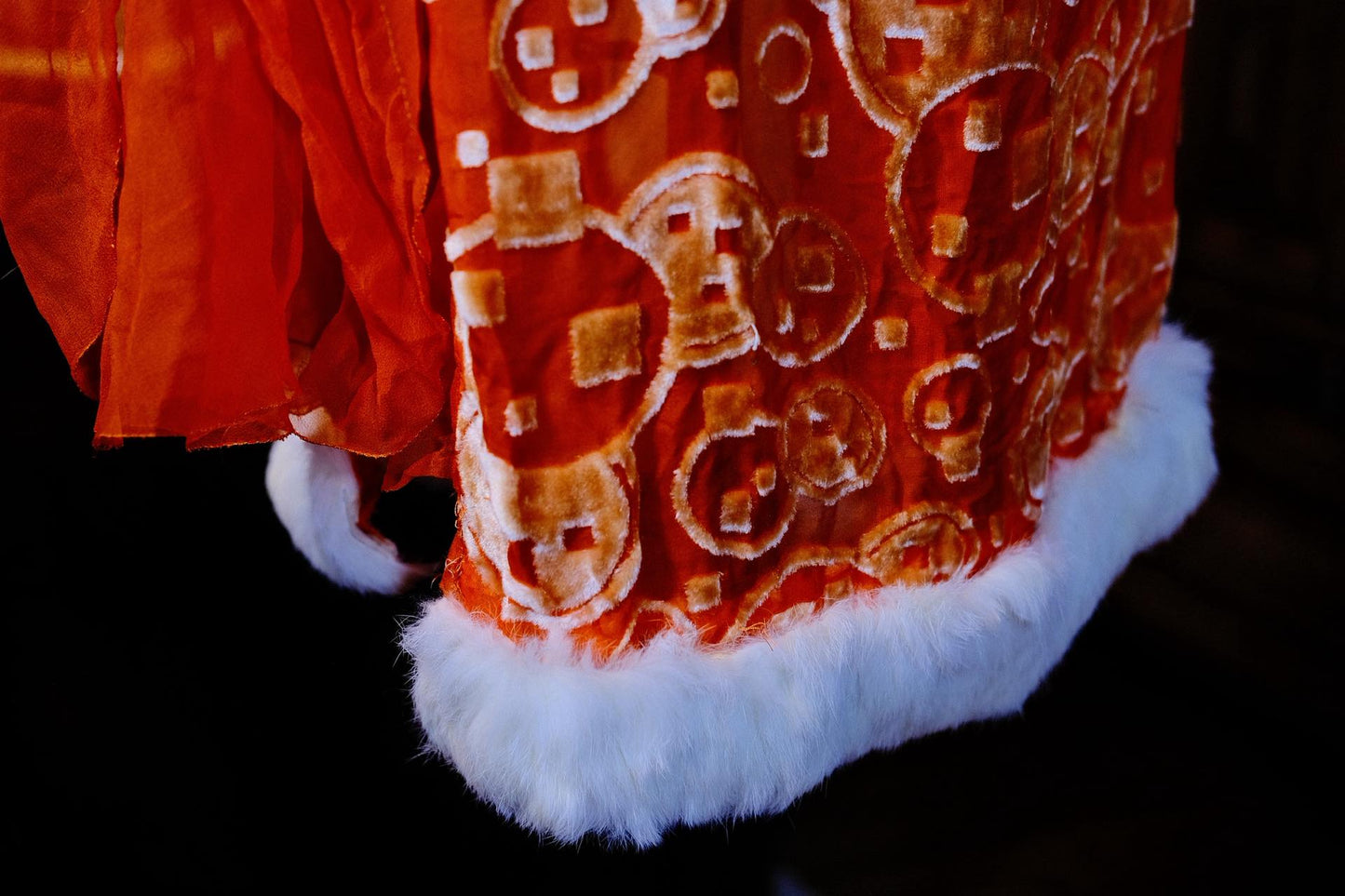
这件民国二十年代的真丝烧花丝绒裙,以“鎏金岁月”之姿,将Art Deco的几何美学与东方“富贵”图腾凝于经纬。裙身采用橙色真丝烧花丝绒,经纬间闪烁着“鎏金溢彩”的暖光——不同于普通丝绒的柔滑,这种烧花工艺需以“化学蚀刻”之法,在丝绒表面蚀出“铜钱纹”的镂空图案,恰合《长物志》“宁古无时,宁朴无巧”的造物哲学。
裙摆的兔毛皮,以“雪绒”之态点缀,每一根兔毛都需匠人以“千针万线”的耐心,将兔毛的柔软与丝绒的挺括完美融合,形成“刚柔并济”的视觉张力。正如《诗经》所言“有匪君子,如金如锡,如圭如璧”,此裙将丝绒的暖与兔毛的软熔于一炉,成就“衣以载道”的奢华诗篇。
二、百年旧梦:从温哥华唐人街到蒙特利尔“鎏金之夜”
此裙的主人,正是前文所述加拿大“老钱”家族的闺秀。二十年代,她或许在蒙特利尔的“鎏金之夜”舞会上,以此裙搭配前文的纯银编织连衣裙惊艳四座:橙色丝绒的暖光衬得她肤色胜雪,兔毛皮的柔软随步伐轻扬如“雪绒飘落”,侧边的水钻胸针在灯光下闪烁如“星河倒挂”。
三、艺术孤品:Art Deco的“东方富贵”
此裙的珍稀,在于它是Art Deco运动的“东方富贵”孤本。全球存世的民国烧花丝绒裙不足百件,而“真丝烧花丝绒+兔毛皮+Art Deco铜钱纹”的组合,更是孤品中的孤品。烧花丝绒需江南织造局“以丝为骨,以绒为肉”的织造技艺,兔毛皮则需中国皮匠“以毛为墨,以针为笔”的缝制功夫,二者结合,成就了“衣以载道”的跨文化杰作。
四、稀缺性:跨文化的“衣冠孤本”
此裙的“铜钱纹”,是Art Deco与东方“富贵”文化的“跨文化对话”。几何化的铜钱纹,以“回纹”的变体呈现,既呼应了西方Art Deco的“几何美学”,又以“东方式吉祥图案”重构了传统纹样的野性。裙摆的兔毛皮,借鉴了西方1920年代的“皮草美学”,却又以“东方式柔软”保留了传统皮草的优雅感。
五、结语:穿在身上的“鎏金岁月”
当指尖拂过裙摆的兔毛皮,仿佛能触摸到百年前蒙特利尔的“鎏金岁月”——那是Art Deco的冷艳,是东方“富贵”的温润,是加拿大“老钱”家族在异域的荣光与隐忍。
Gilded Years: A Study of a Republic of China Year 20 (1930s) Silk Devoré Velvet Art Deco Dress with Rabbit Fur
I. Wealth Tides Upon the Garment: The "Opulent Totem" of Devoré Velvet
This silk devoré (burnout) velvet dress from the 1920s and 1930s takes the posture of "gilded years," condensing the geometric aesthetics of Art Deco and the traditional Eastern totem of "wealth and opulence" within its warp and weft. The body of the dress utilizes an orange silk devoré velvet, with a warm light of "flowing gold and overflowing colors" shimmering through its threads. Distinct from the smooth softness of ordinary velvet, this devoré craftsmanship requires a "chemical etching" method to eat away portions of the pile, creating openwork patterns of "copper coin motifs." This perfectly aligns with the design philosophy from The Treatise on Superfluous Things (Chang Wu Zhi): "Rather antique than fashionable; rather simple than artful."
The rabbit fur at the hem is embellished like "soft snow." Each strand of fur requires the artisan's immense patience through "thousands of stitches and lines" to flawlessly merge the softness of the rabbit fur with the crisp structure of the velvet, forming a visual tension of "strength tempered with gentleness." Just as The Book of Songs (Shi Jing) states, "Elegant is our lord, like gold and tin, like sceptre and mace," this dress melts the warmth of velvet and the softness of rabbit fur into one furnace, achieving a luxurious poetic masterpiece where "the garment carries the culture."
II. Century-Old Dreams: From Vancouver's Chinatown to Montreal's "Gilded Night"
The owner of this dress was precisely a lady from the aforementioned Canadian "old money" family. In the 1920s and 1930s, she might have stunned the crowd at a "Gilded Night" gala in Montreal, pairing this dress with the previously mentioned pure silver woven dress: the warm glow of the orange velvet making her skin appear as fair as snow, the softness of the rabbit fur swaying gently with her steps like "falling snow," and the rhinestone brooch on her side shimmering under the chandeliers like an "inverted galaxy."
III. Artistic Masterpiece: The "Eastern Opulence" of Art Deco
The rarity of this dress lies in its status as a unique "Eastern opulence" chronicle of the Art Deco movement. Fewer than a hundred devoré velvet dresses from the Republic of China era survive worldwide, and the combination of "silk devoré velvet + rabbit fur + Art Deco copper coin motifs" makes this a unique piece among unique pieces. The devoré velvet required the craftsmanship of the Jiangnan Weaving Bureau "using silk as the bone and velvet as the flesh," while the rabbit fur required the stitching skills of Chinese furriers "using fur as ink and the needle as a pen." The fusion of these two elements achieves a cross-cultural masterpiece where "the garment carries the culture."
IV. Scarcity: A Cross-Cultural "Unique Fashion Chronicle"
The "copper coin motif" of this dress is a "cross-cultural dialogue" between Art Deco and the Eastern culture of "wealth and prosperity." The geometric copper coin patterns are presented as a variation of the traditional "fret pattern" (huiwen). This not only echoes the "geometric aesthetics" of Western Art Deco but also reconstructs the wildness of traditional patterns as an "Eastern auspicious motif." The rabbit fur at the hem draws inspiration from the "fur aesthetics" of the Western 1920s, yet retains the elegance of traditional fur through its "Eastern softness."
V. Conclusion: "Gilded Years" Worn on the Body
When fingertips brush across the rabbit fur of the hem, it feels as though one can touch the "gilded years" of Montreal from a century ago—reflecting the cold glamour of Art Deco, the warm softness of Eastern "opulence," and the glory and forbearance of a Canadian "old money" family in a foreign land.