深圳溯源
Couldn't load pickup availability
衣服尺寸:
胸围/腰围/臀围/衣长:104/104/116/112 厘米
细节描述:
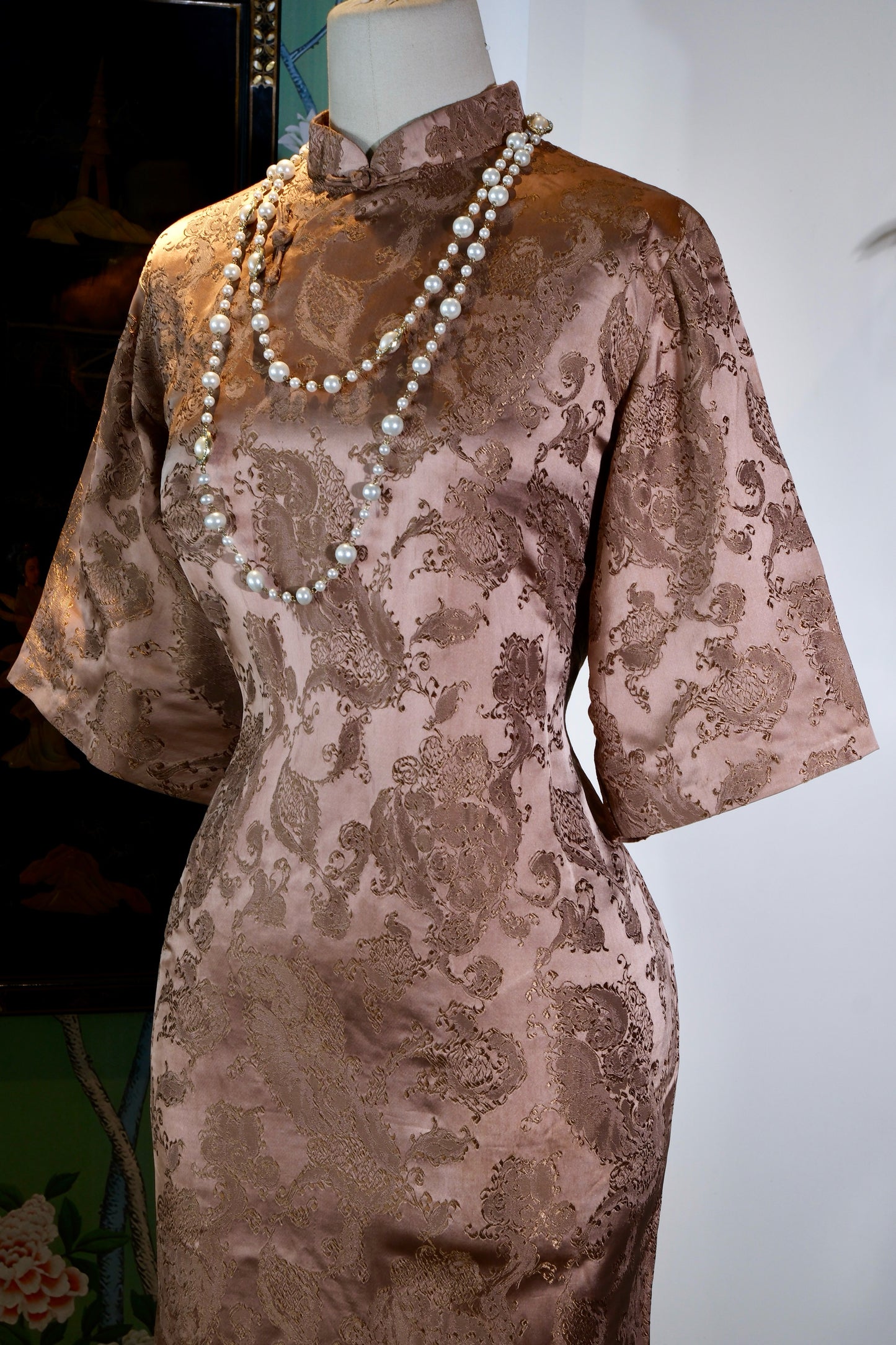
【器物描述:云纹织金,流光溢彩】
此件旗袍,乃上世纪六十年代台湾精工之作。观其面料,选用上等提花缎,色泽呈现出一种极为罕见的“古铜玫瑰金”。这种色调介于沉稳的青铜与柔美的胭脂之间,既有岁月的沉淀感,又不失女性的温婉。
衣身通体织有繁复而华丽的缠枝莲纹与如意云头纹交织的图案。
- 纹样解析: 细看之下,提花工艺精湛绝伦。花纹并非印染,而是通过经纬线的交织浮沉显现,具有极强的立体感。图案中隐约可见凤凰栖梧之态,辅以卷草纹样,寓意“凤穿牡丹”或“吉祥如意”。这种纹样布局疏密有致,随着光线的流转,缎面上的花纹若隐若现,宛如云雾流动,正应了古人所云:“织为云外秋雁行,染作江南春水色。”
- 剪裁形制: 此时的旗袍剪裁已趋于成熟立体,采用了西式省道(Darts)技术,完美贴合人体曲线。立领高度适中,既保留了东方的含蓄,又修饰了颈部线条;袖长至肘部,袖口微敞,露出了女性纤细的小臂,尽显优雅。
【历史回响:宝岛风华与离乱乡愁】
这件旗袍诞生于1960年代的台湾,那是一个特殊的历史切片。
彼时,随国民政府迁台的大批江浙裁缝与纺织工匠,将上海滩“海派旗袍”的精髓带到了宝岛,并与当地的审美及有限的物资条件相结合,孕育出了独特的“台式旗袍”风格。不同于上海的极度奢华张扬,六十年代的台湾旗袍在保留精致工艺的同时,多了一份内敛与书卷气。
这件提花缎旗袍,极可能出自当时台北城中某位名媛或知识女性之手。在那个物质尚不丰裕的年代,这样一匹重工提花缎面是极其珍贵的。它或许曾被珍藏在樟木箱底,只在最重要的宴会、婚礼或家族聚会时才被取出穿上。它见证了那个时代女性在传统与现代、东方与西方文化碰撞中的挣扎与融合——她们穿着最传统的丝绸,谈论着最新的文学与自由。
【艺术价值与稀缺性:寸锦寸金,孤品难寻】
从学术角度审视,此件藏品具有极高的研究价值与稀缺性:
1. 工艺的断代绝响: 这种老式提花缎(Brocade)的织造工艺极其复杂,需要老式木机或早期铁木机手工辅助织造。随着工业化化纤面料的普及,这种厚重、挺括且透气性极佳的天然丝织提花面料已近乎失传。现代机器生产的仿缎,往往光泽贼亮且缺乏筋骨,无法复刻此种“哑光奢华”的质感。
2. 色彩的时光包浆: 这种独特的古铜粉色调,是当年特定染料与丝线氧化后形成的自然包浆。它不是现在的化学染色所能模拟的,这是时间赋予的“色泽”。
3. 文献佐证: 张爱玲在《更衣记》中曾写道:“对于不会说话的人,衣服是一种语言,随身带着的是袖珍戏剧。”这件旗袍,就是那出戏剧的道具。它不仅是服装史的实物标本,更是那个流金岁月的缩影。
【结语】
这不仅是一件旗袍,这是一段被封存的锦绣年华。它静默无言,却用那一针一线、一经一纬,诉说着六十年代东方女性独有的风骨与柔情。对于收藏家而言,得此一件,便是留住了一段不可复制的历史风华。
Measurements / Size Guide:
Bust / Waist / Hips / Total Length: 104/104/116/112 cm
Detailed Description:
This qipao is a piece of fine craftsmanship from 1960s Taiwan. Examining its material, it utilizes superior-quality jacquard satin, presenting a remarkably rare "Bronze Rose Gold" hue. Situated between a grounded bronze and a soft carmine, this palette embodies both the settled depth of age and gentle female grace.
The entire garment is woven with an intricate, sumptuous pattern interlacing interlocking lotus sprigs with auspicious ruyi cloud-head motifs.
Motif Analysis: Upon close inspection, the jacquard weaving technique is extraordinary. The patterns are not printed; rather, they emerge through the floating and sinking of warp and weft threads, exhibiting a strong three-dimensional relief. Within the motif, one can faintly discern a phoenix perched among parasol trees, complemented by scrolling vine patterns that suggest "phoenix threading through peonies" (feng chuan mudan) or "auspicious good fortune." The density of the layout is beautifully balanced; as light shifts across the surface, the motifs on the satin reveal and conceal themselves like drifting fog, echoing the ancient poet's line: "Woven like autumn geese flying beyond the clouds, dyed to the color of spring waters in Jiangnan."
Tailoring and Silhouette: The tailoring of the qipao during this period had matured toward a three-dimensional form, adopting Western-style darting (Darts) to fit the human silhouette. The high standing collar is moderate in height, preserving Eastern restraint while framing the neckline; the sleeves extend to the elbows with slightly widened cuffs, revealing a woman's slender forearms to express pure elegance.
Born in 1960s Taiwan, this qipao represents a unique historical slice of time.
During that era, a large wave of Jiangnan tailors and textile artisans relocated to Taiwan, transplanting the core essence of Shanghai-style (Haipai) qipao craftsmanship onto the island. Blending with local aesthetics and the material conditions of the time, they cultivated a distinct "Taiwanese-style qipao" aesthetic. Unlike the extreme opulence and flair of Shanghai, Taiwanese qipao designs of the 1960s maintained exquisite craftsmanship while embracing greater composure and literary refinement.
This jacquard satin qipao was very likely crafted for a local socialite or intellectual woman in Taipei. In an era when material goods were not overly abundant, a bolt of heavy jacquard satin was immensely precious. It might have been preserved in the bottom of a camphor chest, brought out only for the most significant banquets, weddings, or family gatherings. It witnessed women of that era navigating the collision and fusion between tradition and modernity, East and West—wearing traditional silks while conversing about contemporary literature and freedom.
Examined from an academic perspective, this collectible holds exceptionally high research value and scarcity:
An Extinct Milestone in Craftsmanship: The weaving of this traditional jacquard satin (Brocade) was immensely complex, requiring vintage wooden looms or early iron-and-wood machinery with manual assistance. With the widespread adoption of industrial synthetic fabrics, this heavy, structured, yet highly breathable natural silk jacquard textile has become nearly extinct. Modern machine-made imitations often exhibit a harsh, cheap glare and lack structural integrity, unable to replicate this quality of "matte luxury."
The Patina of Time in Color: This unique bronze-pink tone is a natural patina formed by specific dyes and the slow oxidation of silk threads over decades. It cannot be simulated by modern chemical dyeing; it is a "tone" granted strictly by time.
Literary Footnote: Eileen Chang famously observed in Reflections on Clothing (更衣记): "For those who cannot speak, clothes are a language, a pocket theater carried upon the body." This qipao is precisely a prop from that pocket theater. It stands not only as a physical specimen of fashion history, but as a miniature portrait of a golden era.
This is far more than a qipao; it is a frozen slice of splendid youth. Silent and serene, it speaks through every stitch, every warp, and every weft, telling of the unique character and tenderness of 1960s Eastern women. For a collector, acquiring such a piece is to preserve an unrepeatable chapter of history.