深圳溯源
Couldn't load pickup availability
衣服尺寸:
胸围/腰围/臀围:84/62/90 厘米
衣长:145 厘米
细节描述:
【卷首语】
张爱玲曾言:“衣服是一种言语,随身带着一种袖珍戏剧。”在服装史的浩瀚长河中,上世纪六十年代的台湾旗袍,恰似一首婉约而坚韧的宋词,既承袭了海派文化的摩登余韵,又在宝岛的温婉风土中生长出独特的端庄与雅致。今日所呈这件出自“佳美高级旗袍”的织锦缎古董旗袍,不仅是一件衣物,更是一段被封存的流金岁月。
一、 纹样考释:金丝银线里的东方美学
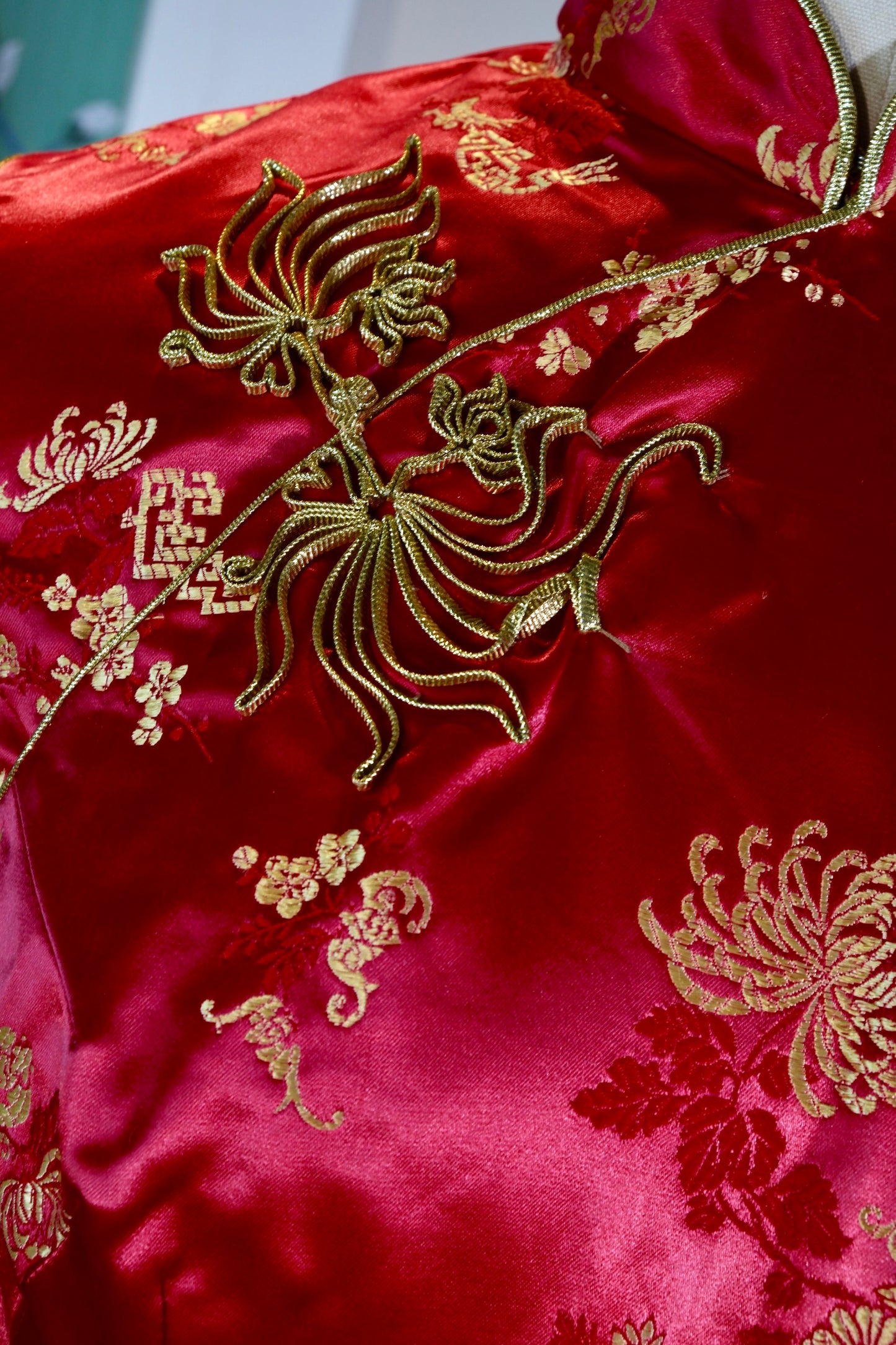
此衣面料选用经典的玫红地织锦缎。在中国传统色彩学中,“红”乃正色,象征吉祥与生命力;而织锦缎以其质地紧密、色泽华丽著称,是清代宫廷至民国名媛皆趋之若鹜的奢华面料。
细观其纹样,可谓“图必有意,意必吉祥”:
- 主纹饰: 通身遍布金色的缠枝菊纹与梅花纹。菊花,花之隐逸者也,傲霜斗雪,象征着高洁与长寿;梅花则是“岁寒三友”之首,寓意坚韧不拔。二者交织,暗合了六十年代女性在时代变迁中柔韧自持的精神内核。
- 边饰: 领口、袖口及滚边均采用金色编织绳滚边,线条利落,勾勒出旗袍修长的轮廓,尽显“S”型曲线的曼妙。
二、 史海钩沉:台南“佳美”与海岛风华
标签上赫然印着“佳美高级旗袍,台南市”字样,这不仅仅是一个商标,更是那个时代台湾裁缝业黄金岁月的见证。
上世纪五六十年代,随着国民政府迁台,大量江浙沪的裁缝师傅将精湛的“海派”技艺带到了台湾。台南作为台湾的历史文化古都,保留了浓厚的传统文化底蕴。不同于台北的快节奏,台南的旗袍制作往往更注重手工的温度与传统的坚守。“佳美”二字,寄托了当时人们对美好生活的朴素向往——“佳”为美好,“美”为圆满。
这件旗袍诞生于那个特殊的年代,它见证了从传统长衫向现代时装过渡的最后辉煌。那时的女子,身着这般挺括的织锦缎旗袍,穿梭于老宅深院或繁华街市,每一步摇曳生姿,都是对东方女性韵味最生动的注脚。
三、 艺术风格与稀缺性:不可复制的时光孤品
1. 剪裁的艺术:
此衣采用了典型的六十年代改良剪裁。相较于早期的宽大平直,此时的旗袍更强调人体工学,收腰极尽贴合,下摆开衩适度,既保留了东方的含蓄,又展露了女性的曲线美。无袖设计(或削肩)在当时颇为前卫,展现了女性手臂的线条之美,透气且干练。
2. 材质的绝唱:
真正的老式织锦缎,因其复杂的提花工艺和高成本的桑蚕丝原料,在现代工业化生产中已难觅踪迹。如今的仿制品虽有色泽,却少了那份经过岁月沉淀后的温润光泽与厚重手感。这件旗袍历经六十载光阴,缎面依然紧致,金线未显黯淡,实属保存得当的奇迹。
3. 稀缺价值:
正如《诗经》所云:“岂曰无衣?与子同袍。”古董衣之所以珍贵,在于其不可再生性。它是那个时代审美、工艺与社会风貌的综合载体。市面上流通的六十年代台湾产原品旗袍,尤其是带有清晰老字号标签且品相如此完好者,已是凤毛麟角。它不仅适合收藏家置于玻璃柜中细细把玩,更适合懂它的雅士在重要场合穿着,让历史在身上复活。
【结语】
锦衣夜行,明珠蒙尘,皆是憾事。这件来自台南“佳美”的红色织锦缎旗袍,是一封写给过去的情书。它等待着下一位主人,用体温唤醒沉睡的金丝,续写那段关于美丽与优雅的传奇。
Measurements / Size Guide:
Bust / Waist / Hips: 84/62/90 cm
Total Length: 145 cm
Detailed Description:
As Eileen Chang famously remarked in her essay Chronicle of Changing Clothes: "Clothes are a language, a pocket theater carried around with oneself." In the vast river of costume history, the Taiwanese qipaos of the 1960s operate precisely like a subtle yet resilient Song dynasty poem—inheriting the modernist, lingering elegance of the traditional Shanghai style (海派) while developing a unique sense of poised dignity and refinement within the gentle, warm landscape of the island enclave. This antique brocade qipao, bearing the archival label of "Jiamei High-End Qipao" (佳美高级旗袍), transcends its primary utility as clothing, serving as a beautifully preserved capsule of a bygone golden era.
The material base of this specimen selects a classic rose-red ground brocade. Within traditional Chinese color theory, this rich crimson operates as a principal hue, symbolizing auspicious fortune, vitality, and celebration. Brocade yardage of this high caliber has long been celebrated for its high structural density and magnificent surface sheen, operating historically as a luxury textile coveted by imperial Qing courts and modern Republican elite madams alike.
Close inspection of the pattern layout reveals a disciplined commitment to the ancestral principle of design: "Every motif carries a definition, and every definition must be auspicious."
The Primary Botanical Configuration: The entire body of the qipao is densely overlaid with gold loomed scrolling chrysanthemum matrices interwoven with plum blossom sprigs. The chrysanthemum, celebrated historically as the hermit of the botanical world, withstands the harsh frost to symbolize high integrity, purity, and longevity. The plum blossom stands proud at the head of the "Three Friends of Winter," representing unyielding resilience. The convergence of these two distinct botanical elements beautifully mirrors the resilient, self-contained character championed by mid-century women navigating a shifting societal horizon.
The Structural Edge Trim: The Mandarin collar, armscye contours, and diagonal lapel side-slits are securely bound using a specialized gold woven cord trim. This execution yields clean, sharp lines that map out the long, elegant silhouette of the qipao, projecting the dramatic S-curve profile to perfection.
The woven maker's mark on the interior lining clearly reads: "Jiamei High-End Qipao, Tainan City" (佳美高级旗袍,台南市). This is far more than a vintage commercial trademark; it functions as physical proof of the golden age of the Taiwanese custom tailoring sector.
During the 1950s and 1960s, custom tailors migrated south from Jiangsu, Zhejiang, and Shanghai, bringing their peak, elite Shanghainese tailoring techniques directly into the Taiwanese fashion ecosystem. As the historic cultural capital of Taiwan, Tainan retained a deeply rooted commitment to ancestral traditions and classical refinement. Distanced from the rapid, industrial rhythm of Taipei, the custom qipao ateliers of Tainan placed immense emphasis on the warmth of slow handcraft and the preservation of ancestral methods. The characters for Jiamei embody a pure, honest aspiration for an ideal lifestyle—Jia denoting exceptional quality and refinement, while Mei represents structural completion and harmony.
Born within that unique socio-industrial window, this qipao bears silent witness to the final, magnificent twilight when traditional long robes fully transitioned into modern global fashion. Women of that generation, clad in this crisp, structural brocade qipao, moved through historic courtyard properties and cosmopolitan city blocks alike. Every single step and sway of their silhouettes served as a living, highly expressive footnote to Eastern grace.
This specimen adopts a classic 1960s modified structural framework. Compared to the wide, flat, and straight rules characteristic of earlier historical eras, pattern drafting during this window placed immense emphasis on human anatomy and ergonomic balance. The waist reduction is drawn in exceptionally tight to trace the body contours precisely, while the lateral side-slits terminate at a highly disciplined height, balancing Eastern modesty with the natural curves of the female form. The modern sleeveless design (approaching a cutaway shoulder) was deeply progressive for its day, exposing the clean lines of the arm while projecting a dry, capable, and efficient cosmopolitan poise.
Authentic, old-school brocade yardage—relying on immensely complex jacquard loom setups and high-cost silk filaments—has almost completely vanished from contemporary commercial textile manufacturing lines. Modern synthetic reproductions may mimic the surface coloration, but they lack the settled, warm matte depth and heavy, substantial hand-feel that only natural fibers and time can bestow. Spanning a sixty-year natural horizon, the satin face of this qipao remains exceptionally tight, and the gold loomed filaments display no visible atmospheric tarnishing—a true miracle of pristine conservation.
As the classical verse from The Book of Songs notes: "How can you say you have no clothes? I will share my robes with you," celebrating the deep, communal bond forged through shared garments. The definitive preciousness of an authentic antique garment resides in its absolute non-renewable nature; it operates as a complex physical carrier of the aesthetics, handcraft, and social landscape of a highly specific historical moment. Surviving 1960s Taiwanese custom qipaos circulating on the open market—most notably those carrying clear, verified heritage brand marks and preserved in such unblemished structural integrity—are an absolute rarity. It transcends a static museum artifact sealed behind glass, waiting instead for a discerning custodian to step into its matrix, awakening the sleeping gold threads with human warmth to continue its elegant narrative.
Fine apparel left in darkness and precious pearls masked by dust represent a profound tragedy. This crimson brocade qipao from Tainan’s historic "Jiamei" atelier is a love letter written directly to the past. It awaits its next true custodian, ready to breathe fresh life into its ancestral weave and continue the timeless legend of peerless Eastern glamour.
Suyuan Archival Textile Registry — Documenting the material culture, preserving the technical lineage of ancestral craft.