深圳溯源
Couldn't load pickup availability
衣服尺寸:
胸围/腰围/臀围:86/70/92 厘米
衣长:90 厘米
细节描述:
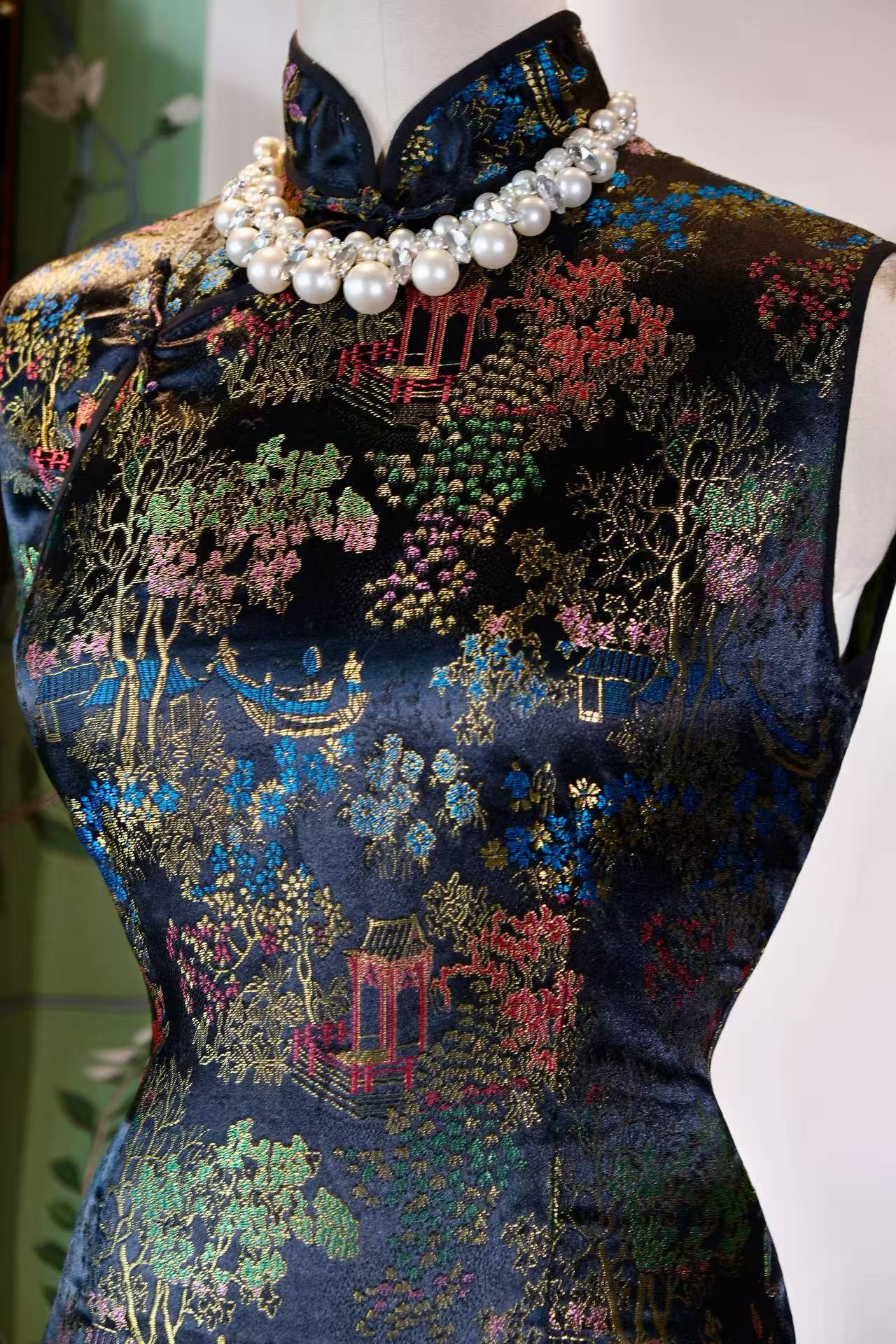
在时光的褶皱里,总有一些织物承载着超越服饰本身的意义——这件上世纪六十年代香港产的古香缎旗袍,便是如此。它以深蓝为底,如夜幕垂落,却以金线为骨、彩丝为魂,在寸缕之间织就了一幅“人在画中游”的东方长卷,让六十年前的香江风华,在今日的凝视中悄然苏醒。
一、古香缎:织就“通景山水”的非遗密码
这件旗袍的面料,正是中国丝绸史上的瑰宝——古香缎。作为宋锦技艺的活态传承,古香缎以“通经断纬”的复杂织造工艺著称,需在提花机上以多色纬线交替穿梭,方能织出层次丰富的图案。其纹样多取材于传统山水、园林、人物,讲究“图必有意,意必吉祥”,而这件旗袍的图案,恰是古香缎“通景式构图”的典范:
- 山水园林的诗意铺陈:从领口至下摆,亭台楼阁错落其间,朱红栏杆、青瓦飞檐掩映在苍松翠柏与粉樱紫藤之间,仿佛将苏州园林的“移步换景”凝缩于方寸。水面以蓝缎为底,金线勾勒出粼粼波光,一叶扁舟载着垂钓者悠然划过,舟旁芦苇轻摇,与岸边垂柳相映成趣,恰如《长物志》所言:“一峰则太华千寻,一勺则江湖万里”。
- 四季花卉的时空交响:图案中,春之桃、夏之荷、秋之菊、冬之梅并非按季节分区,而是以“四季同框”的手法交织绽放,既暗合“岁岁常欢愉”的吉祥寓意,又以色彩的冷暖对比(如粉桃与蓝荷、金菊与紫藤)营造出视觉的韵律感。尤其值得关注的是,花卉与建筑的比例刻意打破写实,亭台仅盈寸,花木却参天,这种“以小见大”的构图,正是中国传统绘画“散点透视”的织造转化。
- 金线的叙事力量:古香缎的灵魂在于“金”。此件旗袍以金线勾勒树干、建筑轮廓与波纹,不仅让图案在深色底料上跃然而出,更赋予织物一种“低调的奢华”——金线并非平铺直叙的亮泽,而是因年代沉淀而泛出温润的哑光,如古画上的金箔,历经岁月却愈发沉静。
二、港产旗袍:殖民语境下的文化坚守
彼时的香港,东西方文化激烈碰撞,旗袍却成为华人女性身份认同的“文化盔甲”。与上海旗袍的“海派摩登”不同,港产旗袍在保留传统工艺的同时,更添几分“在地性”:
- 剪裁的微妙革新:此件旗袍采用无袖设计,领口较传统旗袍略低,腰部收省更为贴合,既保留了“S型”曲线的东方审美,又融入了西式剪裁的利落,恰如张爱玲笔下“传统的中国女性,在西洋文明的冲击下,不得不学会‘暴露’自己的曲线”。
- 面料的在地选择:六十年代的香港,丝绸进口受限,古香缎这类本土织造的提花缎成为名媛贵妇的首选。其厚重的质地与挺括的手感,既能抵御亚热带潮湿气候,又能在舞会、宴席等场合彰显身份——正如亦舒在《喜宝》中所写:“香港女人的旗袍,是穿给镜子看的,也是穿给世界看的。”
三、稀缺性:不可复制的“织物孤本”
在工业化成衣泛滥的今天,这件古香缎旗袍的稀缺性,不仅在于其年代,更在于其“不可复制性”:
- 工艺的濒危:古香缎织造需依赖传统木机与熟练织工,而能掌握“通景山水”复杂纹样设计的匠人,在六十年代后已日渐稀少。如今市面上的“古香缎”多为机器仿品,纹样呆板、金线生硬,远不及这件手工织物的灵动。
- 保存的奇迹:真丝织物易受虫蛀、霉变,而这件旗袍历经六十年仍色泽鲜亮、纹样清晰,可见原主人对其珍视程度。领口处的珍珠项链(虽为搭配道具,却暗合六十年代港式审美)与旗袍的深蓝底色形成冷暖对比,更添一份“旧时王谢堂前燕”的贵气。
- 文化的断层:六十年代后,旗袍逐渐退出日常穿着,古香缎这类传统面料也随之式微。这件旗袍不仅是服饰,更是一部“穿在身上的历史”——它见证了香港从转口港到国际都市的转型,也承载了华人女性在时代变迁中对文化根脉的坚守。
结语:当织物成为时光的容器
抚摸着这件旗袍上的亭台楼阁,仿佛能听见六十年代香港夜总会里的爵士乐,看见穿着它的太太们在浅水湾的夕阳下浅笑。古香缎的经纬之间,织入的不仅是丝线与金箔,更是一个时代的风华、一种文化的韧性。它不是博物馆里的标本,而是仍在呼吸的“活历史”——当现代女性穿上它,便如同与六十年前的自己对话,在传统与现代的交织中,续写着东方美学的永恒篇章。
“一件古董衣的价值,不在于它有多旧,而在于它能让你看见多少故事。”这件古香缎旗袍,便是这样一位沉默的叙事者,等待懂它的人,为它续写新的传奇。
Measurements / Size Guide:
Bust / Waist / Hips: 86/70/92 cm
Total Length: 90 cm
Detailed Description:
Within the folds of time, certain textiles carry a historical resonance that transcends the boundaries of mere apparel. This 1960s Hong Kong-made Gu-Xiang satin Qipao is a definitive case in point. Using a deep midnight navy as its foundation—resembling the velvet drop of night—it deploys metallic gold threads as its structural bones and multicolored silk yarns as its living soul. Across every inch of its fibers, it engineers an epic Eastern panoramic scroll where "the observer wanders inside a painting," allowing the vanished splendor of mid-century Victoria Harbour to quietly awaken under contemporary contemplation.
[I. Gu-Xiang Satin: Deciphering the Intricate Heritage of "Scenic Landscapes"] The fabric of this piece represents a crown jewel in the history of Chinese silk weaving—genuine Gu-Xiang satin. As a living scion of ancestral Song Dynasty brocade techniques, Gu-Xiang satin is celebrated for its punishingly complex structural weaving matrix, requiring multi-colored weft threads to alternate with absolute synchronization on manual jacquard looms to achieve its kaleidoscopic depth. Its iconography draws heavily from traditional shanshui landscapes, classical gardens, and historical figures, adhering strictly to the aesthetic rule: "every motif carries a precise conceptual intent, and every intent signals a sublime benediction." The layout of this Qipao stands as a pristine textbook manifestation of Gu-Xiang satin’s legendary "panoramic composition" (Tongjingshi Goutu):
The Poetic Layout of Classical Gardens: From the mandarin collar down to the hem, pavilions and courtyards cascade in deliberate architectural layers. Vermilion balustrades and slate-gray tiled eaves emerge and submerge amidst twisting pines, weeping willows, blooming peaches, and purple wisterias—compressing the fluid, "step-by-step landscape transformation" (Yibu Huanjing) of Suzhou gardens into a compact sartorial space. The water surfaces utilize the deep navy ground as liquid shadows, while metallic gold threads contour glistening wave ripples. A solitary skiff carrying an elderly angler glides serenely across the weave, flanked by swaying reeds and weeping willows, perfectly capturing the philosophical quote from the Ming Dynasty text Treatise on Superfluous Things (Chang Wu Zhi): "A single peak invokes the thousand-fathom majesty of Mount Hua; a solitary ladle of water encapsulates the myriad miles of rivers and lakes."
The Temporal Symphony of Four-Season Florals: Within this composition, the blossoms of spring (peach), summer (lotus), autumn (chrysanthemum), and winter (plum) bypass seasonal chronologies to bloom simultaneously within a single, unified canvas. This juxtaposition satisfies the auspicious traditional blessing of "eternal joy across all seasons" while capitalizing on sharp thermal palette contrasts (such as blush peach against cool azure lotus, or metallic chrysanthemum against amethyst wisteria) to engineer a magnificent visual rhythm. Crucially, the scaling of florals against architecture deliberately subverts literal realism: the pavilions measure barely an inch, while the flora towers toward the heavens—a brilliant weaving translation of the "scattered perspective" (Sandian Toushi) foundational to traditional Chinese landscape painting.
The Narrative Power of Gold Threads: The ultimate soul of Gu-Xiang satin resides in its "gold." This Qipao weapons metallic gold threads to contour tree trunks, architectural profiles, and shifting aquatic ripples, allowing the motifs to leap dramatically out of the deep dark ground while cloaking the garment in an ethos of "understated opulence." This gold is not a loud, reflective glare; rather, due to six decades of environmental oxidation, it has mellowed into a warm, matte patina resembling the gold leaf on ancient hand-scrolls—quiet, grounded, and deeply serene.
[II. The Hong Kong Qipao: Cultural Fortification Within a Colonial Matrix] During the mid-20th century, Hong Kong operated as a fierce crucible of East-West cultural collision, yet the Qipao morphed into a vital "cultural armor" safeguarding Chinese identity. Distinct from the overt, commercialized "Shanghai Modern" style, Hong Kong-made Qipaos maintained uncompromising traditional craftsmanship while absorbing a highly localized, progressive edge:
The Nuanced Evolution of Pattern-Making: This specific specimen implements a sleek, sleeveless blueprint paired with a mandarin collar engineered slightly lower than its ancestral Republican precedents. The waist darts are aggressively tailored to contour a highly precise "S-curve" silhouette—preserving the marrow of Eastern bodily aesthetics while seamlessly absorbing the crisp, streamlined precision of Western tailoring. It beautifully mirrors Eileen Chang’s famous observation: "Under the impact of Western civilization, the traditional Chinese woman was compelled to learn how to 'expose' the authentic architecture of her own silhouette."
Localized Material Choices: In 1960s Hong Kong, raw silk imports faced strict regulatory constraints, positioning locally woven luxury jacquards like Gu-Xiang satin as the absolute premier choice among elite tai-tais and high-society socialites. Its substantial weight, structural crispness, and rigid hand-feel not only naturally resisted the humid sub-tropical climate but stood as an absolute declaration of status at elite galas and balls. As the legendary Hong Kong author Yi Shu poignantly penned in The Story of Xi Bao: "A Hong Kong woman’s Qipao is cut for the mirror, but it is worn for the world."
[III. Deciphering Rarity: An Unrepeatable "Weaving Archive"] In a contemporary marketplace saturated by industrialized mass-production, the rarity of this Gu-Xiang satin Qipao transcends its temporal classification; it is an absolute, unrepeatable archival monument:
The Extinction of the Technique: The authentic weaving of Gu-Xiang satin relies entirely on ancestral wooden looms and master artisans possessive of generational muscle memory. Master craftsmen capable of mapping out the staggering structural blueprint of a "panoramic garden landscape" became exceptionally scarce after the late 1960s. Contemporary textiles sold under the moniker of "Gu-Xiang Satin" are almost exclusively computerized synthetic imitations defined by flat, rigid patterns and harsh, metallic wires that lack the living, breathing organic fluidity of this manual specimen.
A Miracle of Preservation: Natural silk textiles are notoriously vulnerable to insect degradation and mold. That this Qipao has successfully traversed sixty winters while preserving its vibrant color registration, razor-sharp motif boundaries, and structural crispness stands as a magnificent testament to the profound adoration of its original custodian.
The Historical Chasm: By the turn of the 1970s, the Qipao systematically exited daily urban wardrobes, driving traditional luxury textiles like Gu-Xiang satin into near-total commercial extinction. This garment is far more than an item of luxury apparel; it is a piece of "wearable history"—chronicling Hong Kong’s macro-transformation from a colonial entrepôt into a global financial powerhouse, while anchoring the fierce cultural tenacity of Chinese women holding fast to their ancestral roots.
Epilogue: When Textiles Become the Vessels of Time Gazing upon the pavilions and courtyards woven across these fibers, one can almost catch the distant drift of mid-century jazz floating out of a 1960s Hong Kong supper club, or glimpse the silhouettes of elegant matriarchs sharing a laugh beneath the sunset of Repulse Bay. Within the warp and weft of this Gu-Xiang satin lies woven not merely silk filaments and gold foils, but the definitive grace of an epoch and the resilient spine of a culture. It is not a petrified specimen locked inside a museum vitrine; it is a living, breathing history. When a contemporary woman steps into its structure, she enters into a profound monologue with sixty years of her own heritage, continuing the eternal chronicle of Eastern aesthetics right at the intersection of tradition and the modern world.
"The ultimate value of an antique garment resides not in its age, but in the sheer volume of history it allows you to see." This Gu-Xiang satin Qipao stands as that exact silent narrator, patiently waiting for the custodian who understands its language to author its next magnificent chapter.