深圳溯源
Couldn't load pickup availability
衣服尺寸:
胸围/腰围/臀围/衣长:94/80/100/115 厘米
细节描述:
【器物综述】
这是一件极具断代研究价值的上世纪六十年代香港产古董旗袍。它不仅是彼时“中西合璧”服饰文化的实物标本,更是一件将抽象表现主义艺术穿在身上的孤品。其深藏青底色上肆意挥洒的撞色笔刷纹样,配合精工细作的传统盘扣,完美诠释了那个时代香港女性既恪守东方韵味,又拥抱现代文明的独特审美。
一、 纹样考释:当水墨遇上波普
这件旗袍最引人入胜之处,在于其面料图案的革新性。
不同于传统旗袍惯用的牡丹、凤凰或几何回纹,此衣采用的是典型的“抽象笔刷纹”。这种纹样深受20世纪50-60年代西方抽象表现主义的影响,仿佛是画家在画布上随性涂抹的油彩痕迹。
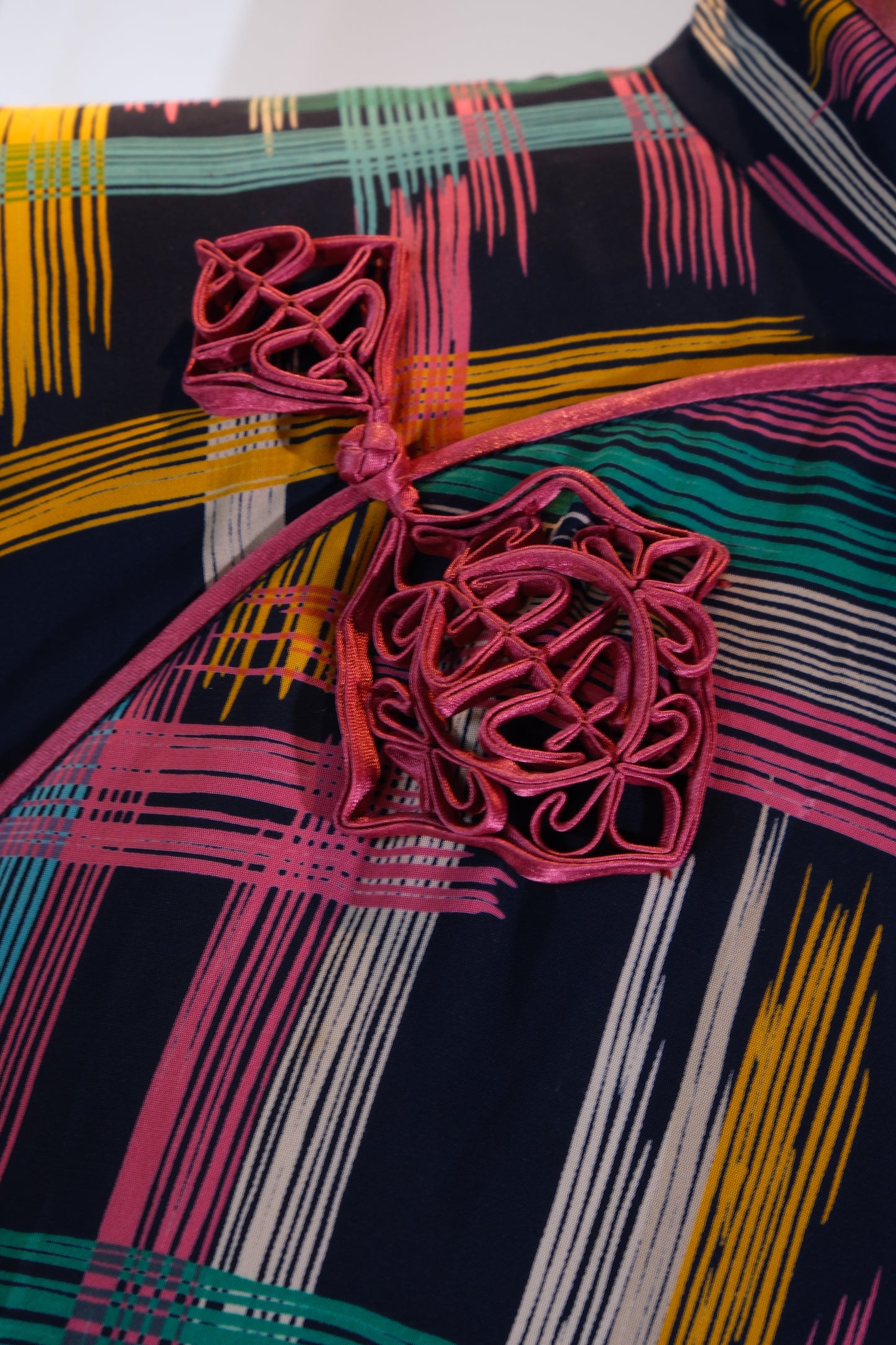
* 色彩美学: 设计师大胆运用了高饱和度的洋红、明黄、翠绿与天蓝,在深沉的藏青色底布上进行强烈的视觉冲撞。这种配色方案在当时被称为“摩登色”,打破了传统配色的含蓄,充满了都市生活的活力与躁动。
* 构图逻辑: 线条并非规整的经纬交织,而是呈现出一种动态的、不规则的交错感。横竖斜向的笔触如同城市夜晚交错的霓虹光影,又似雨后街头斑驳的倒影。这种“乱中有序”的视觉效果,极具现代构成主义的美感。
二、 工艺细节:坚守传统的匠心
尽管面料图案极度西化,但这件旗袍在形制与工艺上依然保留了纯正的中式基因,体现了“中学为体,西学为用”的设计哲学。
* 立领与滚边: 领口采用了经典的元宝领设计,高度适中,修饰颈部线条。领口、袖笼及大襟处均采用了精细的滚边工艺,起到了极好的勾勒与提亮作用,使整体轮廓更加立体。
* 如意盘扣: 请注意那枚精致的双如意盘扣。这是整件衣服的灵魂所在。在如此现代、狂野的面料上,工匠依然坚持使用繁复的传统手工盘扣。这枚盘扣色泽红润,造型饱满,不仅起到了固定衣襟的功能性作用,更是一种文化符号的宣示——无论外表如何摩登,内在的东方骨相未曾改变。
三、 历史语境:六十年代香江的流金岁月
要读懂这件旗袍,必须回到20世纪60年代的香港。
那是一个特殊的转型期。二战后的香港经济腾飞,受到西方文化(尤其是电影、时尚杂志)的强烈冲击。当时的香港名媛与职业女性,不再满足于传统丝绸的温婉,她们渴望一种能表达自我个性、适应快节奏都市生活的服装。
这件旗袍正是那个时代的产物。它很可能出自当时香港中环或尖沙咀某家高档裁缝店之手。那时的裁缝师傅们不仅精通传统剪裁,更敏锐地捕捉到了国际流行趋势,将西方的印花布料引入中式剪裁。穿着这样一件旗袍的女性,或许正走在去往写字楼的路上,或是准备出席一场鸡尾酒会。她自信、独立,眼中闪烁着对未来的憧憬。
四、 学术评价与收藏价值
张爱玲曾在《更衣记》中写道:“对于不会说话的人,衣服是一种语言,随身带着的是袖珍戏剧。”
这件六十年代的抽象笔刷旗袍,就是一出精彩的“袖珍戏剧”。
1. 稀缺性: 由于此类高饱和度化纤或混纺面料随着时间推移极易褪色或脆化,能像这件一样保存完好、色泽依然鲜亮的实物凤毛麟角。
2. 艺术性: 它是服装史中“现代主义”风格的典型代表,见证了旗袍从“传统礼服”向“现代时装”演变的关键节点。
3. 文化价值: 它不仅是一件衣服,更是一段关于东西方文化碰撞、融合的历史记忆。
结语:
这不仅是一件可供赏玩的古董衣,更是一把打开六十年代香江风华的钥匙。它静默无言,却用最绚烂的色彩,讲述着那个黄金时代的摩登往事。对于真正的藏家而言,拥有的不仅是一袭华服,更是一段不可复制的时光。
Measurements / Size Guide:
Bust / Waist / Hips / Total Length: 94/80/100/115 cm
Detailed Description:
This is an antique Hong Kong-made qipao from the 1960s that holds immense value for chronological dating research. It serves not only as a physical specimen of the "East-meets-West" clothing culture of that era, but also as a unique piece of wearable abstract expressionist art. The uninhibited contrast-color brushstroke pattern splashed across a deep navy blue background, paired with meticulously crafted traditional frog closures, perfectly defines the unique aesthetic of Hong Kong women of that time—who firmly upheld Eastern charm while fully embracing modern civilization.
The most captivating aspect of this qipao lies in the revolutionary nature of its fabric pattern.
Departing from the peonies, phoenixes, or geometric fret patterns (huiwen) commonly seen on traditional qipaos, this garment features a classic "abstract brushstroke pattern." Deeply influenced by Western abstract expressionism of the 1950s and 1960s, this motif looks as though a painter spontaneously smeared oil pigments across a canvas.
Color Aesthetics: The designer boldly used highly saturated colors—magenta, bright yellow, emerald green, and sky blue—to create a powerful visual clash on the deep navy blue ground fabric. Known as "modern colors" at the time, this palette broke away from the modesty of traditional color schemes and was filled with the vitality and restlessness of urban life.
Composition Logic: The lines are not woven in a neat warp-and-weft grid, but instead present a dynamic, irregular interlacing feel. The horizontal, vertical, and diagonal brushstrokes resemble the intersecting reflections of neon lights in the city at night, or mottled reflections on a street after rain. This visual effect of "order within chaos" possesses a distinct modernist constructivist beauty.
Although the fabric pattern is extremely Westernized, this qipao retains pure Chinese genes in its form and craftsmanship, embodying the design philosophy of "Chinese learning for substance, Western learning for utility."
Standing Collar and Piping: The neckline features a classic high mandarin collar design, moderate in height, which beautifully frames the neckline. Refined piping craftsmanship is applied along the collar, armholes, and front opening (dajin), providing excellent contouring and highlights that give the overall silhouette a more three-dimensional structure.
Ruyi Frog Closures: Note the exquisite double ruyi frog closure (pankou). This is the very soul of the entire garment. On such a modern and wild fabric, the artisan still insisted on using intricate, traditional hand-crafted frog closures. This closure is rich in color and full in shape; it serves not only the functional purpose of securing the lapel, but also stands as a declaration of a cultural symbol—no matter how modern the exterior appears, the internal Eastern skeleton remains unchanged.
To truly understand this qipao, one must return to 1960s Hong Kong.
That was a unique period of transition. Following the postwar economic boom, Hong Kong experienced a powerful impact from Western culture, particularly through films and fashion magazines. Hong Kong socialites and career women of the time were no longer satisfied with the gentleness of traditional silks; they craved clothing that could express their individuality and adapt to a fast-paced urban lifestyle.
This qipao is a direct product of that era. It was highly likely crafted by a high-end tailoring shop in Central or Tsim Sha Tsui. The master tailors of that time were not only proficient in traditional cutting techniques, but were also keen observers of international fashion trends, introducing Western printed fabrics into Chinese tailoring. A woman wearing such a qipao might have been on her way to an office building, or preparing to attend a cocktail party. She was confident, independent, and her eyes shone with anticipation for the future.
Eileen Chang once wrote in Reflections on Clothing (更衣记): "For those who cannot speak, clothes are a language, a pocket theater carried upon the body."
This 1960s abstract brushstroke qipao is precisely a brilliant "pocket theater."
Scarcity: Because these highly saturated synthetic or blended fabrics are extremely prone to fading or becoming brittle over time, physical pieces that remain as well-preserved and vibrantly colored as this one are truly rare.
Artistry: It stands as a typical representative of the "modernist" style in apparel history, witnessing a key turning point in the evolution of the qipao from "traditional formal wear" to "modern fashion."
Cultural Value: It is not merely a piece of clothing, but a historical memory of the collision and fusion between Eastern and Western cultures.
This is not just an antique garment to be admired, but a key to unlocking the elegance of 1960s Hong Kong. It stands in silence, yet narrates the modern stories of that golden era through its most brilliant colors. For a true collector, what is owned is not just a beautiful piece of clothing, but an unrepeatable fragment of time.