Elegance's Swan Song of the Late 1930s: When Neoclassicism Met the Splendor of a Troubled Era
In 1939, as the gathering clouds of war first flickered across Europe, Parisian fashion salons were quietly brewing their final, peerless brilliance. This day dress (Day Dress), born in the twilight years of the 1930s, stands not merely as an epitome of shifting societal aesthetics, but as an ode within fashion history dedicated to the natural female form.
I. Silhouette: A Gentle Rebellion Against the "Straight-Cut" Line
The Jazz Age (Jazz Age) of the 1920s had aggressively flattened secondary sexual characteristics, pursuing a straight-line, tubular silhouette (Tubular Silhouette). Entering the 1930s, however, designers led by Madame Madeleine Vionnet (Madeleine Vionnet) pioneered the revival of Neoclassicism (Neoclassicism). This dress flawlessly interprets the silhouette characteristics of that period: discarding rigid underskirts and corset bindings, it deploys meticulous vertical pleating (Vertical Pleating) to allow the fabric to follow the natural contours of the body, fluidly tracing the soft curves of bust, waist, and hips.
II. Structure & Craftsmanship: Vitality Within Order
-
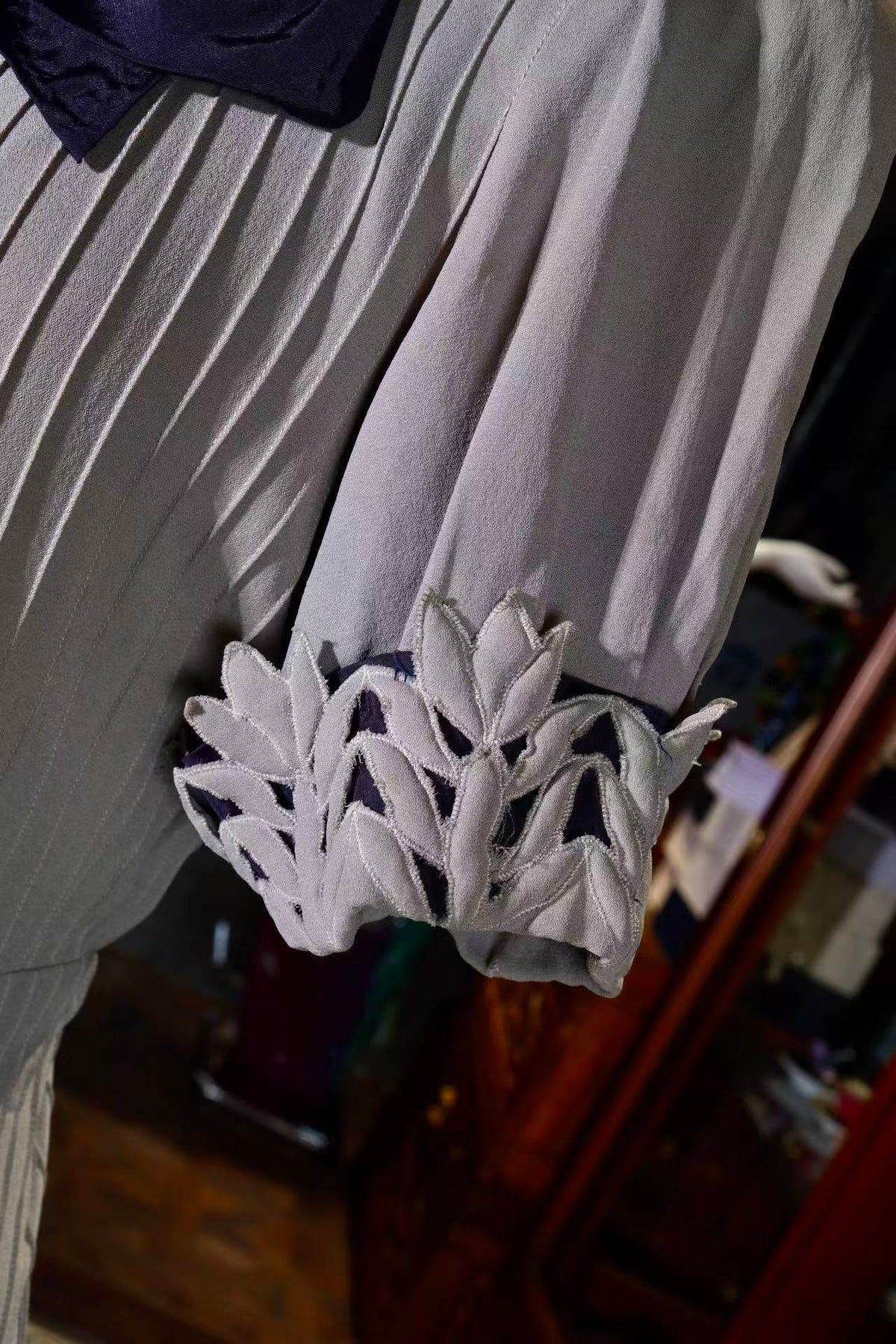
Draping and Pleating: The dense vertical pleating blanketing the entire dress not only achieves a vertical visual elongation that endows the wearer with a slender, elevated posture, but generates a rippling, wave-like cadence with every step.
-
Cuff Deconstruction: By the late 1930s, designers turned their gaze toward sleeve construction, striving to infuse gentleness with a hint of structural strength. The short sleeves of this dress incorporate intricate double-layered cutwork appliqués (Cutwork Appliqué) at the cuffs. Against a deep purple underlayer, grayish-white leaf motifs interweave to resemble wrought-iron bas-relief ornamentation, shattering monochromatic monotony while demonstrating exceptional handcraft mastery.
-
Waist Definition: A gently cinched natural waistline apportions the upper and lower proportions to perfection, terminating at mid-calf—the most decorous and appropriate daytime social skirt length of the late 1930s.
III. Embellishment: The Neoclassical "Brooch" Aesthetic
The masterstroke of the entire ensemble resides in the Art Deco (Art Deco) jeweled brooch pinned at the neckline. This crescent-shaped, diamond-encrusted brooch functions as far more than an accessory; it serves as a functional design mechanism—cleverly securing a lustrous, deep purple silk panel across the left shoulder to form an elegant jabot (Jabot). This asymmetrical neckline design simultaneously shatters classical solemnity while infusing the understated dress with a mysterious, noble aura.
Epilogue
This late-1930s day dress captures the final elegance before the breaking of the storm. Marrying the tranquil softness of a Greek goddess with the quiet yearning for solace felt by humanity amidst the Great Depression, it transcends mere tailoring to become a silent poem authored by an entire epoch on womanhood, art, and survival.