深圳溯源
Couldn't load pickup availability
衣服尺寸:
胸围/腰围/臀围:// 厘米
衣长: 厘米
细节描述:
【藏品综述】
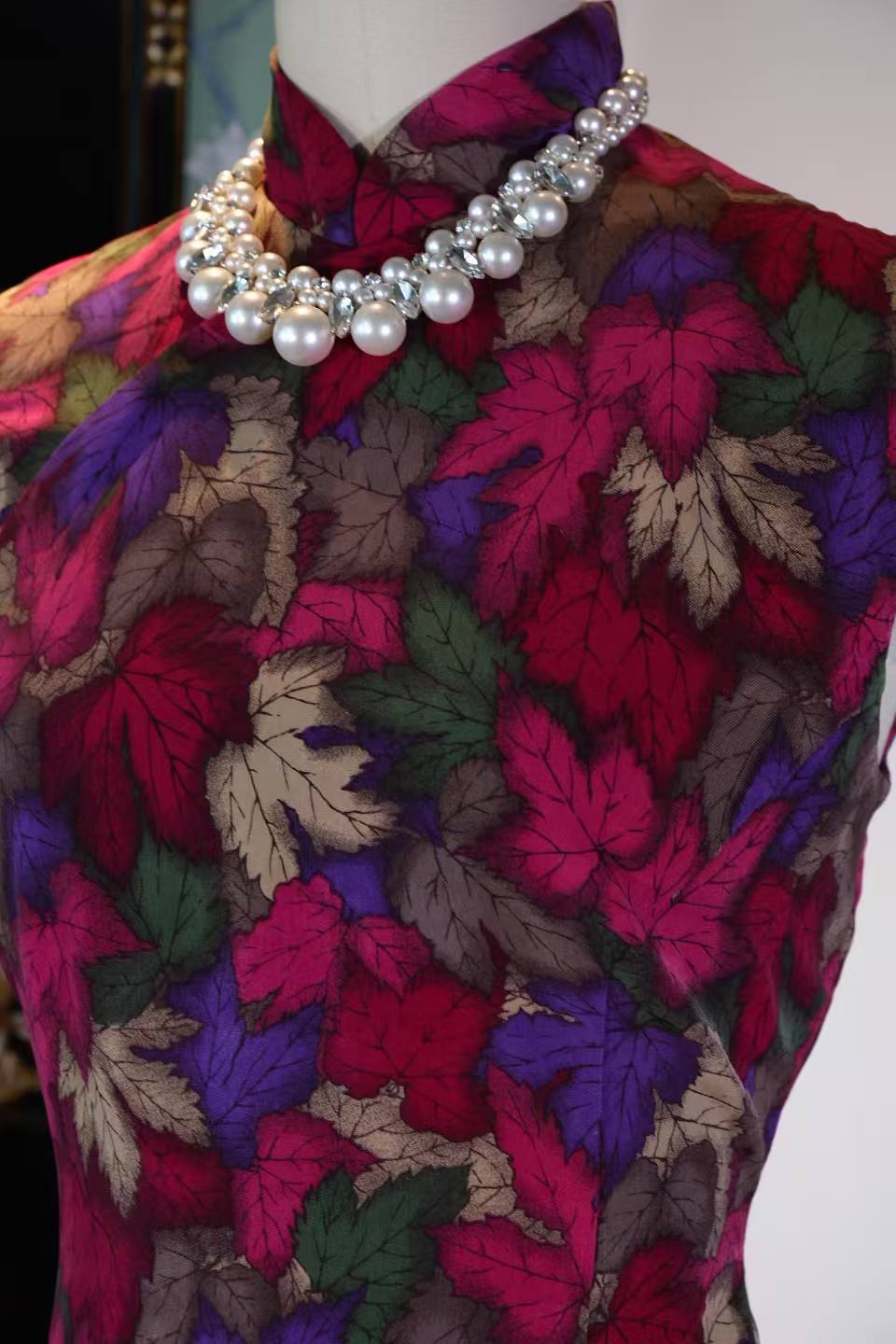
这是一件产自上世纪六十年代的香港制无袖旗袍,其最显著的特征在于面料上那极具表现主义色彩的“油画风格”彩色枫叶印花。作为服装史研究者,我将其视为香港成衣工业黄金时代的缩影——彼时的香港正处于东西方文化交汇的熔炉之中,这件旗袍便是那个摩登时代最生动的注脚。它不仅仅是一件衣物,更是一段被封存的时光,是“海派”遗风与“港式”审美碰撞出的璀璨火花。
一、 图案赏析:当东方丝绸遇上西方油彩
这件旗袍的面料设计极为大胆且罕见,完全脱离了传统旗袍中常见的牡丹、凤凰或梅兰竹菊等具象吉祥纹样,转而采用了一种极具现代感的“满地碎叶”构图。
- 色彩美学: 设计师运用了高饱和度的对比色。深邃的紫罗兰色、热烈的洋红色(Magenta)、沉稳的赭石色以及点缀其间的墨绿色,交织出一幅浓墨重彩的秋日画卷。这种配色方案带有明显的野兽派(Fauvism)绘画特征,强调色彩的情感表达而非写实。
- 笔触质感: 仔细观察叶片,你会发现它们并非平面的印染,而是模拟了油画笔触的堆叠感。叶脉的处理粗犷而有力,仿佛画家用刮刀在画布上留下的痕迹。这种将西方油画技法转译到纺织面料上的尝试,在六十年代的香港纺织界属于极高成本的工艺,旨在模仿当时流行的抽象艺术风格。
- 视觉张力: 密集的叶片铺满全身,形成一种强烈的视觉冲击力。这种“繁复之美”打破了传统旗袍留白的意境,转而追求一种热烈、奔放的生命力,正如六十年代那个躁动而充满活力的社会氛围。
二、 历史溯源:香江岁月的霓裳羽衣
要读懂这件旗袍,必须回到那个特殊的年代。
- 地缘文化的结晶: 上世纪五六十年代,大量上海裁缝与纺织精英南迁至香港,带来了精湛的“海派”剪裁技艺。与此同时,香港作为自由港,率先接触到了西方的波普艺术与抽象表现主义。这件旗袍正是这一历史进程的产物——它拥有最正统的中式立领与归拔工艺(通过湿热定型使平面布料呈现立体曲线),却披上了一件极其西化的“油画外衣”。
- 稀缺性考证: 在那个年代,此类印花面料多用于出口或供应高端百货公司(如连卡佛)。由于采用了复杂的套色印花工艺,且面料多为真丝或高品质人造丝,保存难度极大。历经六十载岁月,这件旗袍依然色泽鲜亮,无明显褪色或破损,实属凤毛麟角。它不仅是一件衣服,更是研究六十年代香港纺织印染技术与审美流变的珍贵实物史料。
三、 艺术互文:引经据典中的东方秋韵
虽然这件旗袍在视觉上深受西方现代艺术影响,但其精神内核依然是东方的。看着这满衣斑斓的枫叶,我不禁想起唐代诗人杜牧在《山行》中的千古名句:
“停车坐爱枫林晚,霜叶红于二月花。”
古人眼中的红叶,是深秋的静美与生命的顽强;而这件六十年代的旗袍,则将这份“红”演绎得更加热烈与现代。它不再仅仅是文人墨客笔下的萧瑟秋意,而是化作了都市女性身上自信、独立的宣言。
此外,这种色彩的运用也让人联想到清代李渔在《闲情偶寄》中对服饰配色的论述:“记云:‘红紫不以为亵服’。” 虽古礼有禁,但到了民国及以后的香港,这种禁忌已被彻底打破。设计师敢于将紫与红大面积并置,恰恰印证了张爱玲所言:“对于不会说话的人,衣服是一种语言,随身带着的是袖珍戏剧。” 这件旗袍,就是一出关于秋天、关于色彩、关于那个辉煌年代的无声戏剧。
四、 结语
这件六十年代香港产油画风格枫叶旗袍,以其独特的艺术语言,跨越了时间的长河。它不仅展示了那个时代工匠们高超的技艺与大胆的审美,更承载了一段不可复制的历史记忆。对于收藏家而言,拥有的不仅是一件绝美的衣裳,更是一把开启那个流金岁月大门的钥匙。
Measurements / Size Guide:
Bust / Waist / Hips: / / cm
Total Length: cm
Detailed Description:
This artifact is an immaculate, sleeveless vintage qipao custom-engineered in Hong Kong during the 1960s. Its definitive architectural feature is the highly expressive, "oil-painting style" polychromatic maple leaf print layout surfacing across the entire textile. Within the framework of costume sociology and textile archaeology, this specimen stands as a flawless micro-monument capturing the golden age of the post-war Hong Kong garment industry.
Operating at a unique geographical and political crossroads, 1960s Hong Kong functioned as a vibrant cultural crucible where traditional Haipai (Shanghai-style) craftsmanship cross-pollinated with Western post-war modernism. This garment is the physical manifestation of that modern chapter—a silent, wearable theater documenting the exact historical coordinate where ancestral heritage met an unyielding, confident global aesthetic.
The surface design of this textile represents an incredibly bold, rare departure from traditional qipao design codes. It completely bypasses literal, standard imperial motifs—such as celebratory peonies, phoenixes, or fine-line depictions of the traditional four gentlemen plants (Mei-Lan-Ju-Zhu)—shifting instead toward an avant-garde, all-over abstract motif (mandi suihua) featuring a dense matrix of scattered autumn foliage.
Fauvist Color Mechanics: The composition utilizes a palette of high-saturation, contrasting tones. Deep, moody violet, intense magenta red, grounded raw ochre, and structural accents of dark forest green interlace to build a heavy, emotionally charged autumn landscape. This palette mirrors the artistic philosophy of Fauvism, prioritizing the raw, emotional character of color over literal botanical representation.
Impasto-Imitated Tactile Weaving: Close inspections of the maple leaf boundaries reveal that they are not flat, superficial industrial prints. Instead, the textile engineering mimics the heavy, layered density of impasto oil-paint brushstrokes. The veins of the leaves are rendered with coarse, forceful momentum, replicating the structural gashes left by a painter's palette knife. Translating this specific dimensional depth onto a fluid textile grid required an exceptionally high-cost color-separation and multi-register printing methodology rare for 1960s Pan-Asian mills, specifically engineered to channel the abstract art movements dominating the era.
Visual Tension: The hyper-dense clustering of the leaves across the anatomy creates a commanding visual presence. This aesthetic of "maximalist luxury" (fanfu zhi mei) deliberately shatters the traditional Chinese art concept of negative space (liubai), replacing it with an unthrottled, radiant expression of vitality that directly reflects the restless, vibrant socioeconomic atmosphere of the 1960s.
To accurately evaluate this qipao, its construction must be examined against the specific material infrastructure of its post-war environment:
Following the mid-century migration of master tailors and textile industrialists from mainland China to Hong Kong, the colony inherited centuries of peerless ancestral pattern-drafting and specialized Gui-ba mechanics (the highly disciplined art of using localized heat and moisture to stretch and mold flat fabric into a permanent three-dimensional contour). Concurrently, as a booming global free port, Hong Kong maintained immediate commercial exposure to Western Pop Art and Abstract Expressionism. This garment is the absolute physical child of that convergence: it preserves the strict, immaculate skeleton of a traditional high mandarin collar while wrapping the body in an intensely westernized, contemporary canvas.
Furthermore, textiles of this high graphic caliber were engineered in restricted quantities, intended primarily for high-end international export or custom allocation to elite mid-century department stores like Lane Crawford. Because these organic silks or premium high-weight rayons utilize multi-layered, delicate dye chemistry, they are notoriously volatile historical artifacts. For this piece to survive over six decades with its color brilliance entirely intact, its pattern geometry unwarped, and its fibers free of structural fracturing is an extraordinary anomaly that speaks to decades of pristine custodial care. It functions not merely as dress, but as an irreplaceable primary source document for the analysis of 1960s dye methodologies and aesthetic evolutions along the Pacific Rim.
Though the superficial visual tension of this piece heavily references Western modernism, its spiritual core remains deeply anchored within classical Eastern literature. Gazing upon this sea of brilliant maple foliage instantly evokes the immortal lines of the Tang Dynasty poet Du Mu from his classic work Mountain Travel (Shan Xing):
"I stop my carriage, enamored by the maple groves at dusk; The frost-bitten leaves radiate a crimson deeper than spring's first blossoms." ——《山行》
Within ancestral text, the crimson autumn leaf operated as a symbol of serene, late-season quietude and unyielding resilience against bitter frost. This 1960s qipao, however, accelerates that classic "red" into a fiercely modern statement. It is no longer an emblem of melancholy literati isolation; it functions as a bold, confident declaration of self-assured autonomy worn proudly by the modern urban woman.
This daring color play also redefines traditional aesthetic boundaries. In his Board of Leisure treatise Casual Notes on Leisurely Living (Xianqing Ouji), the Qing Dynasty scholar Li Yu noted the historic ritual text guidelines regarding color pairings: "Ancient records state: Crimson and violet should not be utilized for informal or under-garments." While ancient societal hierarchies enforced strict boundaries between primary and secondary hues, the mid-century generation in Hong Kong completely dissolved these constraints. The designer's willingness to place intense violet directly beside hot magenta confirms the famous sociological observation of Eileen Chang:
"To those who cannot speak, clothing is a form of speech; it carries with it a pocket-sized drama."
This dress stands as precisely that—a silent, wearable theater archiving a magnificent generation's redefinition of beauty, gender autonomy, and modern identity.
This 1960s Hong Kong oil-paint style maple leaf qipao bridges the boundaries between material culture, high craft, and fine art. It showcases not only the apex of mid-century textile technology and master tailoring but guards an irreplaceable slice of transnational history. For the serious connoisseur, to hold this specimen is not merely to possess an exquisite article of historic luxury; it is to hold the definitive key to the gilded era (liujin suiyue) of a legendary modern renaissance.