深圳溯源
Couldn't load pickup availability
衣服尺寸:
胸围/腰围/臀围:88/70/94 厘米
衣长:99 厘米
细节描述:
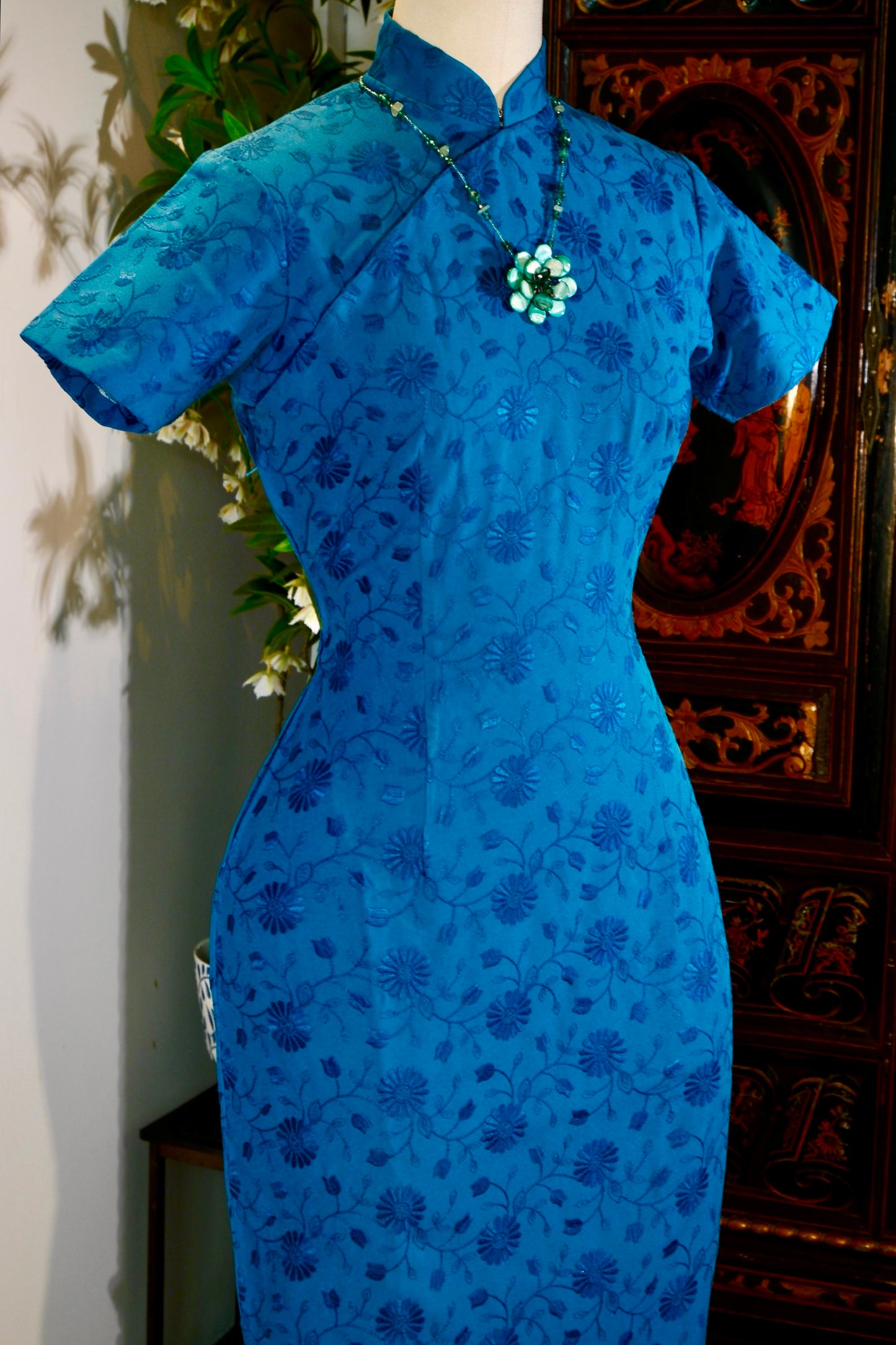
一、 图案描述:幽蓝深处的繁花绮梦
这件旗袍的视觉核心,在于那一抹深邃而静谧的“孔雀蓝”底色。它并非那种张扬刺眼的亮蓝,而是一种仿佛沉淀了时光的色泽,宛如雨后初霁的天空,又似深海之渊的宁静。
在这层幽蓝之上,工匠运用了上世纪六十年代香港精湛的机器提花与刺绣工艺,铺陈出一幅连绵不绝的花卉纹样。
- 花型考究: 仔细观察,这些花朵并非俗艳的牡丹或大朵芍药,而是更接近于雏菊(Chrysanthemum)或波斯菊的形态。花瓣层层叠叠,呈放射状舒展,花蕊处针脚细密,呈现出一种微浮雕般的立体感。这种花型在传统文化中寓意着“隐逸”与“高洁”,少了一分富贵气,多了一分文人的清雅。
- 枝叶曼妙: 连接花朵的是蜿蜒曲折的藤蔓与叶片。叶片的处理极具动感,采用了类似“打籽绣”质感的机绣手法,使得叶片在光线下呈现出细微的颗粒感和光泽变化。枝蔓交错,疏密有致,如同书法中的草书笔意,行云流水般贯穿全身,打破了深色底料的沉闷,赋予了衣物呼吸感。
- 光影流转: 这种特殊的机器绣花面料(Jacquard/Embroidery fabric),其精妙之处在于“同色异光”。底布是哑光的棉麻质感,而花纹部分则带有丝线的微弱反光。随着穿着者的走动,光线在凹凸不平的纹理间跳跃,整件衣服仿佛有了生命,波光粼粼。
二、 历史回溯:六十年代的香江裁缝街
要读懂这件旗袍,必须回到那个风云际会的年代——20世纪60年代的香港。
那是香港旗袍制作的“黄金时代”末期,也是现代工业与传统手工艺激烈碰撞并完美融合的时期。彼时,上海的一批顶尖裁缝师傅南下香江,将海派旗袍的精髓带到了香港,并与本地的审美及西方的剪裁理念相结合,形成了独树一帜的“港式旗袍”风格。
这件衣服正是那个时代的缩影。
- 剪裁的西风东渐: 观察其腰身线条,相比30年代的老式旗袍,它的收腰更加明显,胸省和腰省的处理更加立体,甚至隐约可见西式立体剪裁的影子。这种设计是为了适应当时香港女性日益活跃的社会生活和快节奏的都市步调,既端庄得体,又方便行动。
三、 艺术风格与稀缺性:引经据典的东方美学
张爱玲曾在《更衣记》中写道:“对于不会说话的人,衣服是一种语言,随身带着的是袖珍戏剧。”这件蓝色绣花旗袍,便是一出无声的折子戏。
Measurements / Size Guide:
Bust / Waist / Hips: 88/70/94 cm
Total Length: 99 cm
Detailed Description:
The visual core of this qipao resides in that singular stroke of a deep and serene "peacock blue" grounding base. Rejecting any loud or piercing bright blue, it displays a coloration that seems to have settled naturally through time—resembling a clear sky just after a rainfall, or the profound tranquility of a deep-sea abyss.
Upon this layer of hidden blue, craftsmen utilized the exquisite machine-jacquard and embroidery techniques of 1960s Hong Kong to lay out a continuous, unbroken landscape of floral motifs.
Exquisite Floral Forms: Observing closely, these blossoms reject vulgar, flamboyant peonies or oversized herbaceous peonies, leaning instead much closer to the morphology of daisies or cosmos. The petals layer over one another, spreading radially, while the embroidery stitches at the pistil remain exceptionally dense and uniform—yielding a subtle, low-relief three-dimensional presence. Within traditional culture, this specific floral form carries metaphors of "seclusion" and "noble purity," shedding a wealthy aura in favor of a scholar's elegant refinement.
Graceful Branches and Foliage: Winding, twisting vines and leaves interlace to connect the blossoms. The execution of the leaves is intensely dynamic, implementing a machine-embroidery technique that mimics the tactile quality of traditional seed stitches (Dazi embroidery), causing the foliage to display a fine grain and shifting luster under light. The branches crisscross with meticulously balanced density, flowing across the entire garment body like the fluid strokes of cursive calligraphy (Caoshu)—shattering the structural weight of the deep background fabric to grant the textile a breathing vitality.
The Interplay of Light and Shadow: The sheer genius of this specialized machine-embroidered textile (Jacquard/Embroidery fabric) lies in its "monochromatic variation of luster." The grounding chassis presents a matte, organic cotton-linen texture, whereas the patterned sections catch a faint, delicate reflection off the silken filaments. As the wearer moves, light dances across the uneven, raised textures, making the entire garment appear alive, as if rippling with soft waves.
To fully comprehend this qipao, one must travel back to that era of sweeping historical currents—the Hong Kong of the 1960s.
That timeline marked the twilight of the "Golden Age" for Hong Kong qipao fabrication, as well as an era where modern industry and traditional handicraft collided fiercely and fused flawlessly. During this window, a wave of elite master tailors from Shanghai migrated south to Hong Kong, carrying the absolute essence of Shanghai-style qipaos into the territory. They masterfully blended this heritage with local tastes and Western drafting concepts, pioneering the highly singular and distinct "Hong Kong-style qipao."
This garment stands as a definitive microcosm of that transformative decade.
The Eastward Migration of Western Tailoring: Examine the lines of the waist profile; compared to the old-school heritage templates of the 1930s, its waist reduction is significantly more pronounced. The execution of the bust darts and waist darts is vastly more three-dimensional, even offering a distinct glimpse into Western three-dimensional pattern drafting. This structural methodology was engineered specifically to adapt to the increasingly active social lives and fast-paced urban lifestyles of contemporary Hong Kong women—remaining impeccably dignified while liberating physical movement.
The celebrated author Eileen Chang once penned in her essay Chronicle of Changing Clothes: "To those who cannot speak, clothes are a language; what one carries with them is a pocket drama." This blue embroidered qipao operates precisely as a silent, beautifully staged operatic vignette.