深圳溯源
Couldn't load pickup availability
衣服尺寸:
胸围/腰围/臀围:90/80/106 厘米
衣长:109 厘米
细节描述:
在服装史的长河中,二十世纪六十年代是一个充满张力的时代。彼时的香港,东西方文化激烈碰撞又完美交融,诞生了无数令后世惊艳的时装杰作。眼前这件古董旗袍,便是那个“流金岁月”里最璀璨的注脚。
织金镂银,繁花似锦
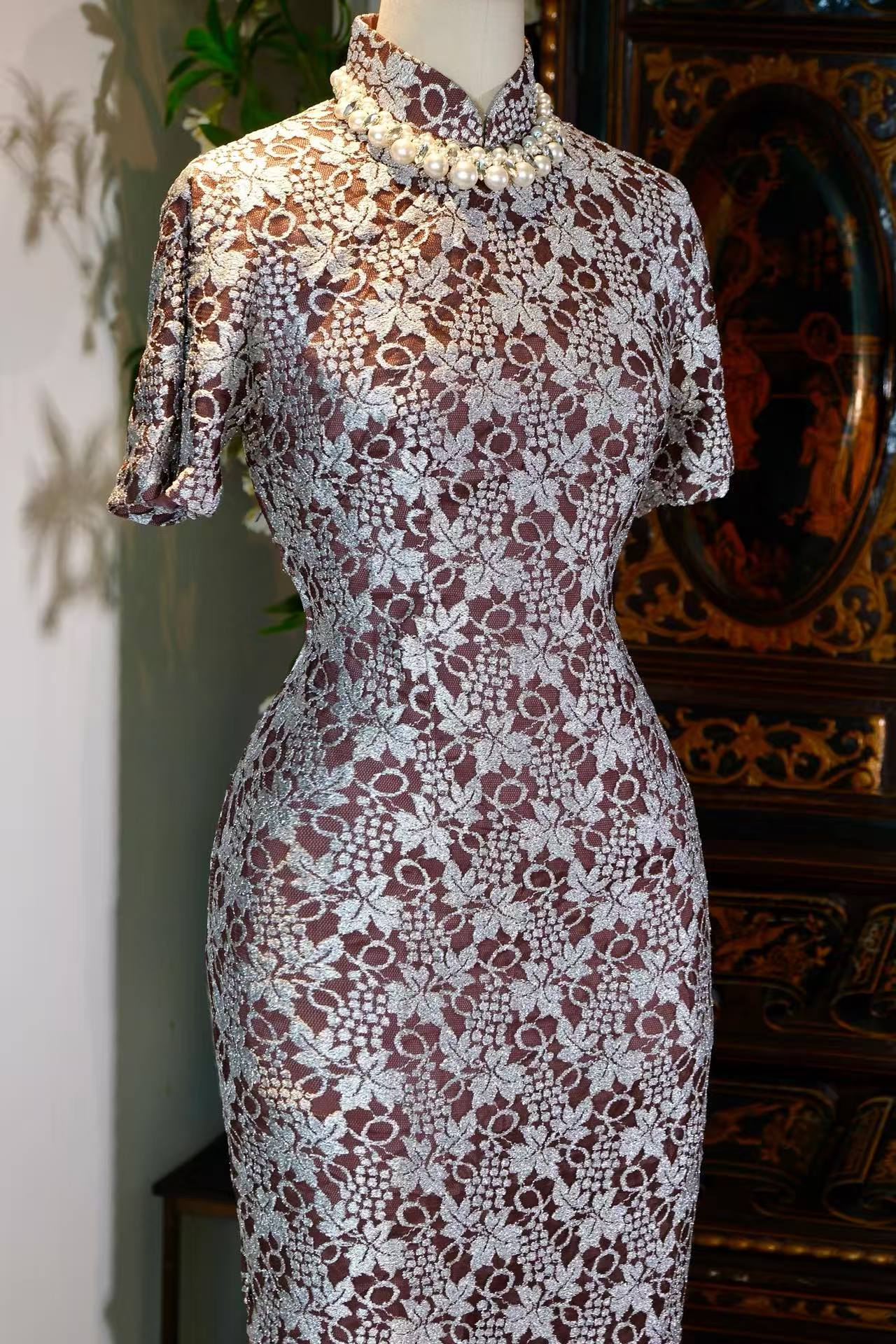
这件旗袍最摄人心魄之处,在于其面料的奢华与工艺的繁复。它并非传统的丝绸或棉麻,而是选用了极为罕见的金属织银蕾丝。
- 图案意象:细观其纹样,通体铺陈着连绵不绝的缠枝花卉纹。设计师巧妙地运用了巴洛克式的繁复构图,将东方的写意花卉与西方的几何骨架相结合。蕾丝的镂空处,肌肤若隐若现,宛如“犹抱琵琶半遮面”;而织银的丝线则在光线下流转生辉,呈现出一种浮雕般的立体感。
- 色彩美学:底色是沉稳而高贵的深紫红(或赭石色),象征着成熟女性的内敛与底蕴;而覆盖其上的银线,则如月光倾洒,清冷中透着奢华。这种“暗地亮花”的视觉效果,正是六十年代高级定制旗袍追求的极致美学——低调的张扬。
港派旗袍的黄金时代
如果说三十年代的海派旗袍是“初长成的少女”,那么六十年代的港派旗袍便是“风韵犹存的少妇”。
这件旗袍的剪裁,精准地体现了当时香港裁缝界的最高水准。它摒弃了早期的宽大平直,转而极度强调人体工学。你看那腰线的收束,臀围的贴合,以及肩部的圆润处理,每一寸剪裁都在勾勒女性的S型曲线。这不仅是布料的堆叠,更是建筑般的结构艺术。
在那个没有弹力面料的年代,要让如此硬挺的金属蕾丝完美贴合身体曲线,需要匠人拥有极高的“归拔”技艺。这不仅仅是一件衣服,它是当年香港名师手下的“软雕塑”。
稀缺性与传世价值
引用张爱玲在《更衣记》中的描述:“回忆这东西若是有气味的话,那就是樟脑的香,甜而稳妥,像记得分明的快乐。”这件旗袍便是这样的存在。
- 稀缺性:金属蕾丝面料在那个年代成本极高,且极易氧化断裂,保存至今且品相如此完好者,可谓凤毛麟角。它是那个时代经济腾飞、物质丰盈的实物见证。
- 艺术风格:它融合了西方的晚礼服面料(蕾丝、亮片)与东方的传统形制(立领、斜襟),是全球化早期时尚融合的典范。
穿上它,你穿上的不仅仅是布料,而是一段关于香江名媛、关于那个纸醉金迷又风华绝代的六十年代的传奇。这不仅仅是一件古董衣,这是一段可以触摸的历史。
Measurements / Size Guide:
Bust / Waist / Hips: 90/80/106 cm
Total Length: 109 cm
Detailed Description:
In the long river of fashion history, the 1960s was an epoch charged with absolute tension. In Hong Kong at that time, Eastern and Western cultures clashed fiercely yet fused flawlessly, giving birth to countless sartorial masterpieces that continue to mesmerize posterity. The antique Qipao before us stands as the most brilliant footnote to those "Golden Years."
[I. Woven with Gold and镂 Silver: Opulent Blooms in Relief] The most spellbinding aspect of this Qipao lies in the sheer luxury of its fabric and the intricate virtuosity of its craftsmanship. Rejecting traditional silk, cotton, or linen, it utilizes an exceptionally rare metallic silver-woven lace.
Motif & Imagery: Upon close inspection, the entire body is blanketed in a continuous, interlocking pattern of scrolling tendrils and blossoms. The designer masterfully employs a Baroque-style compositional density, grafting Eastern expressive florals onto a Western geometric skeleton. Through the openwork of the lace, skin is elusively revealed and concealed—evoking the classic poetic allure of "partially hiding one’s face behind a lute." Meanwhile, the silver-woven threads shimmer and ripple under the light, imparting a sculptural, three-dimensional relief effect to the garment.
Color Aesthetics: The background is a stable, regal deep burgundy (or ochre tone), symbolizing the maturity, restraint, and cultural depth of a sophisticated woman. The silver overlay cascading across it resembles crisp moonlight scattered on dark water, projecting a cool, patrician luxury. This visual contrast of "bright motifs over a dark ground" represents the ultimate aesthetic pursuit of 1960s haute couture Qipaos—an understated yet undeniable statement of opulence.
[II. The Golden Era of the Hong Kong-Style Qipao] If the Shanghai-style (Haipai) Qipao of the 1930s was a "young maiden newly come of age," then the Hong Kong-style (Gangpai) Qipao of the 1960s was a "sophisticated woman in the absolute prime of her poise and glamour."
The tailoring of this Qipao offers a textbook demonstration of the peak technical standards of mid-century Hong Kong master tailors. Departing from the boxy, flat lines of earlier eras, it pivots drastically toward rigorous ergonomics. Notice the precise constriction of the waist, the faultless contouring around the hips, and the softly rounded treatment of the shoulders—every single inch of pattern-making is dedicated to sculpting the female "S-curve." This is far more than a mere assembly of fabric; it is architectural structure engineered as art.
In an era before the invention of elastane or stretch textiles, manipulating such an unyielding, rigid metallic lace to contour flawlessly to the human form demanded a virtuoso mastery of manual iron-shaping and stretching (Gui-Ba). This is no longer merely apparel; it is a "soft sculpture" born beneath the hands of a Hong Kong master artisan.
[III. Rarity and Heirloomed Value] To invoke Eileen Chang’s eloquent prose in Chronicle of Changing Clothes: "If memory had an odor, it would be the scent of camphor—sweet and reassuring, like a clearly remembered joy." This Qipao stands as exactly that kind of sensory vessel.
Rarity: Metallic lace fabrics were exorbitantly expensive to manufacture during the mid-20th century. Furthermore, because metallic threads are highly susceptible to oxidation and embrittlement over time, specimens that survive to this day in such pristine, unaltered condition are exceptionally rare. It stands as a tangible material witness to Hong Kong's mid-century economic ascent and newfound material abundance.
Artistic Philosophy: By seamlessly fusing Western eveningwear materials (lace and metallic sheen) with traditional Eastern silhouettes (the mandarin collar and diagonal Xiejin opening), this garment serves as a textbook vanguard of early globalized fashion integration.
To step into this Qipao is to wear far more than engineered fabric; it is to drape oneself in the living legend of Hong Kong's mid-century socialites and the breathtaking, high-society glamour of the 1960s. This is not merely an antique garment—it is a fragment of frozen history you can touch.