深圳溯源
Couldn't load pickup availability
衣服尺寸:
胸围/腰围/臀围:100/80/100 厘米
衣长: 112 厘米
细节描述:
一、纹样考据:繁花似锦中的“吉语”密码
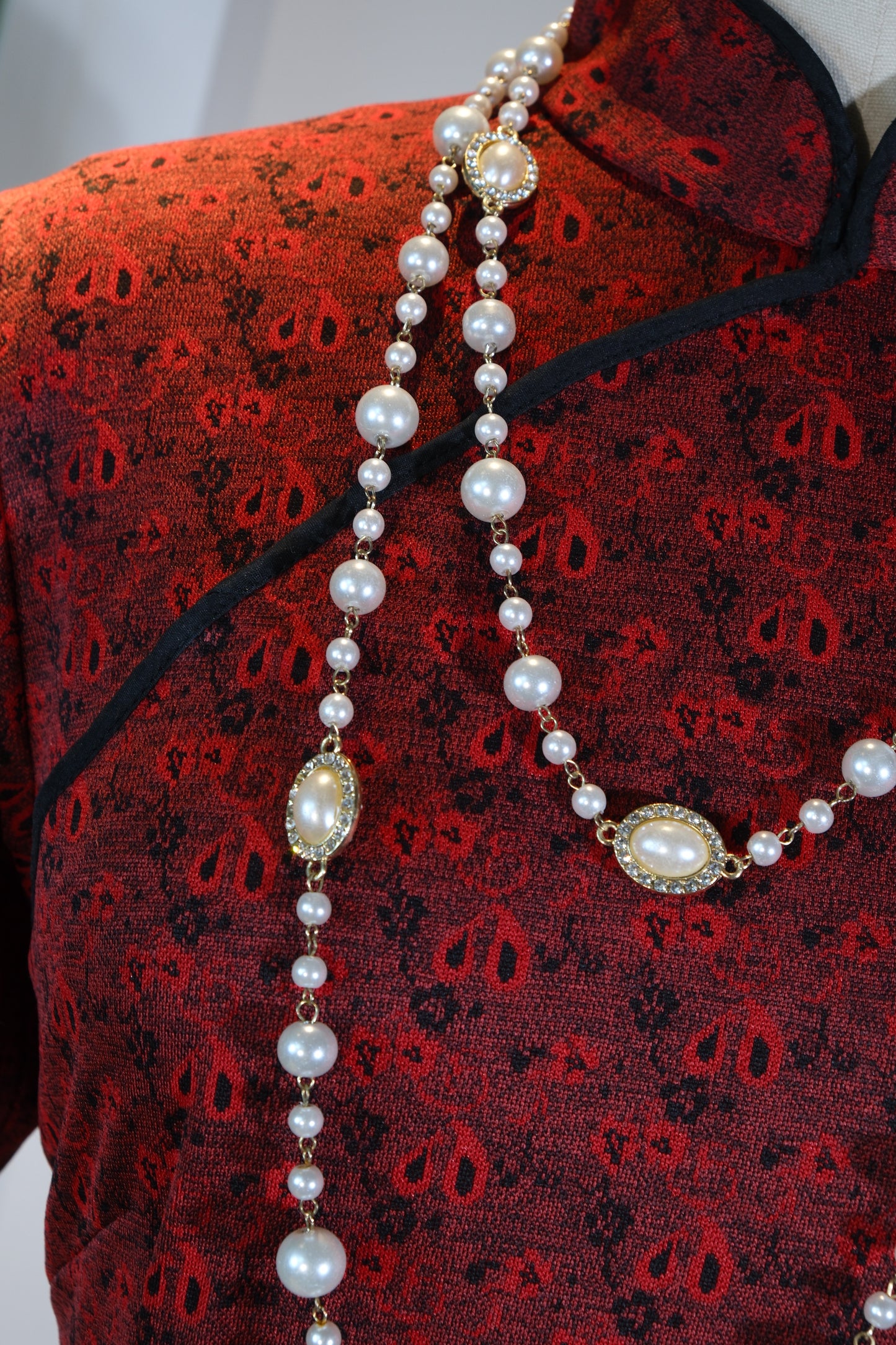
这件诞生于上世纪六十年代的香港产古董旗袍,其面料工艺堪称那个时代纺织工业的缩影。衣身采用经典的红色提花织锦为底,这种面料在当年多用于制作婚嫁或节庆礼服,寓意红红火火。
细观其上的图案,并非随意的装饰,而是蕴含着深厚的传统吉祥寓意。
- 主纹样:这是一种抽象化、几何化的“如意云头”或“团寿”变体纹样。每一个独立的单元都像是一个倒置的心形或灵芝状,线条圆润饱满,排列整齐有序。这种纹样在传统纹样学中被称为“暗八仙”或“杂宝”的一种演变,象征着“事事如意”与“长寿安康”。
- 色彩美学:底色为正红,间以深黑或藏青色的经纬线交织出花纹。这种“红黑配”是极具东方韵味的经典配色,既保留了红色的喜庆热烈,又通过深色压住了浮躁,透出一种沉稳大气的贵族气质。正如《长物志》中所言:“随方制象,各有所宜”,这种配色正是为了适应当时上流社会既需隆重又不失庄重的社交需求。
二、形制与剪裁:西风东渐下的“海派”余韵
这件旗袍虽产自香港,却完美继承了上海“海派旗袍”的精髓,并融入了六十年代特有的审美风尚。
- 立领与滚边:采用了经典的元宝领设计,高度适中,紧贴颈部,展现出女性颈部的修长。领口、袖口及大襟处均饰有黑色的宽滚边( piping),这种强烈的黑白红对比,不仅勾勒出了服装的结构感,更在视觉上起到了“收束”的作用,使整体造型更加利落。
- 省道与廓形:请注意其腰部的剪裁。六十年代的旗袍深受西方立体剪裁的影响,不再像三十年代那样完全依赖平面的归拔工艺,而是大量使用了西式省道。这使得衣服能紧紧包裹住穿着者的身体曲线,呈现出完美的S型轮廓。袖子为标准的短袖设计,长度恰到好处地露出手臂最纤细的部分,这是那个年代追求干练、独立女性形象的体现。
三、配饰之美:珠光宝气里的“张爱玲式”奢华
图中搭配的珍珠项链是点睛之笔。这并非普通的单串珍珠,而是采用了长短不一的双层叠戴法,且中间镶嵌有椭圆形的宝石扣饰。
这种搭配风格让人联想到张爱玲笔下的都市女性——既有传统的温婉,又有现代的张扬。珍珠的温润光泽与织锦的华丽质感形成了微妙的平衡。正如《倾城之恋》中白流苏的装扮,这种繁复而精致的首饰,是那个动荡年代里女性对美好生活的一种执着坚守与自我表达。
四、历史回响:一件古董衣的稀缺叙事
为什么我们要珍视这样一件六十年代的香港旗袍?
- 时代的见证:1960年代的香港,正处于经济腾飞的前夜,也是中西文化碰撞最激烈的时期。这件旗袍见证了那一代移民女性如何在异乡重建生活,她们将故乡的记忆穿在身上,又将西方的审美融入日常。它是“离散”与“融合”的实物标本。
- 工艺的绝唱:随着70年代成衣工业的爆发和化纤面料的普及,这种高支棉混纺的重工织锦面料逐渐退出了历史舞台。如今,要在市面上找到保存如此完好、色泽依然鲜亮、且版型未被修改过的六十年代原版织锦旗袍,实属凤毛麟角。
- 不可复制的艺术:每一寸织锦都是时间的沉淀。它不仅仅是一件衣服,更是一首凝固的诗。当你穿上它,你穿上的不仅是六十前的时尚,更是那段流金岁月里,东方女性独有的坚韧与优雅。
结语:
“锦衣旗袍诗,曼玉花样时。”这件红黑织锦旗袍,以其独特的纹样语言和精湛的剪裁工艺,诉说着一个关于美、关于传承、关于时光的故事。它不仅属于博物馆的展柜,更属于每一个懂得欣赏东方古典美学与现代摩登精神完美结合的灵魂。
Measurements / Size Guide:
Bust / Waist / Hips: 100/80/100 cm
Total Length: 112 cm
Detailed Description:
Born in Hong Kong during the 1960s, the textile engineering of this antique qipao functions as a pristine miniature of the mid-century global textile sector. The garment body adopts a classic red jacquard brocade ground; historically, yardage of this structural weight was primarily reserved for matrimonial ceremonies or landmark ancestral festivals, symbolizing maximum vitality, celebration, and familial prosperity.
Close inspection of the pattern layout reveals a disciplined commitment to traditional auspicious metaphors rather than random aesthetic placement:
The Primary Pattern Matrix: The design utilizes an abstracted, geometricized variation of the ancestral Ruyi cloud-head (“如意云头”) or longevity roundel (“团寿”) motif. Every independent design cell repeats as an inverted heart-shape or lingzhi-mushroom profile, beautifully rounded and organized across a strict structural grid. Within classical pattern theory, this layout represents an evolution of the "Eight Hidden Immortals" (“暗八仙”) or "Miscellaneous Treasures" (“杂宝”) lexicon, broadcasting the dual auspicious codes of complete fulfillment and lifelong tranquility.
The Chromatic Palette: The foundational ground is realized in a vibrant orthochromatic red, interwoven with dense jet-black or deep navy warp and weft threads to construct the pattern. This red-and-black contrast stands as an iconic, timeless combination within Eastern color theory—safely preserving the celebratory warmth of the red field while relying on the deep charcoal undertones to ground the textile, projecting a steady, aristocratic dignity. As the Ming dynasty text Treatise on Superfluous Things (《长物志》) notes: "Design objects exactly according to their environment, ensuring each matches its proper place." This chromatic balancing was engineered specifically to suit the elite social requirements of mid-century high society, which demanded immense visual presence balanced by perfect decorum.
Although manufactured within the unique urban matrix of post-war Hong Kong, this specimen flawlessly inherits the core marrow of the traditional Shanghai style (海派) while projecting distinct 1960s tailoring adjustments:
The Mandarin Collar and Structural Piping: It features the classic Yuanbao collar layout, moderate in height and hugging the throat closely to visually elongate the neck contours into a graceful line. The collar edge, armscye, and diagonal front lapel are bound using a sharp black wide piping. This powerful graphic contrast between black and red not only defines the architectural joints of the garment but creates an optical slimming effect, ensuring a highly tailored finish.
Structural Darting and Silhouette Geometry: Close attention must be paid to the pattern drafting across the waist. 1960s qipao construction was deeply influenced by Western three-dimensional structural engineering. Rather than relying exclusively on the flat hot-iron manipulation and blocking (归拔工艺) characteristic of the 1930s, this era integrated calculated Western structural darts (省道). This allows the textile chassis to contour flawlessly around the natural curves of the female form, yielding a sharp, dramatic S-curve profile. The short sleeves terminate at a highly disciplined height, exposing the narrowest part of the arm to project the capable, efficient, and independent poise championed by the new woman of that generation.
The paired pearl necklace functions as a vital technical accent to the entire ensemble. Moving far beyond a simplistic single-strand arrangement, it utilizes a multi-layered, double-strand stacking methodology calculated at varying lengths, anchored at the center by an oval-cut gemstone box clasp closure.
This styling approach directly materializes the urban female archetype famously chronicled by Eileen Chang—balancing ancestral, approachable warmth with modern self-expression. The soft, muted luster of the pearls establishes a flawless visual equilibrium against the high-density brilliance of the brocade weave. Reminiscent of the styling worn by the character Bai Liusu in the classic text Love in a Fallen City, these complex, highly refined heirloom accessories represent a firm declaration of personal dignity and an unyielding commitment to an elevated lifestyle amidst a rapidly shifting era.
The absolute preservation of a 1960s Hong Kong-produced brocade garment commands profound curatorial value across three specific dimensions:
A Physical Specimen of Post-War Migration: Hong Kong in the 1960s operated as a cultural crucible on the eve of its massive economic boom, experiencing intense cultural friction and synthesis. This qipao bears physical witness to how displaced migrant master tailors and women reconstructed their cultural lives in a new landscape—carrying the memory of their ancestral homes on their bodies while seamlessly adapting to global Western aesthetics. It operates as an irreplaceable physical archive of cultural fusion.
The Twilight of High-Density Weaving: Following the explosion of ready-to-wear automated manufacturing lines and cheap synthetic petrochemical fibers in the 1970s, this specific high-twist, cotton-blended heavy-gauge brocade yardage completely exited commercial production lines. Finding an unaltered, original-material 1960s specimen that retains its structural pattern symmetry and pristine colorfastness is an absolute rarity on the contemporary global market.
An Irreproducible Living Archive: Every square inch of this jacquard weave represents a natural settlement of time. It transcends its primary classification as a functional garment to stand as a frozen piece of visual poetry. To step into its structural matrix is to do far more than adopt a mid-century style; it is to directly step into the resilient grace and absolute composure of that golden generation of Eastern women.
"Fine brocades weave a qipao poem, capturing the timeless elegance of a bygone era." This red-and-black jacquard brocade qipao, commanding a disciplined pattern language and masterful mid-century pattern drafting, tells an unforgettable story of craftsmanship, lineage, and natural time. It transcends a static museum archive sealed behind display glass, waiting instead for a discerning custodian who understands how to celebrate the ultimate convergence of classical Eastern aesthetics and modern cosmopolitan spirit.
Suyuan Archival Textile Registry — Documenting the material culture, preserving the technical lineage of ancestral craft.