深圳溯源
Couldn't load pickup availability
衣服尺寸:
胸围/腰围/臀围:94/82/96 厘米
衣长:110 厘米
细节描述:
这件上世纪六十年代香港产的波点提花古董旗袍,是中西服饰文化交融的活态标本。其艺术价值不仅在于精湛的工艺,更在于它承载了特定历史时期女性的审美自觉与身份表达。
图案与面料:几何秩序中的东方韵律
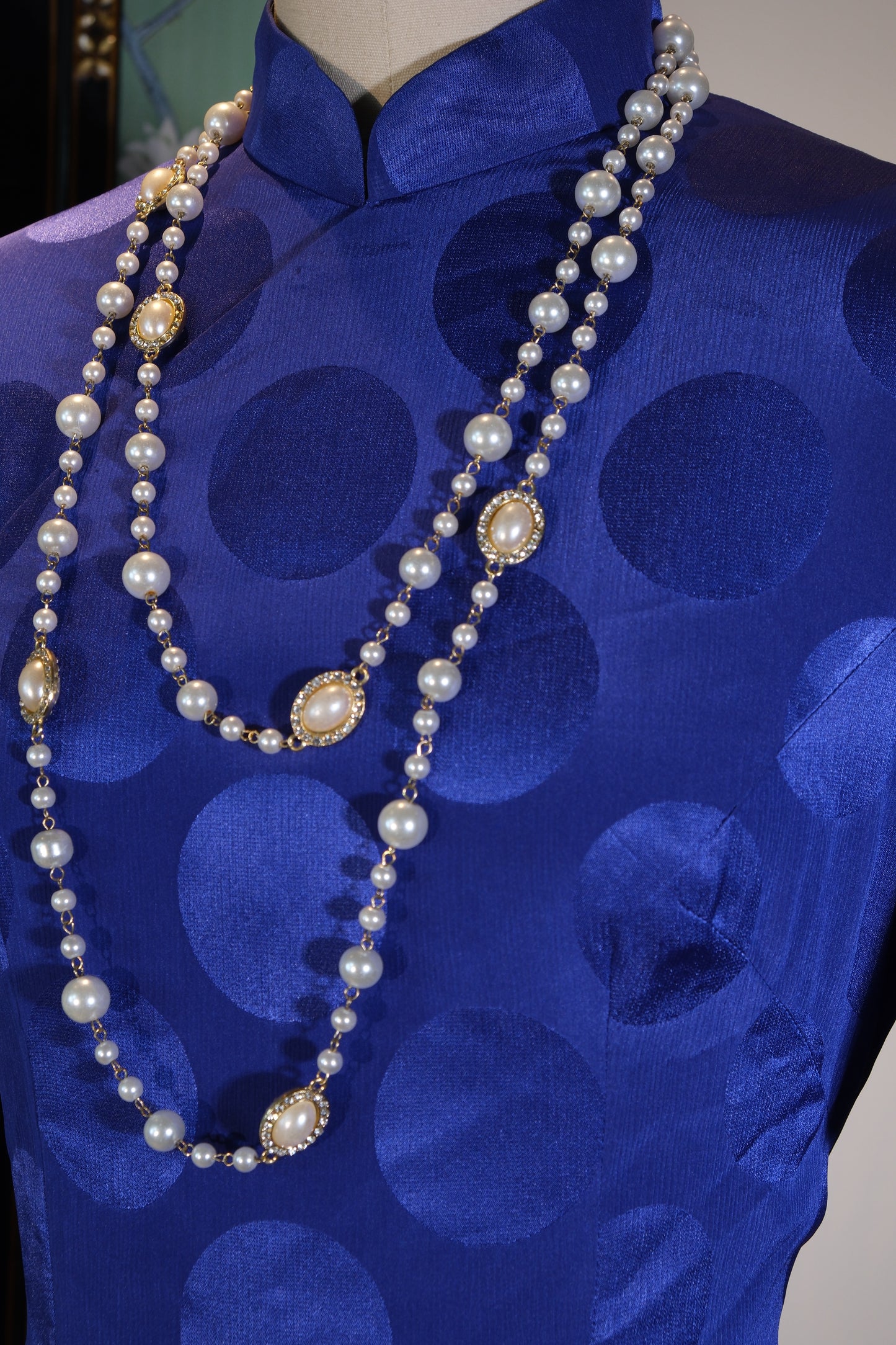
这件旗袍的面料采用真丝提花工艺,在深邃的宝蓝色底布上,以同色系但不同光泽度的丝线织出大小不一、错落有致的圆形波点。这些圆点并非简单的平面印花,而是通过提花技术形成的立体肌理,光线流转间呈现出微妙的明暗变化,宛如夜空中的星月或水面泛起的涟漪。这种设计既吸收了西方现代主义对几何图形的偏爱,又暗合了中国传统“天圆地方”、“圆满如意”的哲学意象。
从服装史角度看,六十年代的香港正处于经济腾飞与文化转型期,旗袍作为日常着装开始融入更多西式剪裁元素。此件旗袍虽保留了立领、斜襟等传统形制,但其修身廓形与短袖设计已明显受到当时国际流行趋势影响,体现了“海派”与“港式”风格的融合。
配饰点睛:珍珠项链的古典与现代对话
搭配的多层珍珠项链,由大小不一的天然淡水珍珠串联而成,其间点缀数枚椭圆形镶钻金属饰片,形成视觉焦点。这种叠戴方式在六十年代好莱坞明星如奥黛丽·赫本、格蕾丝·凯利的造型中极为常见,象征着优雅与高贵。而将其与中式旗袍并置,则构成了一种跨越文化的时尚对话——珍珠代表西方的精致与浪漫,旗袍则承载东方的含蓄与端庄。两者结合,恰如张爱玲笔下“穿着旗袍的女人是诗”,既有古典韵味,又不失现代气息。
稀缺性与收藏价值:时光淬炼下的孤品
由于年代久远且保存完好,此类完整无损的六十年代香港产旗袍实属罕见。当时多数家庭仅有一两件体面旗袍用于重要场合,日常穿着多为棉麻材质,因此丝绸提花款本就稀少。加之历经半个多世纪仍能保持色泽鲜亮、结构完整,更显珍贵。它不仅是衣物,更是历史的见证者,记录了一个时代女性如何在传统与现代之间寻找自我表达的空间。
正如《礼记·深衣》所言:“古者深衣,盖有制度,以应规、矩、绳、权、衡。”这件旗袍虽非古代深衣,却同样蕴含着对比例、线条与功能的极致追求。它是穿在身上的艺术品,也是流动的文化记忆。
Measurements / Size Guide:
Bust / Waist / Hips: 94/82/96 cm
Total Length: 110 cm
Detailed Description:
This antique polka dot jacquard qipao, produced in Hong Kong during the 1960s of the last century, stands as a living biological specimen of the fusion between Eastern and Western costume cultures. Its artistic value rests not only in its exquisite craftsmanship, but more profoundly in its role as an emotional vessel carrying a specific historical period of women's aesthetic self-awareness and identity expression.
The fabric matrix of this qipao implements a pure silk jacquard technique. Upon a deep, intense sapphire blue grounding chassis, silk filaments of identical color family but contrasting luster levels are woven to produce polka dots of varying dimensions arranged in a meticulously scattered, organic composition. Rather than being simple, flat surface prints, these circular dots comprise a three-dimensional tactile texture manifested through jacquard engineering. As ambient light shifts and flows, they present highly nuanced variations of brightness and shade—evoking stars and moons scattered across a midnight sky, or delicate ripples undulating over a water surface. This design layout simultaneously absorbs the Western modernist partiality for geometric shapes while subtly aligning with traditional Chinese philosophical imagery of "the spherical heaven and the rectangular earth" (Tianyuan Difang) and "rounded perfection and fulfillment" (Yuanman Ruyi).
Appraised through the prism of costume history, 1960s Hong Kong was navigating a critical window of economic takeoff and cultural transformation. Operating as everyday attire, the qipao began to actively incorporate more Western pattern-drafting elements. While this specific piece retains conventional heritage components like the standing collar and the diagonal closure line (Xiejin), its form-fitting, reduced silhouette and short-sleeve engineering are visibly influenced by international fashion trends of the era, beautifully embodying the structural synthesis of Shanghai-style (Haipai) and Hong Kong-style craftsmanship.
The styling is accentuated by a multi-strand pearl necklace composed of natural freshwater pearls linked together in varying scales, punctuated by several oval-shaped, diamond-encrusted metal accent plates that establish a definitive visual focal point. This specific layering methodology was an absolute staple among 1960s Hollywood icons like Audrey Hepburn and Grace Kelly, operating as an international symbol of elegance and noble refinement. Juxtaposing this accessory choice with a traditional Chinese qipao constructs a cross-cultural fashion dialogue—pearls articulating Western sophistication and romance, while the qipao anchors Eastern containment and dignity. The pairing flawlessly actualizes the sentiment penned by the celebrated author Eileen Chang that "a woman dressed in a qipao is a poem," remaining saturated with classical charm without losing a trace of modern breath.
Owing to its historical age and absolute perfection of preservation state, finding an intact, undamaged 1960s Hong Kong-produced qipao of this caliber is exceptionally rare—a true phenomenon. During that timeline, the vast majority of households possessed only one or two decent, respectable qipaos reserved exclusively for milestone occasions, utilizing common cotton or linen matrices for daily wear; consequently, premium silk jacquard variants were inherently limited in production volume. Furthermore, for a piece to cross more than half a century of natural timeline while retaining its rich color vibrancy and structural integrity renders it incredibly precious. It functions not merely as an article of clothing, but as a material witness to history—archiving how the women of that era carved out a space for personal self-expression between the forces of tradition and modernization.
As the ancient text The Book of Rites · Shenyi states: "The ancient deep robe (Shenyi) conformed entirely to structural regulations, aligning perfectly with the compass, the square, the plumb-line, and the balance." Though this qipao is not an ancient deep robe, it identically embodies an ultimate pursuit of proportion, silhouette lines, and functional utility. It stands as a wearable masterpiece of art, and a piece of fluid cultural memory.