溯源
Couldn't load pickup availability
衣服尺寸:
胸围/腰围/臀围/衣长:108/88/116/100 厘米
细节描述:
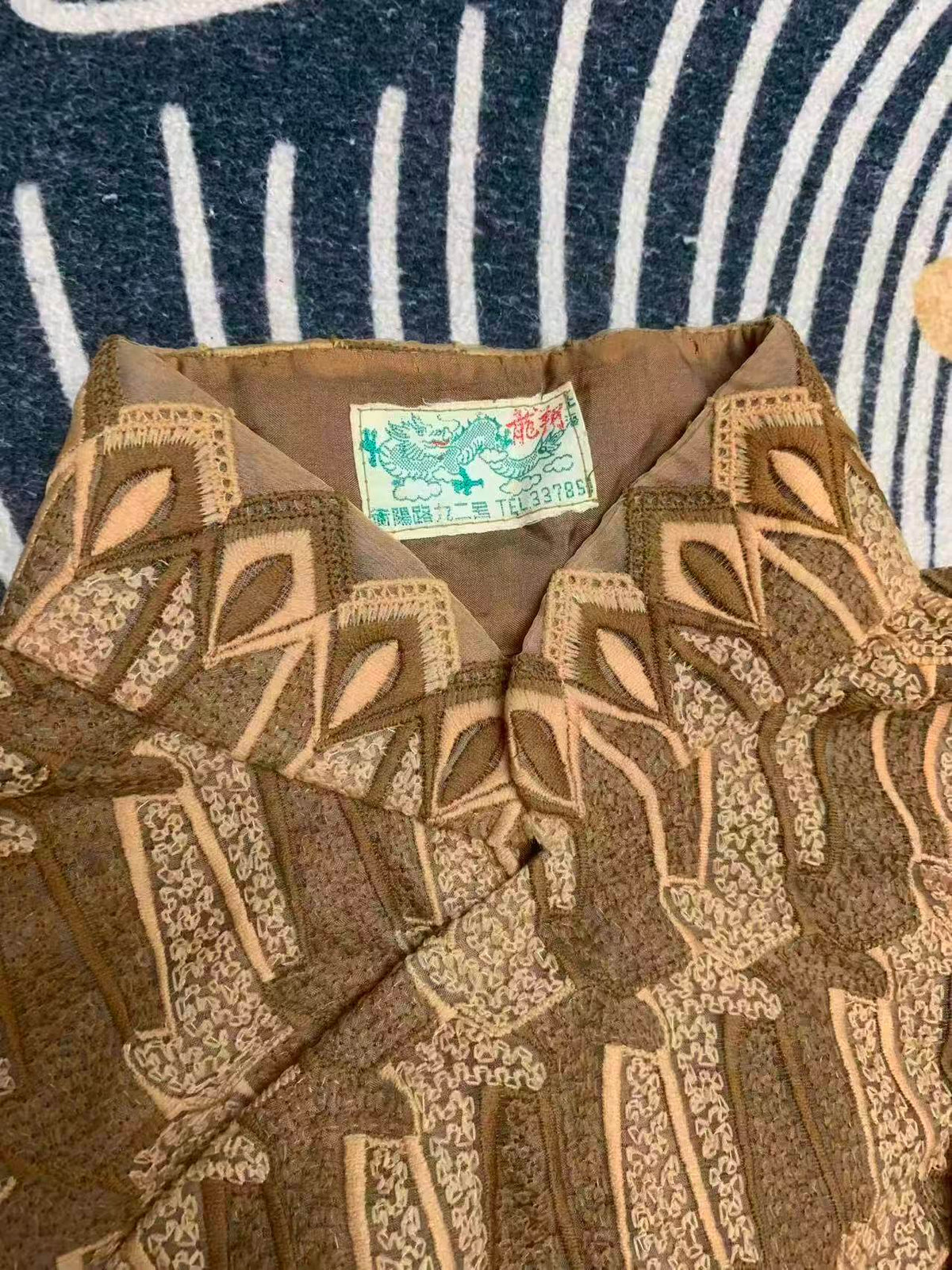
【衣上纹样:几何与蕾丝的建筑美学】
这件旗袍的面料,绝非寻常的丝绸或棉麻,而是一块典型的日本进口机绣蕾丝(Machine-embroidered Lace)。在1960年代,这种面料极为稀缺,通常只出现在高端定制礼服上。
1. 几何图腾的构建:
仔细观察,你会发现上面的纹样并非传统旗袍常见的具象花鸟,而是一种高度抽象化的几何图形。
这些图案由一个个倒置的、类似“蘑菇头”或“抽象花卉”的几何单元纵向排列而成。每一个单元都像是一座精致的微缩建筑:
- 顶部是扇贝状或心形的蕾丝镂空,宛如教堂的穹顶;
- 中部是垂直的蕾丝线条,如同希腊的立柱;
- 底部则是横向的锁边,形成了稳固的基座。
2. 光影的雕塑感:
这种蕾丝工艺极其特殊。深棕色的底布如同大地的土壤,而浅棕色与杏色的机绣线圈则如同浮雕般凸起。当光线照射时,蕾丝的镂空部分会透出底布的色彩,而凸起的绣线则形成强烈的阴影。
这不仅让衣服本身自带一种“明暗对照法”(Chiaroscuro)的立体感,更让穿着者在举手投足间,光影流转,仿佛一座流动的雕塑。
3. 色彩的沉稳与高贵:
整体色调是经典的焦糖棕色(Caramel Brown)搭配杏色(Apricot)。这是一种极具“老上海”贵族气息的配色——不张扬,却在低调中透出温润的奢华。它像是一杯陈年的波尔多红酒,又像是一本泛黄的线装书,散发着浓郁的复古情调。
【古董故事:跨越海峡的针线传奇】
这件旗袍的领标,是解开它身世之谜的钥匙。那枚绣有“龙翔”二字及龙纹图案的布标,是上世纪中叶台湾高级成衣业的标志性符号。
1. 时代的迁徙与传承:
1949年后,上海的一批顶级裁缝大师(如“培罗蒙”、“荣昌祥”的传人)迁往台湾,同时也带去了精湛的裁剪技艺。到了1960年代,台湾旗袍业进入鼎盛时期,形成了独特的“海派改良”风格。这件旗袍正是那个时代的产物——它有着上海旗袍的精致剪裁,又在面料选择上大胆吸收了国际(日本)的先进工艺。
2. “龙翔”的辉煌:
“龙翔”在当时是台湾顶尖的旗袍制衣商之一,专为政要夫人、电影明星和社会名流提供定制服务。他们以选用顶级进口面料(如日本的机绣蕾丝、瑞士的镂空面料)和严苛的“归拔”工艺著称。这件旗袍的领标清晰地写着地址和电话,那不仅是商业信息,更是一个时代的“身份证明”。
【引经据典:衣冠楚楚里的东方风骨】
张爱玲在《更衣记》中写道:
“对于不会说话的人,衣服是一种语言,随身带着的是袖珍戏剧。”
这件旗袍,就是一出没有台词的古典戏剧。
- 领口的隐喻: 它保留了传统旗袍的元宝领,但高度略有降低,线条更加柔和。这正如《红楼梦》中所描绘的“软烟罗”,既有“软”的温润,又有“罗”的骨架。它象征着60年代女性既保留传统温婉,又追求现代独立的双重特质。
- 修身的剪裁: 它的腰身收得极好,省道(Darts)隐藏得天衣无缝。古人云:“楚腰纤细掌中轻”,这件旗袍完美地诠释了东方女性“S”型的曲线美,但又不过分暴露,始终保持着一种“发乎情,止乎礼”的含蓄。
- 稀缺性: 如今,能在市场上见到一件品相如此完好、面料如此特殊(日本进口机绣蕾丝保存极难,稍有不当就会氧化发黄)、且有清晰原版“龙翔”领标的旗袍,简直是凤毛麟角。它是收藏家眼中的“博物馆级”藏品。
Measurements / Size Guide:
Bust / Waist / Hips / Total Length: 108/88/116/100 cm
Detailed Description:
[Garment Patterns: The Architectural Aesthetics of Geometry and Lace]
The fabric of this cheongsam is by no means ordinary silk or cotton-linen; it is a quintessential piece of imported Japanese machine-embroidered lace. In the 1960s, this type of fabric was extremely scarce, typically appearing only on high-end custom gowns.
1. Construction of Geometric Totems: A close inspection reveals that the motifs on the dress are not the concrete flowers or birds commonly seen on traditional cheongsams, but rather highly abstracted geometric shapes. These patterns are composed of vertically arranged, inverted geometric units resembling "mushroom caps" or "abstract flowers." Each unit resembles a exquisite miniature building:
The top features scalloped or heart-shaped lace cutouts, echoing a cathedral dome;
The middle consists of vertical lace lines, like Greek columns;
The bottom ends in horizontal edge-locking, forming a stable base.
2. Sculptural Quality of Light and Shadow: This lace technique is remarkably unique. The dark brown base cloth resembles the earth's soil, while the light brown and apricot machine-embroidered loops rise like reliefs. When light shines on it, the cutouts of the lace reveal the colors of the base fabric, while the raised embroidery threads create strong shadows. This not only imparts an inherent "chiaroscuro" three-dimensional quality to the garment itself, but also allows light and shadow to flow with every movement of the wearer, making her appear like a living sculpture.
3. Composed and Noble Color Palette: The overall tone is a classic caramel brown paired with apricot. This is a color scheme imbued with the aristocratic air of "Old Shanghai"—unostentatious, yet emanating warm luxury in its understated tone. It is like an aged Bordeaux wine, or a yellowed thread-bound book, exuding a rich vintage sentiment.
[Antique Story: A Thread-and-Needle Legend Across the Strait]
The neck label of this cheongsam is the key to unlocking the mystery of its origins. The cloth label embroidered with the two characters "Dragon Flying" (Dragon Flying / Long Xiang) and a dragon pattern is an iconic symbol of Taiwan's high-end ready-to-wear industry in the middle of the last century.
1. Migration and Inheritance of an Era: After 1949, a group of top master tailors from Shanghai (such as successors from "Pei Luo Meng" and "Rong Chang Xiang") relocated to Taiwan, bringing with them exquisite tailoring techniques. By the 1960s, the cheongsam industry in Taiwan entered its golden age, forming a unique "Shanghainese modified" style. This cheongsam is precisely a product of that era—it possesses the meticulous tailoring of Shanghai cheongsams while boldly incorporating advanced international (Japanese) textile crafts in its choice of fabric.
2. The Glory of "Dragon Flying": "Dragon Flying" was one of the top cheongsam makers in Taiwan at the time, providing custom services exclusively for wives of political figures, movie stars, and socialites. They were renowned for selecting top-tier imported fabrics (such as Japanese machine-embroidered lace and Swiss eyelet fabrics) and practicing strict iron-shaping techniques. The neck label of this cheongsam clearly displays its address and telephone number—more than just commercial information, it is a "proof of identity" for an entire era.
[Literary Allusions: Eastern Spirit in Elegant Attire]
Eileen Chang wrote in A Record of Changing Clothes: "To those who cannot speak, clothes are a language, carrying with them a pocket-sized drama wherever they go."
This cheongsam is a classical drama without spoken lines.
Metaphor of the Collar: It retains the traditional ingot collar of classic cheongsams, though the height is slightly lowered and the lines are rendered softer. This is reminiscent of the "soft smoke gauze" described in Dream of the Red Chamber, possessing both the warmth of "softness" and the structure of "gauze." It symbolizes the dual qualities of 1960s women, who preserved traditional gentleness while pursuing modern independence.
Fitted Tailoring: The waistline is cinched exceptionally well, with the darts hidden seamlessly. As the ancients said, "The slender waist of Chu is light in the palm of a hand." This cheongsam perfectly interprets the S-curve beauty of Eastern women, yet without being overly revealing, maintaining a sense of restraint that "springs from emotion, yet stops at propriety."
Rarity: Today, finding a cheongsam on the market in such pristine condition, crafted from such a special fabric (imported Japanese machine-embroidered lace is extremely difficult to preserve, as improper care easily leads to oxidation and yellowing), and bearing a clear, original "Dragon Flying" neck label, is exceptionally rare. It is a "museum-grade" collectible piece in the eyes of connoisseurs.