《海上传奇:1920s真丝与法国尚蒂伊蕾丝的跨洋对话》
这不仅是一件衣裳,更是一段被封存的时光切片。
【纹样与形制:中西合璧的极致美学】
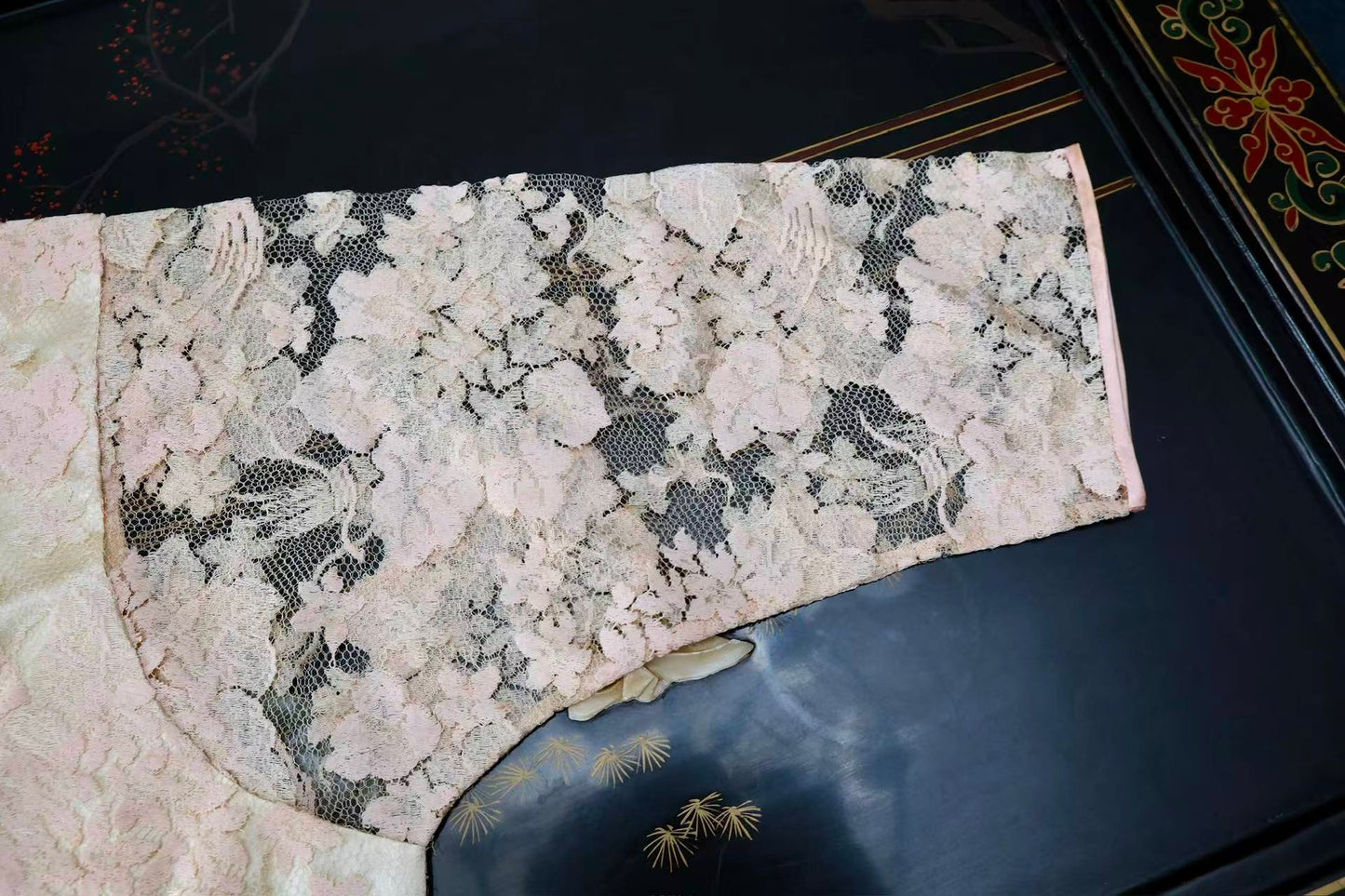
此件旗袍诞生于上世纪二十年代,正值中国服饰由“倒大袖”向修身剪裁过渡的变革期。其最摄人心魄之处,在于上半身大面积拼接的法国进口手工蕾丝。
细观其纹样,蕾丝采用了经典的“尚蒂伊”风格构图,以细腻的网底为纸,以丝线为墨,勾勒出繁复而疏朗的缠枝花卉与卷草纹。这种纹样并非传统的中国折枝花鸟,而是带有新艺术运动余韵的欧式植物图腾,象征着彼时上海滩对西方摩登文明的热烈拥抱。
蕾丝下摆呈现出锯齿状边缘,这是一种极具装饰性的剪裁手法,打破了直线的单调,在行走间如波浪般起伏。下半身则选用素净的重磅真丝,色泽温润如象牙,与上半身的通透形成虚实对比,既保留了东方女性的含蓄,又展露了受西方影响的审美解放。
【古董衣的故事:穿越百年的回响】
在张爱玲笔下的《沉香屑·第一炉香》里,葛薇龙曾看着衣橱里的衣服感叹:“这些衣服,都是无声的电影。”
这件旗袍便是如此。想象一下,在近百年前的上海霞飞路,或是天津五大道,一位受过新式教育的名媛,身着此衣,手执折扇。那时的她,刚刚剪去长发,正谈论着易卜生的《玩偶之家》。这件衣服见证了那个时代女性从深闺走向社交场的历史性一步——它不再是为了取悦男权凝视的紧身束缚,而是女性自我意识觉醒后,对美与自由的独立宣言。
【稀缺性与艺术价值】
真正的古董旗袍,其价值在于“不可复制性”。
● 手工的温度: 领口与襟边的精致花扣,每一颗皆由工匠手工盘制,造型如花朵绽放,针脚细密,如今机器难以复刻其神韵。
● 材质的绝唱: 那个年代进口的法国蕾丝,丝线中往往混织有极细的马海毛或金银线,历经百年依然光泽尚存,这种面料在二战后已极难寻觅。
这不仅仅是一件旗袍,这是穿在身上的民国建筑,是流动的东方诗意。
Legends of the Sea: A Transoceanic Dialogue Between 1920s Silk and French Chantilly Lace
This is not merely a garment, but a sealed slice of captured time.
【Motifs and Form: The Ultimate Aesthetic of East-West Fusion】
This qipao was born in the 1920s, precisely during the transformative era when Chinese costume was transitioning from the wide-sleeved Dao Da Xiu style to a more form-fitting silhouette. Its most captivating feature lies in the large area of imported handcrafted French lace spliced across the upper body.
Looking closely at the motif, the lace utilizes a classic "Chantilly" style composition—using the delicate mesh ground as paper and silk thread as ink to sketch intricate yet airy trailing flowers and scrolling grass patterns. Rather than traditional Chinese broken-branch flora and fauna, this motif features European botanical totems bearing the lingering charm of the Art Nouveau movement, symbolizing the enthusiastic embrace of Western modern civilization on the Shanghai Bund at that time.
The lace hem presents a scalloped, zigzag edge, an immensely decorative tailoring technique that breaks up the monotony of straight lines and undulates like waves with every step. The lower half of the garment is crafted from a pristine, heavy-weight silk with a warm, ivory-like luster. This creates a striking contrast of the substantial and the ethereal against the transparency of the upper body, at once preserving the implicit modesty of the Eastern woman while revealing an aesthetic liberation influenced by the West.
【The Story of the Antique Garment: Echoes Across a Century】
In Eileen Chang’s Aloeswood Incense: The First Brazier, Ge Weilong once looked at the clothes in her wardrobe and sighed: "These clothes are like silent movies."
This qipao is exactly that. Imagine a lady of the new era who had received a modern education, dressed in this attire with a folding fan in hand, walking along Avenue Joffre in Shanghai or the Five Great Avenues in Tianjin nearly a century ago. At that time, she had just bobbed her hair and was discussing Henrik Ibsen’s A Doll's House. This garment witnessed the historic step of women in that era moving from the secluded inner chambers out into the social sphere—it was no longer a tight restraint designed to please the patriarchal gaze, but an independent declaration of beauty and freedom following the awakening of female self-consciousness.
【Rarity and Artistic Value】
The true value of an authentic antique qipao lies in its "non-replicability."
-
The Warmth of Handcrafting: The exquisite frog closures (pankou) along the collar and lapel edge were each hand-knotted by artisans into blooming floral shapes with meticulous stitching. Today, machines find it difficult to replicate their unique charm and spirit.
-
A Swan Song of Materials: French lace imported during that era was often interwoven with extremely fine mohair or gold and silver threads, allowing it to retain its luster even after a hundred years. This specific kind of textile has been exceptionally rare to find since World War II.
This is not just a qipao; it is Republic of China architecture worn on the body, a piece of flowing Eastern poetry.