深圳溯源
30年代 - 三十年代几何郁金香真丝曳地旗袍 | 1930s - 1930s Geometric Tulip Silk Floor-length Cheongsam: A Monolith of Art Deco and Oriental Poetics
30年代 - 三十年代几何郁金香真丝曳地旗袍 | 1930s - 1930s Geometric Tulip Silk Floor-length Cheongsam: A Monolith of Art Deco and Oriental Poetics
Couldn't load pickup availability
三十年代几何郁金香真丝曳地旗袍
“锦江春色来天地,玉垒浮云变古今。”
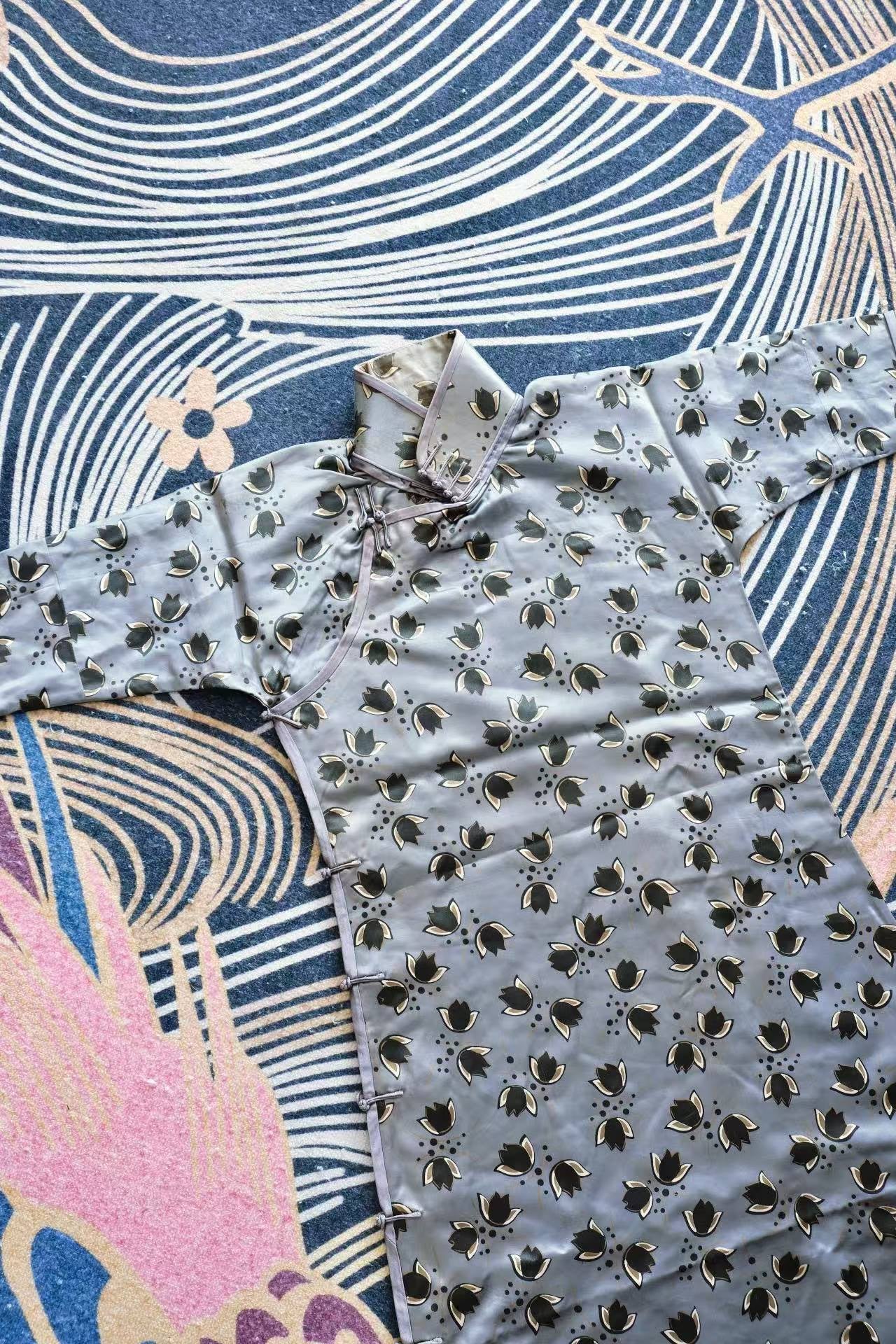
旗袍通体以银灰色真丝重缎为底,其上遍布的郁金香图案堪称“
1930年代的上海,被誉为“东方巴黎”,Art Deco风格随外滩建筑群、百乐门舞厅渗透进城市肌理,
如今,当我们在展柜前凝视这件灰蓝重缎旗袍,
1930s Geometric Tulip Silk Floor-length Cheongsam: A Monolith of Art Deco and Oriental Poetics
A Dialogue Across Time "Spring colors on the Jin River arrive from Heaven and Earth; floating clouds over Yulei change through past and present." When the spring colors of Du Fu’s poetry are frozen upon a canvas of silver-gray heavy silk, transformed into the eternal bloom of 1930s geometric tulips, this floor-length cheongsam becomes a living fossil of East-West aesthetic fusion. It reconstructs Oriental rhythm through the sharp lines of Art Deco. As stated in the Kao Gong Ji (The Record of Trades): "Heaven has its seasons, Earth has its Qi, materials have their beauty, and craftsmanship has its skill." This piece remains a unique artistic masterpiece, fixed in the long river of time.
The Geometry of Nature The body of the garment is crafted from premium silver-gray silk satin, featuring a tulip pattern that is a "harmony of the man-made and the natural." The designer deconstructs traditional flora through the geometric language of Art Deco: each tulip is composed of three symmetrical arc-shaped petals, with champagne-gold outlines forming sharp, broken lines and deep black centers—as solemn as the Taotie motifs on ancient bronzes. The stems are simplified into slender golden lines, interspersed with scattered black dots to create a rhythmic composition described in traditional aesthetics as "sparse enough for a horse to gallop through, yet dense enough to block the wind." This wisdom of "managing complexity through simplicity" echoes the modular aesthetics of the Yingzao Fashi (State Building Standards) while responding to the mechanical beauty championed by the Art Deco movement.
The Spirit of "Oriental Paris" In 1930s Shanghai, known as the "Oriental Paris," Art Deco permeated the city's texture—from the Bund architecture to the Paramount Ballroom. This cheongsam is a microscopic reflection of that era. The tulip, as the national flower of the Netherlands, was stripped of its realistic form and classical ornamentation through geometric transformation, becoming a symbol of "Modernity." It redefined "elegance" within the context of industrial civilization. This cross-cultural translation aligns with Lin Yutang’s philosophy of "standing with one foot in Western culture and one in Eastern," rendering the cheongsam as "wearable history and tangible poetry."
The Eternal "Aura" Today, as we gaze upon this silver-gray satin piece behind the gallery glass, we touch more than the warm texture of silk; we decode the spirit of an era. It deconstructs tradition with geometric lines yet reconstructs aesthetics with Oriental spirit. It embraces industrial civilization without losing the warmth of the human hand. It once swayed with the steps of socialites; today, it speaks the truth in silence: "Fashion fades, only style remains the same." As Walter Benjamin noted regarding the disappearance of the "Aura," this rare Art Deco geometric tulip cheongsam is precisely that "Aura" that never fades, shining eternally in the currents of time.
Share