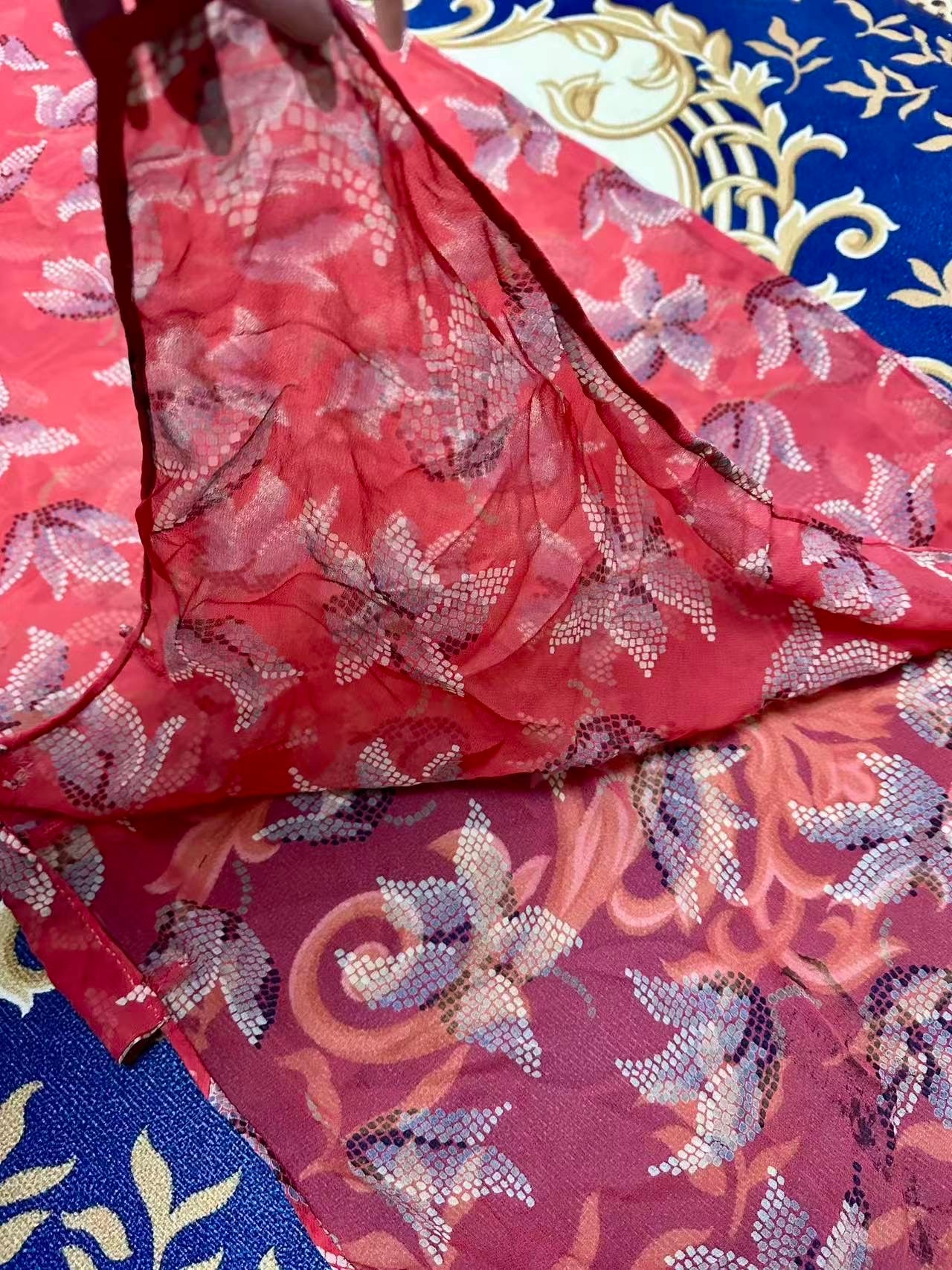
三十年代Art Deco郁金香纹乔其薄纱旗袍:海派摩登的流动诗篇
此件藏品为上世纪三十年代上海工坊杰作,以乔其薄纱为绢,郁金香纹为骨,将Art Deco几何美学与东方女性曲线完美融合。面料选用轻若鸿毛的乔其纱,透光处如烟霞流转,行走间裙裾摇曳生姿,尽显“雾里看花”的朦胧诗意。
其纹样设计堪称海派艺术的典范:以郁金香为主体,花瓣以渐变点彩技法勾勒,每片花瓣由深至浅的点状纹样排列,暗合Art Deco风格对机械几何线条的迷恋,却以柔化处理消解了工业时代的冷硬感。正如《装饰艺术的中国化表达》所言:“海派旗袍纹样常将西洋花卉与传统缠枝结合,形成‘西风东韵’的独特视觉体系”,此件郁金香纹疏密错落,枝叶以卷曲线条延伸,既保留花卉的写实形态,又通过抽象化处理形成韵律感,恰似《申报》1935年一篇时尚评论所描述的“将花园搬上衣襟,却以现代笔触重绘自然”。
工艺上更显稀缺性:乔其纱的脆弱特性使其极难保存,而此件旗袍的印花清晰度、纱质完整性均属罕见。三十年代上海滩虽为远东时尚中心,但真丝乔其纱需进口,仅少数贵族仕女能享,更遑论以复杂套色工艺印制郁金香纹。张信哲收藏的同系列旗袍中,此件因完美呈现“透、薄、软”的纱质美学,成为研究海派服饰材料革新的关键实物。
今展于上海博物馆《摩登华影》展厅,与同期银器、手包共同勾勒民国时尚版图。当观者透过展柜凝视那若隐若现的郁金香纹,仿佛能窥见外滩夜色下穿着它的女子,如何以一袭轻纱,在东西方文化交汇的浪潮中,定格了中国女性身体解放与审美觉醒的黄金时代。此物不仅是服饰,更是镌刻在丝绸上的摩登史诗,见证着海派时尚如何以兼容并包的姿态,成为东方现代性的独特注脚。
1930s Art Deco Tulip-Patterned Georgette Chiffon Qipao: A Fluid Poem of Haipai Modernity
[I. Aesthetic Fusion: Art Deco Meets Oriental Curves] This masterpiece, hailing from a 1930s Shanghai atelier, utilizes Georgette chiffon as its canvas and tulip motifs as its soul. It flawlessly melds the geometric aesthetics of Art Deco with the undulating curves of the Oriental female silhouette. Crafted from Georgette gauze as light as a feather, the fabric flows like shifting mist under the light. With every step, the swaying hemline creates a hazy, poetic elegance—truly embodying the ethereal beauty of "viewing blossoms through a veil."
[II. Motifs: A Paradigm of Haipai Artistry] The pattern design stands as a quintessential example of Haipai (Shanghai-style) artistry. Centered around the tulip, the petals are outlined using a stippling technique of gradient dots. The arrangement of these dots, shifting from deep to pale hues, aligns with the Art Deco fascination with mechanical and geometric lines, yet softens the cold rigidity of the Industrial Age. As noted in The Sinicization of Art Deco: "Haipai Qipao motifs often fused Western flora with traditional winding branches, forming a unique visual system of 'Western winds with Eastern charms'." The tulip patterns here are spaced with rhythmic precision, with stems and leaves extending in curled lines that preserve realistic forms while achieving a modern cadence through abstraction. It evokes a 1935 Shun Pao fashion commentary: "Transplanting a garden onto one’s lapel, yet redrawing nature with a modern brush."
[III. Rarity and Craftsmanship] The scarcity of this piece lies in its exceptional preservation. The fragile nature of Georgette gauze makes it notoriously difficult to maintain; yet, the clarity of the print and the integrity of the fabric on this Qipao are exceedingly rare. Although 1930s Shanghai was the fashion hub of the Far East, silk Georgette remained a luxury import reserved for the aristocratic elite—let alone fabric printed with such complex multi-color tulip motifs. Within the series of Qipaos in the Jeff Chang Collection, this piece serves as a critical artifact for researching material innovation in Haipai attire, perfectly manifesting the "translucent, thin, and soft" aesthetic of gauze.
[IV. Epilogue: An Epic Inscribed on Silk] Now exhibited in the Glamour in Frames gallery at the Shanghai Museum, this Qipao—alongside contemporary silverware and evening bags—sketches the fashion landscape of the Republican era. As viewers gaze at the faint tulip patterns through the display case, they might glimpse a woman in Old Shanghai by the Bund, capturing the Golden Age of Chinese female liberation and aesthetic awakening through a single veil of silk. This is more than a garment; it is a modern epic inscribed on silk, witnessing how Haipai fashion became a unique footnote to Oriental modernity through its spirit of all-inclusive brilliance.