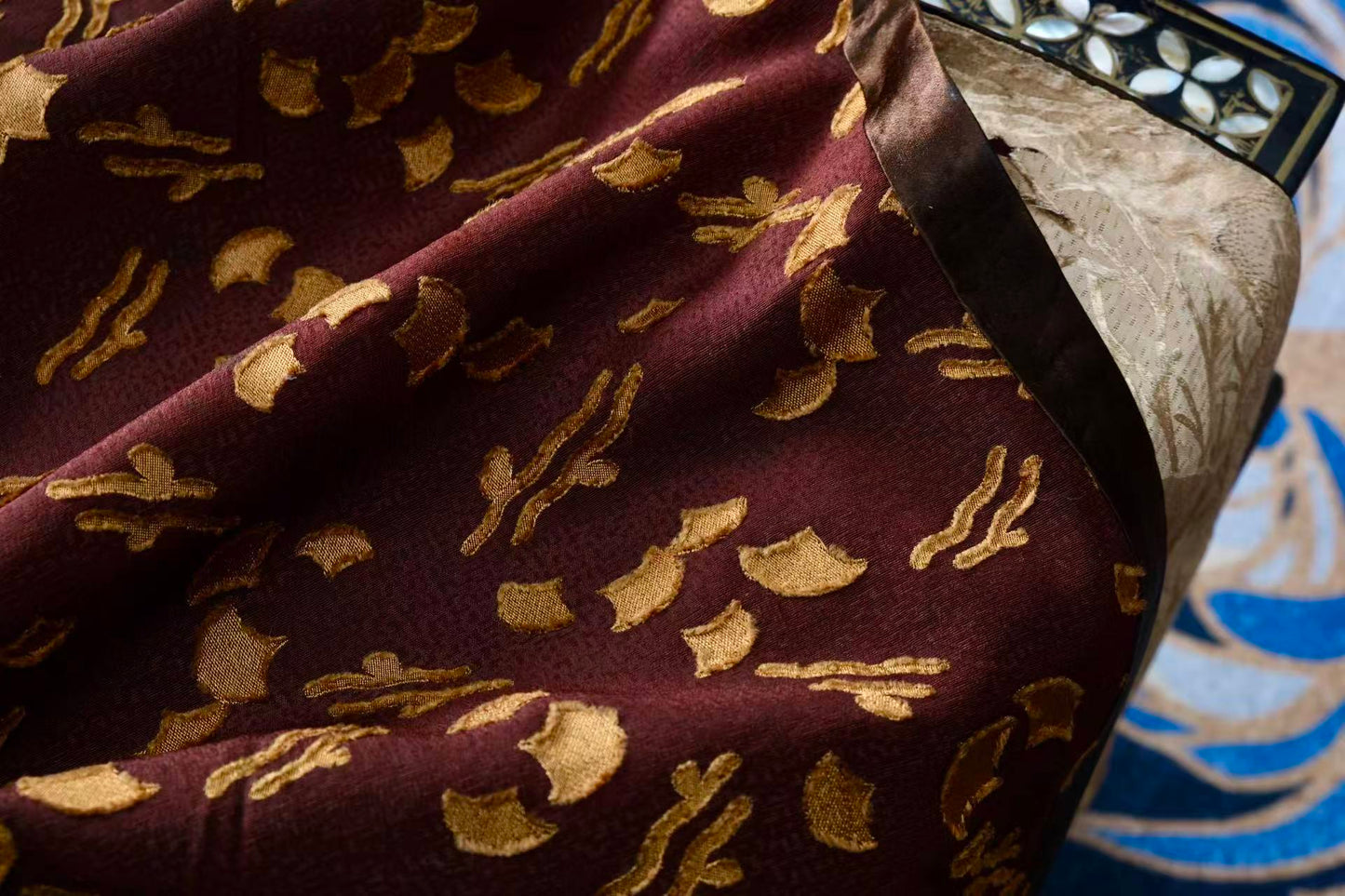
寿山桃影,几何意象:三十年代 Art Deco 寿桃纹提花旗袍
一、图案纹样:几何化的生命诗学
这件旗袍的纹样堪称上世纪30年代“中西纹样融合”的典范。深棕缎面上,以提花工艺织就的“寿桃纹”铺陈出独特的视觉韵律:每个“寿桃”并非传统写实的饱满果实,而是被解构为简洁的几何弧线——半圆的桃身、流线型的枝叶,以对称或散点式排列铺陈,既保留了“寿桃”象征长寿的文化基因,又通过几何化处理,暗合Art Deco风格“机械美学与装饰性并重”的核心精神。金线的光泽在棕底上若隐若现,如暗夜中的星芒,既呼应了Art Deco对“奢华感”的追求,又以传统吉祥纹样的内核,完成了东方审美与西方现代主义的对话。
二、工艺细节:宽绲与寿桃花扣的匠心叙事
旗袍的工艺细节,是民国制衣技艺的“活化石”。领口、袖口、开衩处的“宽绲边”,以同色系深棕丝绒绲条层层包裹,绲条边缘压细线,使轮廓立体而精致,既符合30年代“繁复精致”的审美风尚,又通过宽绲的厚重感,平衡了提花纹样的轻盈,让整件衣裳在视觉上“稳而不滞”。
三、时代故事:摩登上海的“衣香鬓影”
这件旗袍诞生于上世纪30年代的上海,那是中国近代服饰史的“黄金时代”。彼时,Art Deco风格随西方建筑、电影、时尚涌入上海,与本土文化碰撞出独特的“海派美学”。旗袍作为女性解放的象征,从宽袍大袖的清式旗装,演变为凸显女性曲线的“新式旗袍”,而这件衣裳,正是这一变革的缩影:它摒弃了传统刺绣的繁复,以提花工艺实现纹样的工业化与艺术化结合;它保留了中式盘扣、立领的传统元素,却用几何纹样与宽绲工艺,注入西方现代主义的简洁与奢华。穿着它的女子,或许是外滩舞厅里摇曳生姿的名媛,或许是《良友》画报上摩登女郎的原型——她踩着细高跟,手持描金团扇,旗袍的下摆随步伐摆动,丝绸在灯光下闪烁,仿佛将“长寿”“富贵”的古老祈愿,化作了都市女性对自由、时尚的现代宣言。
四、艺术稀缺性:历史的“衣褶”与文化的“切片”
从艺术史维度看,这件旗袍的稀缺性体现在三重维度:其一,工艺的不可复制性——提花工艺需手工织机与匠人经验的完美配合,现代机器难以复刻其纹理的细腻与丝绸的光泽;其二,风格的过渡性——它处于“传统纹样”向“现代设计”转型的关键节点,是Art Deco风格在东方服饰中“在地化”的实证;其三,文化的承载性——寿桃纹、盘扣、宽绲,每一处细节都是中国传统服饰文化的“活化石”,而整体的几何化处理,则是民国“中西合璧”美学的具象表达。正如沈从文在《中国古代服饰研究》中所言:“服饰是历史的皮肤,每一道褶皱里都藏着时代的密码。”这件旗袍,正是解读上世纪30年代上海、解读中西文化交融、解读女性服饰变革的“密码本”。
五、结语:衣香里的百年回响
当我们将目光投向这件旗袍,看到的不仅是布料与针线的堆叠,更是一个时代的呼吸:它是Art Deco风格的“东方变奏”,是海派文化的“衣着注脚”,是无数民国女子“爱美之心”的物质载体。当我们轻抚它的纹路,仿佛能听见外滩的汽笛、舞厅的爵士乐,以及那个时代女性对美的执着追求。这,便是古董衣的魅力:它用沉默的衣褶,诉说着百年不息的故事。
The Geometry of Longevity: A 1930s Art Deco "Longevity Peach" Qipao
I. Pattern: The Poetics of Geometric Vitality
This Qipao is a paradigm of the "Sino-Western fusion" of the 1930s. On a deep brown satin base, the "Longevity Peach" (Shoutao) motif is rendered through a jacquard technique to create a unique visual rhythm. Rather than traditional realistic fruit, each peach is deconstructed into minimalist geometric arcs—semicircular bodies and streamlined leaves arranged in symmetrical or scattered patterns. This retains the cultural DNA of longevity while aligning with the core Art Deco spirit of "mechanical aesthetics balanced with ornamation." The subtle shimmer of gold thread against the brown base evokes a sense of "understated luxury," completing a dialogue between Oriental aesthetics and Western Modernism.
II. Craftsmanship: A Narrative of Wide Piping and Ruyi Knots
The details of this garment are "living fossils" of Republican-era tailoring. The collar, cuffs, and side slits feature "Wide Piping" (Kuan Gun)—layers of tonal dark brown velvet strips pressed with fine lines to create a three-dimensional contour. This reflects the 1930s obsession with "intricate refinement" while providing a visual weight that balances the lightness of the jacquard pattern, making the overall silhouette stable yet fluid.
III. Historical Context: The "Shadows of Elegance" in Modern Shanghai
Born in 1930s Shanghai—the "Golden Age" of modern Chinese fashion—this Qipao witnessed the influx of Art Deco through Western architecture, film, and fashion. As a symbol of female liberation, the Qipao evolved from the loose Manchu robes into the "New Style Qipao" (Xinshi Qipao) that accentuated the female curve. This garment is a microcosm of that revolution: it replaces complex embroidery with industrial-artistic jacquard and injects Western minimalism into traditional standing collars and frog buttons.
IV. Artistic Rarity: A Slice of Cultural History
Its rarity is threefold: First, the irreproducibility of the jacquard texture and silk luster achieved on manual looms. Second, its transitional style, serving as evidence of the "localization" of Art Deco in Eastern dress. Third, its cultural weight—every fold is a "code" for understanding 1930s Shanghai and the intersection of Sino-Western cultures, as Shen Congwen noted: "Clothing is the skin of history."
V. Conclusion: A Century of Echoes
Touching this fabric, one hears the foghorns of the Bund and the jazz from the ballrooms. It is an "Oriental Variation" of Art Deco and a material carrier of the "pursuit of beauty" by women a century ago. It uses silent folds to tell a story that never fades.