深圳溯源
Couldn't load pickup availability
四十年代海派波点提花双襟旗袍:现代意识与东方美学的物质见证
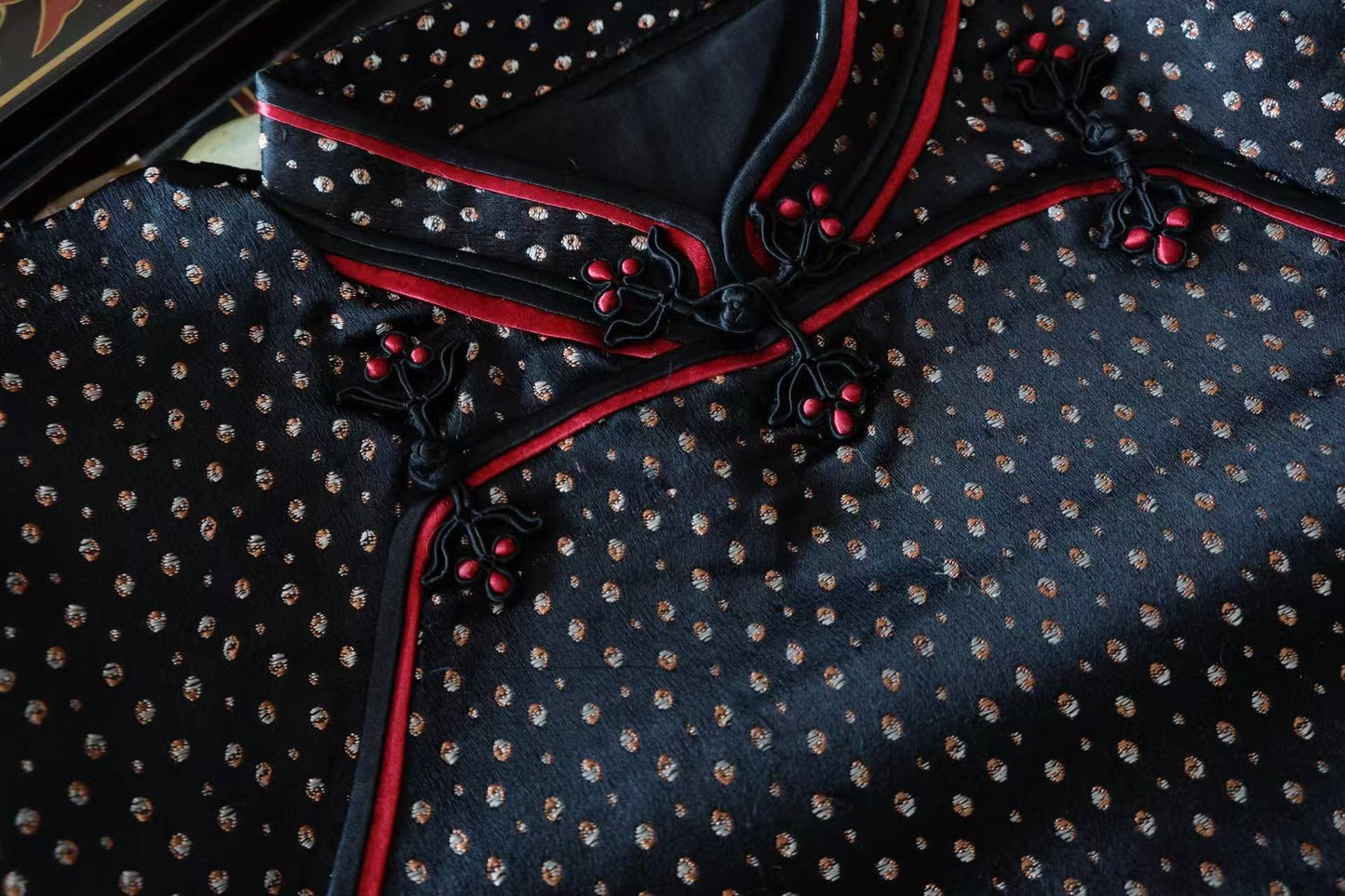
这件上世纪四十年代中期的波点提花双襟花扣垫肩古董旗袍,
这件旗袍的形制透露出明确的时代气息。1940年代中期,
衣襟采用“双襟”设计——即在传统右衽大襟之外,
旗袍面料为黑色底配细密波点提花,这种“波点”
这种“素地碎花”或“暗纹提花”的面料在当时极为考究,
领口、襟边、袖口及开衩处均饰以红色绲边,形成强烈的“
最为夺目的是领口与双襟上排列的立体花扣(盘扣)。
存世的1940年代中期旗袍多为单襟、素面或印花,如此件集“
这件旗袍不仅是一件衣物,更是一份流动的文本。它以布为纸,
它不仅是收藏的珍品,更是研究中国近现代服饰史、
1940s Haipai Polka Dot Jacquard Double-Breasted Cheongsam: A Fragment of Modernity and Oriental Poetics
A Golden Era Silhouette This mid-1940s antique cheongsam is a rare vestige of the golden age of Shanghai-style (Haipai) fashion. It stands as a material witness to the confluence of post-war modern consciousness and Oriental aesthetics. Influenced by Western trends, the silhouette features a transition from the traditional "wide-cuff" to a more tapered sleeve, while the integrated shoulder pads emphasize a structured, upright shoulder line—reflecting the independent and confident spirit of the modern woman of that era.
The Craft of the "Double-Breasted" Design The garment utilizes a double-breasted (Shuangjin) layout, an evolution of the early Republican-era vests. By adding a parallel or symmetrical small lapel alongside the traditional right-side closure, the design achieves a balanced, symmetrical beauty. This "new combination of old elements" adds a sophisticated sense of layering and remains a hallmark of high-end Haipai tailoring.
The "Broken Star" Jacquard Fabric The fabric is a black ground adorned with fine polka-dot jacquard, patterns historically referred to in the Republic of China as "Rice-Bead" or "Fragmented Star" motifs. Unlike common prints, these micro-dots are meticulously woven using warp and weft threads, with some containing metallic or contrasting silk filaments that create a shimmering effect. As the ancient text Qing Yi Lu (Records of the Strange and Fine) describes: "Gold is woven and beads are strung, creating light and shadow that flow like water." This subtle jacquard signaled the wearer’s refined taste, avoiding garishness in favor of shifting, liquid shadows.
The Red-and-Black Dialectic The collar, lapels, cuffs, and side slits are all finished with vibrant red piping, creating a dramatic "Red-Black Contrast." In the traditional Chinese color system, Black (Xuan) symbolizes solemnity and depth, while Red (Zhu) signifies vitality and celebration. Their juxtaposition creates a look that is both respectful of tradition and lively in its modern expression—a perfect example of "Chinese essence with Western application."
The Art of "Pocket Drama" Buttons The most captivating features are the three-dimensional floral frog buttons (Pankou) lining the collar and double lapels. Crafted with black silk "vines" and red bead "stamens," they resemble plum or begonia blossoms. These are not merely functional fasteners but independent works of art. Each button required a complex process of "coiling, knotting, sewing, and embellishing," reflecting the 1940s aesthetic where "decoration is an attitude."
A Living Text of History While most surviving 1940s cheongsams are single-breasted or simply printed, this piece—combining double lapels, polka-dot jacquard, shoulder pads, and 3D pankou—is an incredibly rare archival unique piece (Gu-pin). As the legendary writer Eileen Chang famously noted: "Clothes are a language... a pocket drama that one carries around." This cheongsam is the most intriguing scene of that drama—low-key yet magnificent, silent yet filled with the power of narrative.