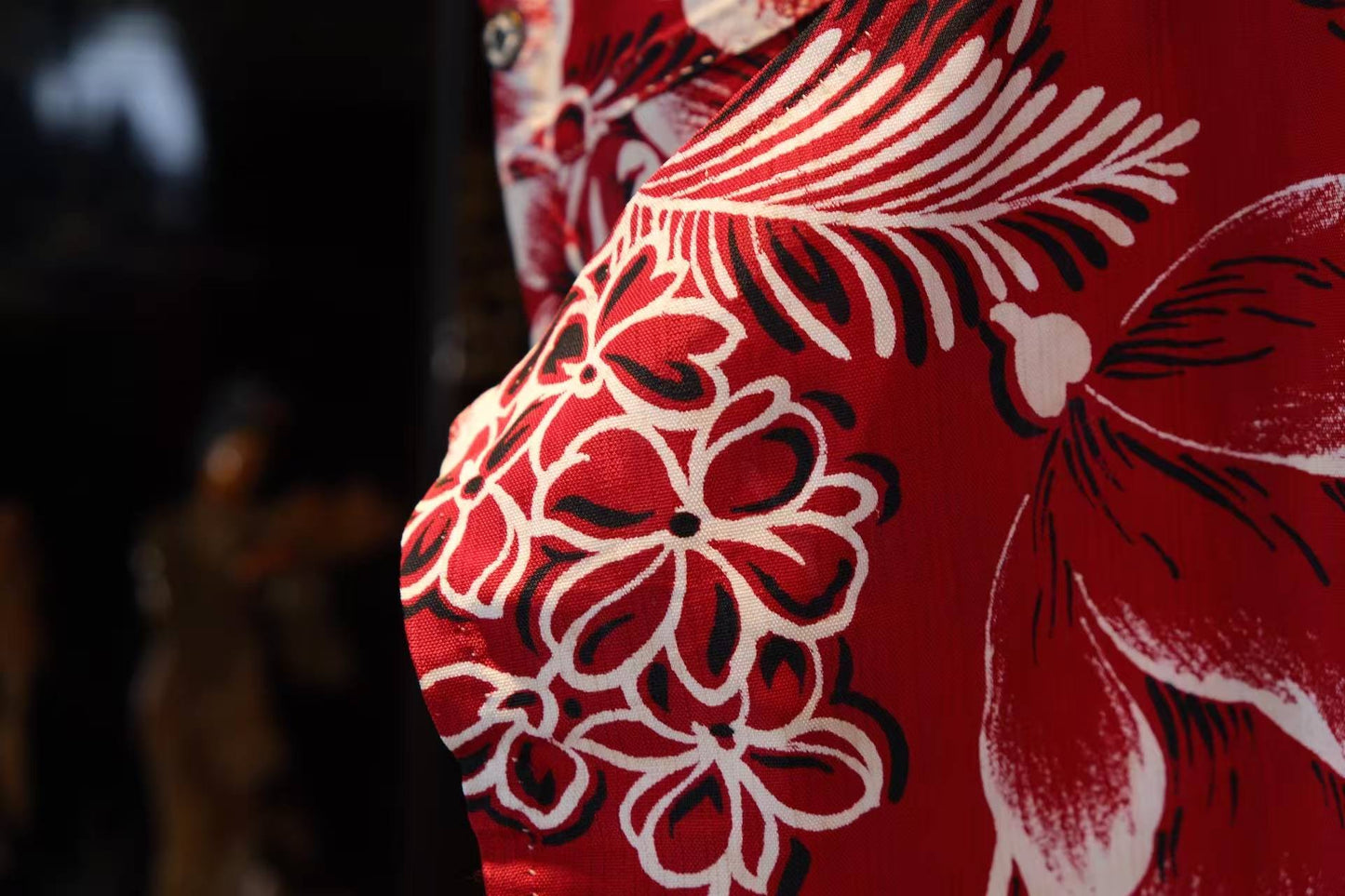
This garment is a quintessential specimen of the "Shanghai Style" (Haipai) Qipao from the 1940s. Moving away from the loose-fitting robes of the late Qing and early Republic, it has evolved into a "New Era feminine attire" that emphasizes the female silhouette. Its tailoring subtly aligns with the ancient principle of "following the compass and square" from the Book of Rites, yet it is reconstructed with Western three-dimensional cutting—fitted shoulders, a cinched waist, and a slightly flared hem—melting Oriental grace and Western anatomical aesthetics into one.
The motif centers on the "Splashed-Ink Peony," an artistic language traceable to a triple tradition:
Folklore & Auspicious Omens: Since the Tang Dynasty, the peony has been hailed as the "King of Flowers," symbolizing wealth and longevity. Against a carmine base, the white-contoured peonies bloom in layers, echoing the fame of being "peerless under heaven" from the Youyang Zazu. It serves as a metaphor for the wearer's identity as "the beauty of the nation."
The Shanghai School of Painting: The brushwork originates from the "Boneless" (Mogu) technique of the Shanghai School artist Xu Gu. Petal edges are rendered with white powder gradients, allowing the base color to peek through the center, achieving what the Maritime Forest of Ink describes as "rhythmic vitality without the need for varied colors." The leaves are outlined in black, resembling the "Gold and Stone" calligraphic strength of Wu Changshuo, creating a "Black and White Symphony" upon the red ground—a testament to the aesthetic tension of Modern Classicism in the Republican era.
Historical Metaphor: During the 1940s, as national industries struggled for survival, this "Splashed-Ink Peony" abandoned complex traditional embroidery in favor of machine printing to achieve a "freehand" effect. Just as the Shen Bao advocated in 1943, it sought to "pursue literati charm through mechanical labor," becoming a fashion manifesto of the symbiosis between practicality and aesthetics during a turbulent period.
Brushing your hand over this carmine red, one can almost hear the sigh from Eileen Chang’s Chronicle of Changing Clothes as she "drapes the robe over the body." It is not only a physical manifesto of the "liberation of curves" for Republican-era women but also a living fossil of East-West cultural collision. The patterns inherit the spirit of literati painting, the tailoring aligns with Western anatomy, and the fabric witnesses the struggle of national industry. As Shen Congwen noted in Research on Ancient Chinese Costumes: "The use of clothing is not merely to cover the body, but to serve as a projection of the spirit of the age."
Having endured eighty years of vicissitudes, the red remains unfaded—much like that "brilliant era amidst chaos." Within its warp and weft, it eternally radiates a splendor that belongs to Shanghai, to China, and to women.