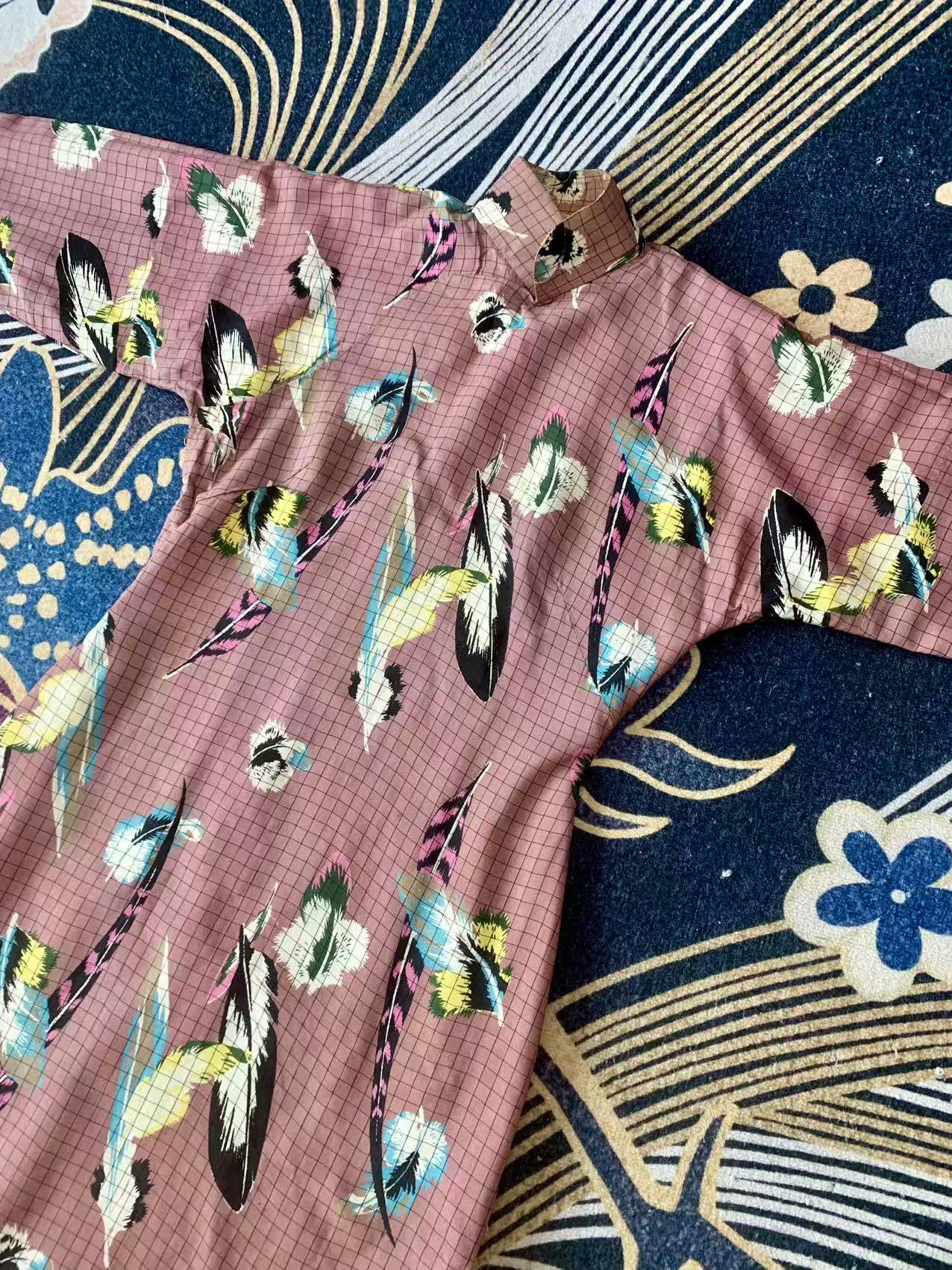
民国四十年代羊毛针织Art Deco古董旗袍 ——華龍綢緞呢絨公司的时代绝响
衣服尺寸:
胸围/腰围/臀围:82/72/96 厘米
衣长:113 厘米
细节描述:
一、图案:Art Deco与东方美学的碰撞
这件旗袍的图案,是民国时期中西文化交融的视觉史诗。底色为温柔的藕粉,其上以Art Deco风格重构的羽毛纹样肆意舒展,黑白、蓝绿、明黄的色块如宝石般镶嵌其间,既有几何线条的利落,又不失羽毛的轻盈灵动。细看之下,羽毛的排列暗合“风动羽翼”的东方意象,却以西方现代主义的抽象手法呈现——这种“中学为体,西学为用”的设计,正是四十年代上海摩登美学的缩影。
二、故事:華龍綢緞呢絨公司的时代印记
旗袍领口内侧的标签“華龍綢緞呢絨公司”,如同一枚时光印章,指向民国上海纺织业的黄金年代。華龍公司作为当时沪上知名绸缎庄,以“兼收并蓄,中西合璧”为理念,专供上层社会定制面料。这件旗袍采用罕见的羊毛针织工艺,既突破传统丝绸旗袍的柔美范式,又迎合了四十年代“实用与时尚并重”的穿着需求——羊毛的挺括质感,让旗袍在保留曲线美的同时,更添一份现代女性的飒爽。
三、艺术与稀缺性:不可复制的时代孤品
从艺术史角度看,这件旗袍是Art Deco风格在中国服饰上的巅峰实践。其图案的几何化羽毛、色彩的高饱和度对比,与同期法国设计师Paul Poiret的“东方主义”设计遥相呼应,却又因本土化的工艺(如传统立领、斜襟)而独具东方韵味。更难得的是,羊毛针织面料在民国旗袍中本就罕见,加之華龍公司的品牌背书,使其成为存世量极少的“活化石”——据《中国近代纺织史》记载,1940年代能生产此类面料的工厂不足十家,而完整保存至今的成衣更是凤毛麟角。
张爱玲在《更衣记》中写道:“旗袍的领子、袖子、下摆,每一处都是时代的注脚。”这件旗袍,恰是注脚中最璀璨的一页:它以Art Deco的锋芒,划破传统服饰的温柔乡;以羊毛针织的革新,回应女性解放的浪潮;更以华龙的标签,定格了民国商业文明的辉煌。
今日重观此衣,不仅是欣赏一件古董,更是触摸一段“西风东渐”的文化记忆——它的稀缺,在于工艺的绝版;它的永恒,在于时代的回响。
An Art Deco Poem in Wool Knit: A 1940s Republic-Era Vintage Cheongsam
— The Epochal Swan Song of the "Hwa Lung Silk & Woolen Co." —
Measurements / Size Guide:
Bust / Waist / Hips: 82/72/96 cm
Total Length: 113 cm
Detailed Description:
I. Patterns: The Collision of Art Deco and Eastern Aesthetics
The pattern of this cheongsam (qipao) is a visual epic of the fusion between Chinese and Western cultures during the Republic of China era. Against a gentle lotus-pink base, feather motifs reconstructed in the Art Deco style stretch boldly across the fabric. Blocks of black, white, blue-green, and bright yellow are inlaid like gemstones, possessing both the crispness of geometric lines and the ethereal lightness of feathers. Upon closer inspection, the arrangement of the feathers evokes the Eastern imagery of "wings caught in the wind," yet is rendered through the abstract lens of Western Modernism. This design—using Western techniques to serve Eastern substance—is the epitome of 1940s "Modern Shanghai" aesthetics.
II. Story: The Temporal Imprint of Hwa Lung Silk & Woolen Co.
The label inside the collar, "Hwa Lung Silk & Woolen Co." (Hua Long Chou Duan Ni Rong Gong Si), acts as a temporal seal pointing toward the golden age of the Shanghai textile industry. As a renowned silk and wool emporium in old Shanghai, Hwa Lung championed the philosophy of "inclusivity and East-meets-West," specializing in bespoke fabrics for high society. This qipao employs a rare wool knit process, breaking the soft paradigm of traditional silk qipaos while catering to the 1940s demand for "utility paired with fashion." The structured texture of the wool allows the garment to retain its curvaceous beauty while adding a sense of crisp, modern feminine independence.
III. Art and Scarcity: An Irreplaceable Period Specimen
From an art history perspective, this qipao represents the pinnacle of Art Deco practice in Chinese costume. The geometric feathers and high-saturation color contrasts echo the "Orientalism" of contemporary French designer Paul Poiret, yet remain uniquely Eastern due to localized craftsmanship (such as the traditional standing collar and diagonal closure). Furthermore, wool knit fabrics were exceptionally rare in Republic-era qipaos. Combined with the brand pedigree of Hwa Lung, it has become a "living fossil" with extremely low survival rates. According to the History of Modern Chinese Textiles, fewer than ten factories in the 1940s were capable of producing such fabrics, and intact garments surviving to this day are as rare as phoenix feathers.
As Eileen Chang wrote in Chronicle of Changing Clothes: "The collar, sleeves, and hem of a qipao are all footnotes to an era." This qipao is perhaps the most brilliant page among those footnotes: it uses the edge of Art Deco to pierce through the gentle comfort of traditional attire; it responds to the waves of female liberation through the innovation of wool knit; and through the Hwa Lung label, it freezes the glory of Republic-era commercial civilization.
To view this garment today is not merely to appreciate an antique, but to touch a cultural memory of "Westward winds blowing East." Its scarcity lies in the extinction of its craft; its eternity lies in the echo of its era.