深圳溯源
50年代 - 七彩织金玫瑰旗袍:一袭风华里的时代密码 | 1950s - The Rainbow Woven-Gold Rose Cheongsam: A Code of the Era Encapsulated in Elegance
50年代 - 七彩织金玫瑰旗袍:一袭风华里的时代密码 | 1950s - The Rainbow Woven-Gold Rose Cheongsam: A Code of the Era Encapsulated in Elegance
Couldn't load pickup availability
七彩织金玫瑰旗袍:一袭风华里的时代密码
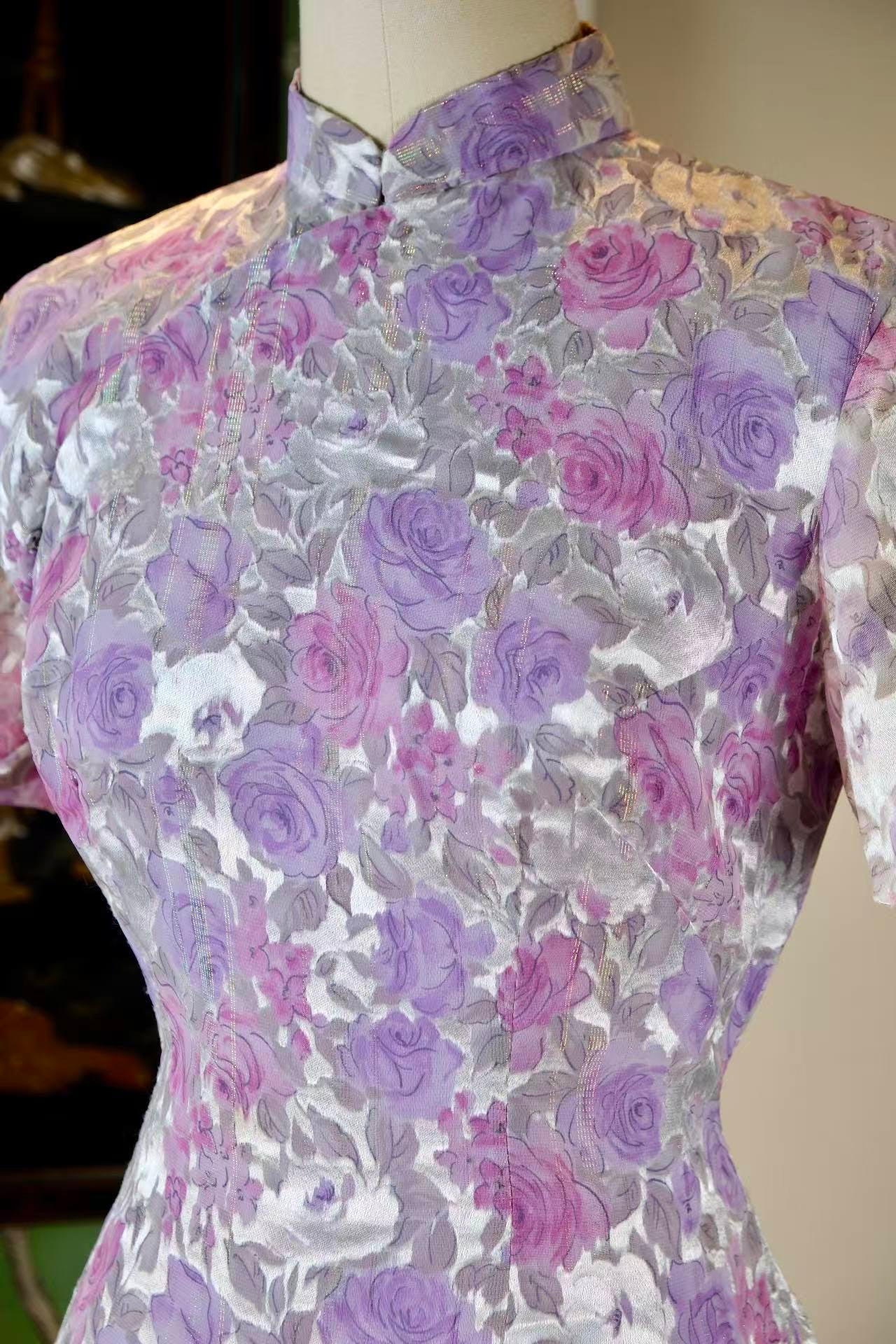
此袍面料以织金工艺缀竖条纹七彩金线,金线在光下流转如虹,
袍身满布玫瑰纹样,粉紫、 薰衣草色、银灰三色交织,花瓣层次分明,枝叶舒卷自然,
更妙者,玫瑰布局暗合“满池娇”遗韵——宋元时期织物喜以荷花、
此袍非独衣饰,实为凝固的历史切片。
The Rainbow Woven-Gold Rose Cheongsam: A Code of the Era Encapsulated in Elegance
The fabric of this gown is adorned with vertical stripes of seven-colored gold threads, utilizing the traditional Zhijin (woven gold) technique. Under the light, these threads shimmer like a shifting rainbow, seamlessly fusing the meticulousness of Eastern weaving with the opulence of Western decoration. As recorded in The Exploitation of the Works of Nature (Tiangong Kaiwu): "Woven gold, where golden filaments are interlaced within the warp and weft, shines as brilliant as a shooting star." Rather than being mere surface embellishment, the gold is integrated into the satin weave, creating a mesmerizing play of light and shadow with every movement. It evokes the rhythmic clatter of looms in mid-century Taiwanese textile workshops, where master artisans danced precious metals with silk threads to create this "priceless brocade."
The gown is covered in a lush tapestry of roses in shades of pink-purple, lavender, and silver-grey. The petals are richly layered and the stems gracefully entwined, showcasing a masterful skill in life-drawing. Historically, the rose was not a mainstream motif in traditional Chinese art; the Miscellaneous Morsels from Youyang (Youyang Zazu) once dismissed it as a "foreign flower" (Hu Hua). It was only after the Tang and Song dynasties that it gradually entered central China, gaining its elegant name "Meigui" in the Republican era. In 1950s Taiwan, influenced by Euro-American culture, the rose became a symbol of modernity. This cheongsam, adorned with roses, stands as a microscopic witness to the convergence of Eastern and Western aesthetics.
Most exquisite is the layout, which carries the lingering charm of the "Manchijiao" (Full-Pond Charm) style. Popular during the Song and Yuan dynasties, this style filled the fabric with lotus flowers and waterfowl to achieve a "seamless" effect. Here, roses fill the entire expanse of the warp and weft, their branches flowing like water—preserving ancient sensibilities while breaking new aesthetic ground. The weaver used gradient silk threads to simulate a blooming effect, with silver-grey leaf veins tracing the edges of pink-purple petals. It is a symphony of Gongbi (meticulous brushwork) and Xieyi (freehand ink wash), pushing the lyricism of floral patterns to its zenith.
This gown is more than a garment; it is a frozen slice of history. It carries memories of the rise of post-war Taiwan’s textile industry and bears witness to the collision and fusion of global aesthetics. Through the eternal dialogue between rose and gold, it speaks of the grace and resilience of women from that era. When displayed, one can almost see a lady of the past gliding by, the gold threads shimmering like a galaxy and the roses blooming like a spring morning. This is the deepest allure of the cheongsam: it gives a shape to time and a temperature to history.
Share