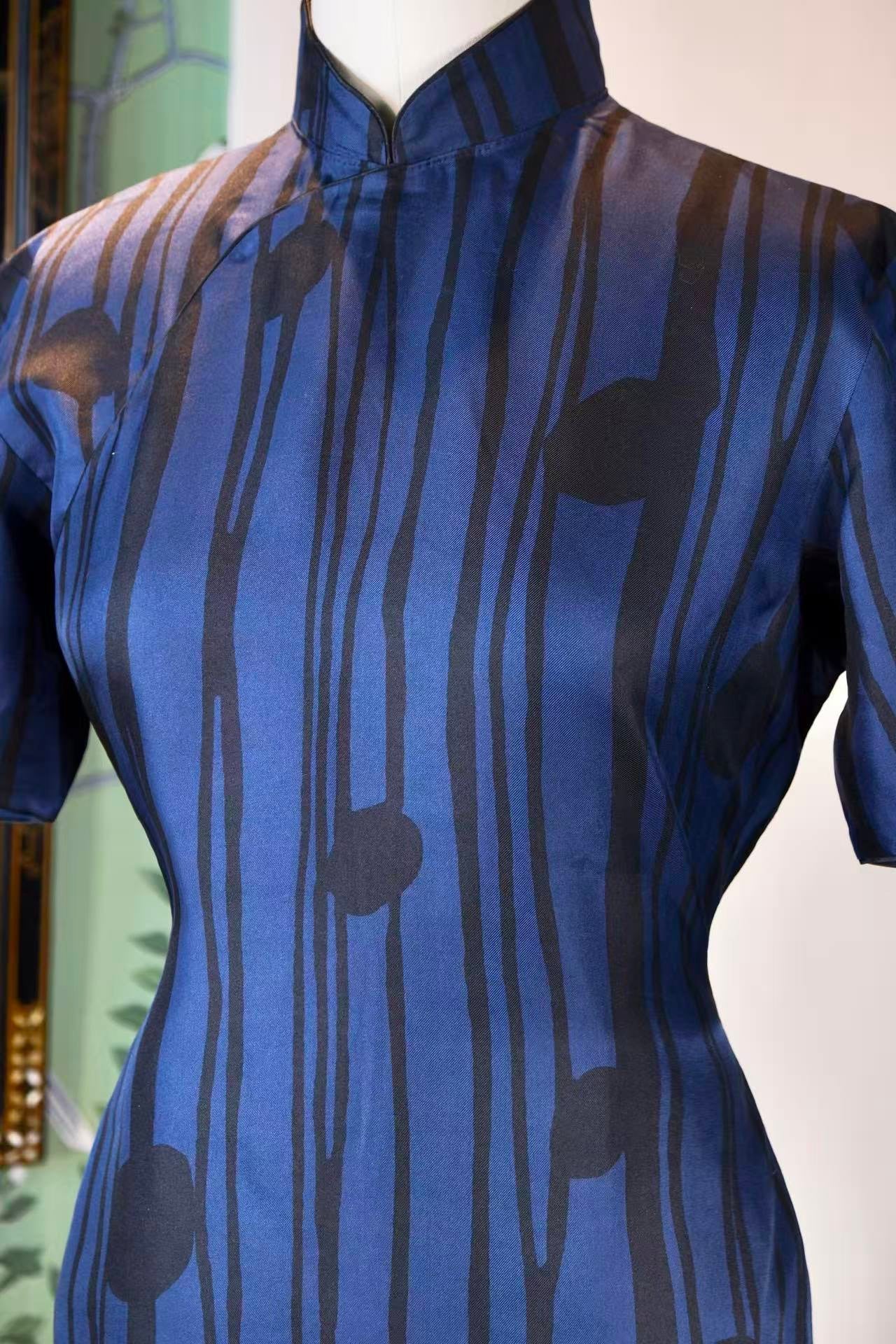
1950s Mid-Century Hong Kong Antique Qipao: Abstract Ink-Wash in Twill Silk
A Sartorial Masterpiece of Post-War Modernity This mid-1950s antique qipao from Hong Kong is a rare masterpiece, embodying the "triple excellence" of abstract printing, twill silk, and the legendary "incense-stick" piping (Xian Xiang Gun). The fabric is a high-density twill silk—known for its strong surface tension and understated luster—which was the preferred choice for elite Hong Kong ateliers of the era, such as "Hung Heung" and "Lin Va." The "incense-stick" piping—an ultra-fine, hand-stitched border—runs along the lapel and cuffs. This subtle, pencil-thin black silk edging defines the garment’s "skeletal" beauty without being ostentatious, serving as the ultimate expression of quiet luxury.
"Wearable Abstract Ink-Wash": A Modernist Vision The motif features a bold abstract design: a deep royal blue base overlaid with vertical black stripes that fall like lines of rain, interspersed with irregular black dots reminiscent of "rain hitting plantain leaves" or "ink droplets diffusing on rice paper." This composition breaks the traditional qipao convention of "all-over florals," pivoting instead toward the aesthetics of "Liubai" (negative space) and "Xieyi" (expressive freehand brushwork), echoing the spirit of Song Dynasty literati paintings. As the poet Su Shi once remarked: "To judge a painting by formal likeness is to have the understanding of a child." This print represents an Oriental Modernist expression—achieving spirit rather than mere form—a true piece of "wearable abstract ink-wash."
The Pinnacle of Bespoke Craftsmanship From the perspective of fashion history, mid-1950s Hong Kong qipaos were at the critical juncture of transitioning from tradition to modernity. Influenced by post-war Western trends like the Bauhaus movement, Hong Kong tailors began experimenting with cleaner, more urbanized silhouettes and motifs. This piece is a quintessential example of "East meets West," blending international Modernism with traditional Chinese ink-wash aesthetics. The combination of twill silk and "incense-stick" piping marks it as a hallmark of High Couture (Haute Couture). While ordinary qipaos used wide piping to conceal raw edges and stitching, this garment dares to use the finest possible border, proving that its tailoring and construction have reached a level of perfection that requires no camouflage.