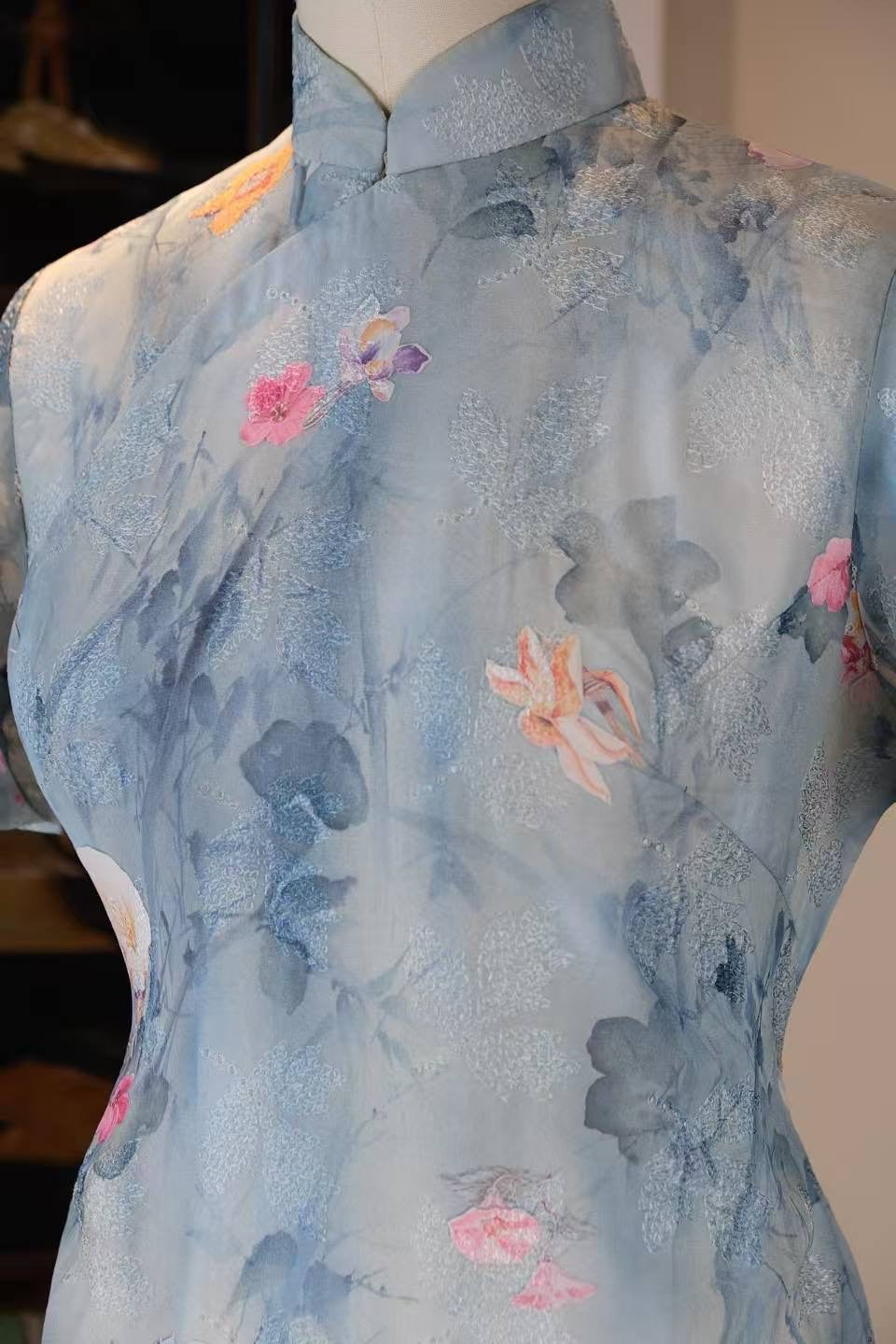
五十年代台湾产天青色水墨机绣蕾丝旗袍
这是一件极为珍稀的上世纪五十年代中期台湾产古董旗袍,以天青色为底,融水墨晕染与机绣蕾丝工艺于一炉,堪称战后华人服饰美学的巅峰之作。其面料轻薄透亮,如烟如雾,花卉图案以写意笔法散点式铺陈,粉、白、橙、紫诸色花卉错落其间,枝叶舒展,宛若纸上水墨未干而被轻纱覆面,既有宋代院体花鸟的清雅,又具文人画“逸笔草草,不求形似”的神韵。
旗袍的图案设计深得中国传统绘画“经营位置”之妙,花卉分布疏密有致,虚实相生,正如《林泉高致》所言“远观其势,近观其质”。机绣蕾丝工艺在当时属高端技术,尤以台湾地区少数工坊能精制此类面料,其针脚细密如发,立体感强,使花卉在光线下呈现浮雕般层次,又因年代久远而略带自然氧化的柔光,更添古朴温润之气。
此袍形制为典型五十年代旗袍,短袖微喇,收腰合体,下摆略开衩,既保留传统旗袍的婉约线条,又适应当时女性日常穿着需求,体现“新生活运动”后对女性服饰实用与审美并重的思潮。天青色作为中国传统色中“青出于蓝而胜于蓝”的象征,既非浓艳亦非寡淡,恰如《诗经》“青青子衿”所喻的君子之志,含蓄而高华。
其稀缺性不仅在于年代久远、保存完好,更在于其工艺与美学的不可复制性——彼时台湾纺织业正处于战后复苏与文化重构的关键期,此类融合水墨意境与西式机绣技法的面料,产量极少,多为仕女名流定制,今已难觅原品。此袍实为“穿在身上的水墨画”,亦是二十世纪中叶华人女性文化记忆的物质载体,值得珍藏与细品。
1950s Taiwan Antique Qipao: Azure Silk with Ink-Wash Aesthetic and Machine-Embroidered Lace
A Masterpiece of Post-War Chinese Aesthetics This exceptionally rare mid-1950s antique qipao from Taiwan is a pinnacle of post-war Chinese sartorial art, seamlessly merging ink-wash textures with machine-embroidered lace. The fabric is light and translucent, akin to mist or smoke. The floral patterns are arranged in a scattered, freehand (Xieyi) composition, with blossoms in shades of pink, white, orange, and purple interspersed throughout. The branches and leaves stretch elegantly, creating the illusion of fresh ink on paper viewed through a delicate veil. It possesses both the refined elegance of Song Dynasty court paintings and the divine charm of literati art—"sketchy strokes that seek the spirit rather than a literal likeness."
The Philosophy of "Managed Position" The pattern design deeply understands the "Management of Position" (Jingying Weizhi) found in traditional Chinese painting. The distribution of flora creates a balance of density and space, a harmony of "the solid and the void," echoing the wisdom of the Linquan Gaozhi: "Observe its momentum from afar, and examine its texture up close." At the time, machine-embroidered lace was a high-end technology mastered only by a few select workshops in Taiwan. The stitches are as fine as hair, providing a three-dimensional, relief-like quality to the flowers under the light. After decades, a subtle, natural oxidative luster has developed, adding a sense of ancient, jade-like warmth.
The Azure Symbolism of the 1950s The silhouette is a quintessential 1950s qipao—short flared sleeves, a fitted waist, and a slight side slit. It preserves the graceful lines of tradition while adapting to the practical needs of modern life, reflecting the mid-century trend of balancing utility with beauty. Azure (Tianqing), a color signifying "rising above the source" in Chinese tradition, is neither gaudy nor dull. It embodies the "gentleman’s ambition" alluded to in the Book of Songs—restrained yet noble.
An Irreplaceable Cultural Specimen Its rarity lies not only in its age and pristine condition but in the irreproducible nature of its craft and aesthetic. During Taiwan's post-war recovery and cultural reconstruction, fabrics that merged ink-wash artistry with Western mechanical embroidery were produced in extremely limited quantities, primarily as bespoke commissions for the social elite. This garment is truly a "wearable ink painting" and a material vessel for the cultural memory of mid-20th-century Chinese women. It is a masterpiece worthy of both collection and deep appreciation.