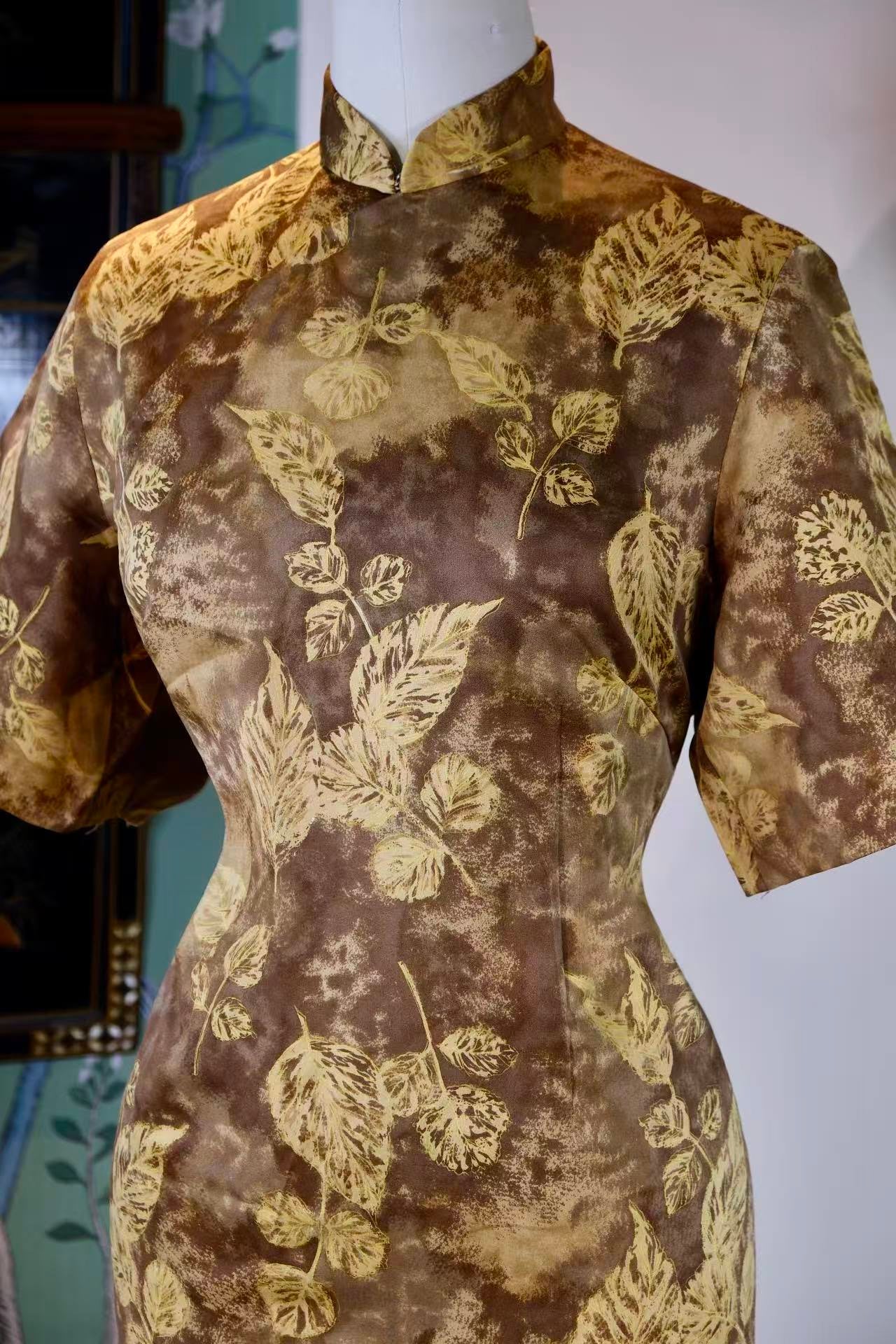
五十年代台湾金叶旗袍:丝绸上的秋日诗篇
“庭前落尽梧桐,水边开彻芙蓉。”——宋·朱庭玉《天净沙·秋》
当一片金叶飘落在赭褐色的天光里,时光便凝固成了这件五十年代台湾古董旗袍的纹样。棕黄色的底子如同秋日晒干的泥土,带着岁月沉淀的哑光质感;手工印染的树叶纹样错落有致,从领口蜿蜒至裙摆,恰似“一叶落而知秋”的东方禅意。叶片脉络以描金细勾,有的舒展如扇,有的卷曲如蝶,枝蔓间疏密得当,将宋人画叶的写实与文人写意的洒脱融为一体。
“云破月来花弄影,绸缪枫叶荻花秋。”——唐·白居易《琵琶行》(化用“枫叶荻花秋瑟瑟”句意)
旗袍的剪裁暗合五十年代台湾改良旗袍的风韵:高领窄袖却在肩线处微微外扩,既保留了传统旗袍的含蓄,又暗藏西式剪裁的立体感;腰节线较民国时期略低,贴合人体曲线却不紧绷,行走时裙摆摇曳如风过林梢,金叶纹样便在光影中流转生姿。这般“合度而不张扬”的美学,恰是彼时台湾仕女“新中式”着装哲学的缩影——在传统与现代的碰撞中,守住一份东方的从容。
这件旗袍的织造者,或许是某位从苏州迁台的老裁缝,在异乡的秋日里,将对江南梧桐的思念缝进了一针一线;又或许是某位台湾本地绣娘,以热带岛屿的相思叶为灵感,化用了中国传统“金叶纹”的吉祥寓意。无论出自谁手,它都是两岸纺织印染技艺同根同源的活化石,每一片金叶都在诉说着:纵使山河相隔,文化的根脉始终在经纬间绵延。
“此情可待成追忆,只是当时已惘然。”——唐·李商隐《锦瑟》
七十年后,当我们的目光掠过这片金叶,触摸的不仅是丝绸的肌理,更是一个时代的呼吸。它曾见证过台湾茶室里的袅袅茶烟,也曾陪伴过某个女子在鹿港小镇的黄昏漫步。如今,当快时尚将“国潮”变成了流水线上的符号,这件金叶旗袍却以它斑驳的金箔与温润的包浆,提醒着我们:真正的东方美学,从来不是元素的堆砌,而是将自然、历史与人文,织成一件“天人合一”的永恒衣裳。
Golden Leaves of the 1950s: An Autumn Poem Woven in Silk
The Legacy of Taiwanese Antique Qipao
"The sycamores before the courtyard shed their leaves; the lotus blossoms by the water have bloomed their last." — Zhu Tingyu, Tian Jing Sha: Autumn (Song Dynasty)
When a single golden leaf drifts into the amber glow of twilight, time freezes into the patterns of this 1950s Taiwanese antique Qipao. The brownish-yellow base resembles autumn earth, carrying a matte texture refined by decades of history. Hand-printed leaf motifs wind gracefully from the collar to the hem, capturing the Zen philosophy of "knowing autumn by the fall of a single leaf." Traced with fine gold-painted veins, some leaves unfurl like fans while others curl like butterflies. The spacing between the vines balances realism with the effortless brushstrokes of a literati painting.
"The clouds break, the moon emerges, and flowers dance in shadows..." — Inspired by Bai Juyi’s Pipa Xing (Tang Dynasty)
The tailoring captures the distinct charm of modified Taiwanese Qipaos from the 1950s: high collars and narrow sleeves are paired with a slight outward expansion at the shoulder line, blending traditional modesty with Western-style sculptural silhouettes. The waistline sits slightly lower than in the earlier Republican era, contouring the body without restriction. As the wearer moves, the hem sways like wind through the treetops, bringing the golden leaf patterns to life in a play of light and shadow. This "measured elegance" epitomizes the "New Chinese" sartorial philosophy of Taiwanese ladies at the time—finding a calm, Oriental composure amidst the collision of tradition and modernity.
The creator of this Qipao might have been an old tailor from Suzhou who migrated to Taiwan, sewing memories of Jiangnan's sycamores into every stitch. Or perhaps it was a local Taiwanese seamstress inspired by the acacia leaves of the tropical island, reinterpreting the auspicious "Golden Leaf" motif. Regardless of its origin, this garment is a living fossil of the shared textile and printing heritage across the Strait. Each golden leaf whispers a truth: though mountains and rivers may separate us, the roots of culture remain intertwined in the warp and weft of the silk.
"This feeling might have become a memory to be cherished, but even then, it felt like a sense of loss." — Li Shangyin, The Ornamented Zither (Tang Dynasty)
Seventy years later, as we gaze upon these golden leaves, we touch more than just the texture of silk; we feel the breath of an era. This Qipao may have witnessed the rising steam in a Taiwanese teahouse or accompanied a lady on a sunset stroll through the old town of Lukang. Today, as fast fashion turns "National Tide" (Guochao) into a factory-line symbol, this Golden Leaf Qipao stands as a reminder through its weathered gold foil and warm patina: true Oriental aesthetics are not a mere stacking of elements, but the weaving of nature, history, and humanity into a garment of "harmony between Heaven and Man."