深圳溯源
Couldn't load pickup availability
在时光的褶皱里,藏着一部未被言说的纺织史诗。
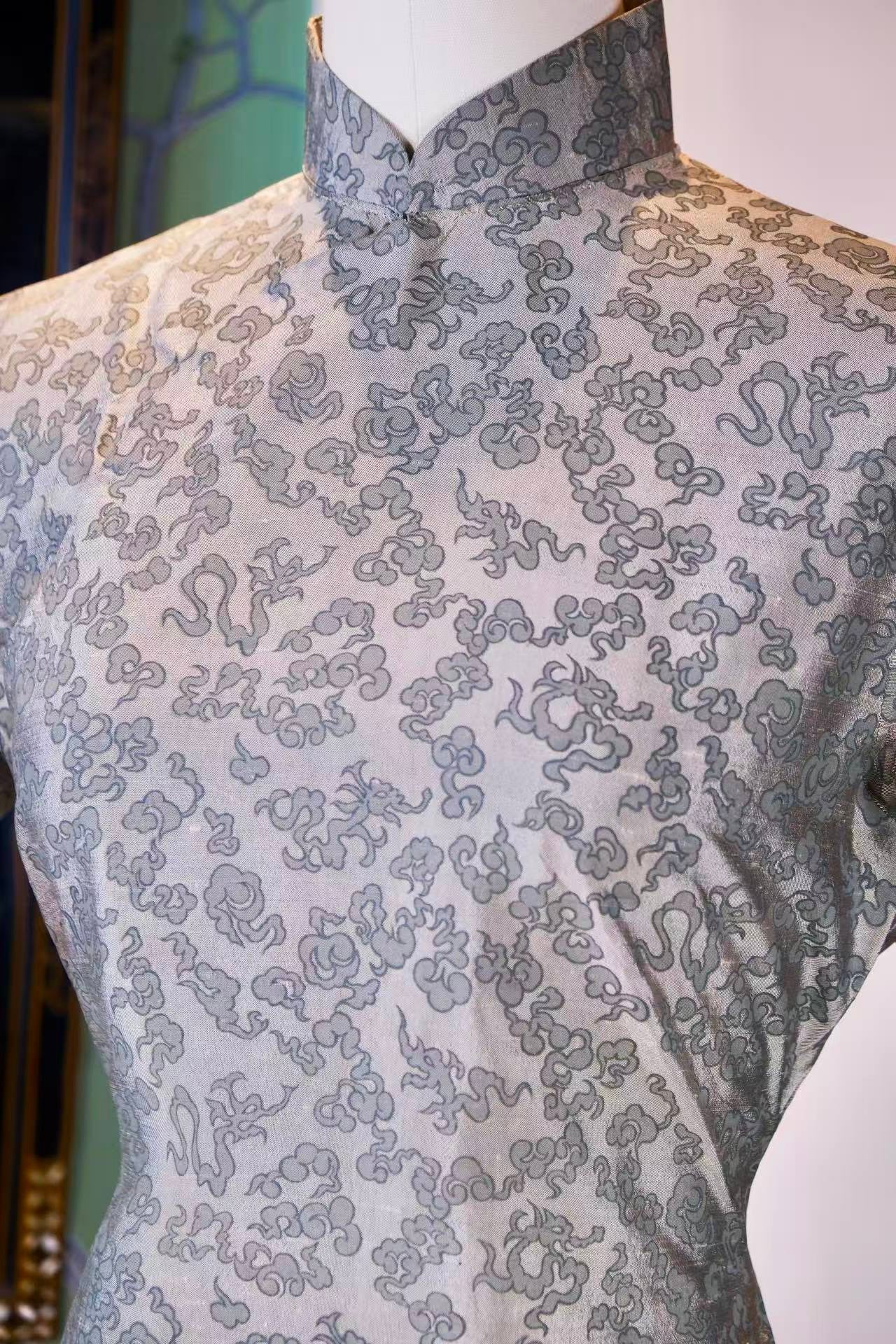
旗袍面料上的云气纹,如篆书般婉转流动,
斜纹绸的肌理,为云气纹的呈现提供了绝佳的画布。
五十年代中期,正值新中国纺织工业的转型期。这件旗袍产自大陆,
旗袍的剪裁,完美契合五十年代女性的审美追求。
当穿着者行走时,斜纹绸的垂坠感与云气纹的流动感相互映衬,
这件五十年代中期的云气纹印花斜纹绸旗袍,不仅是一件衣物,
A Sartorial Epic of the "Yunqi" Motif Hidden within the folds of time is an unspoken sartorial epic. This mid-1950s antique qipao from Mainland China is like an unfolded volume of Tiangong Kaiwu (The Exploitation of the Works of Nature), freezing the artisanal codes and aesthetic spirit of a unique era within the warp and weft of twill silk. The sprawling "Yunqi" (Ethereal Cloud) motifs are not merely a visual feast but a vessel of cultural memory. These patterns, flowing like seal script and as airy as "Wu's sashes fluttering in the wind," trace their ancestry back to the Warring States and Qin-Han dynasties—symbolizing the eternal vitality of the universe.
The Dialogue Between Texture and Imagery The texture of the twill silk provides an exquisite canvas for these clouds. The fine diagonal weave interacts with the scrolling curves, making the clouds appear to drift slowly across the fabric as light shifts—reminiscent of the celestial grace in Gu Kaizhi’s Nymph of the Luo River. This design philosophy, where "imagery must carry intent, and intent must be auspicious," perfectly fuses ancient spiritual connotations with modern aesthetic needs. It is, quite literally, a "wearable artifact."
A Testimony to Mainland Craftsmanship The mid-1950s marked a critical transition for the textile industry in New China. While contemporary Hong Kong qipaos often utilized imported fabrics, this Mainland-produced piece inherited the exquisite weaving traditions of Jiangnan while exploring new industrial horizons. During an era of relative material scarcity, the insistence on using domestic technology to interpret Oriental aesthetics bestows this piece with undeniable rarity.
Modernity Wrapped in Tradition The tailoring reflects the pursuit of grace for the 1950s woman: short sleeves revealing slender wrists, side slits hinting at the leg line, and a tailored waist that contours the feminine form without being restrictive. This balance between the fluidity of the cloud motifs and the precision of the cut creates a poetic contrast—embodying both the modesty of the traditional woman and the independent spirit of the New Era. To wear it is to embody the sentiment of Wen Xin Diao Long: "Affection goes out like a gift, and inspiration returns like an answer."
Conclusion: An Artistic Legacy This qipao is more than a garment; it is a condensed history of Chinese textiles and feminine aesthetics. Every cloud scroll is a wave in the long river of history, witnessing the collision of tradition and modernity. In an age of fast fashion, this "soulful and storied" antique qipao remains a masterpiece worthy of eternal collection, its artistic value only growing more radiant with the passage of time.