深圳溯源
Couldn't load pickup availability
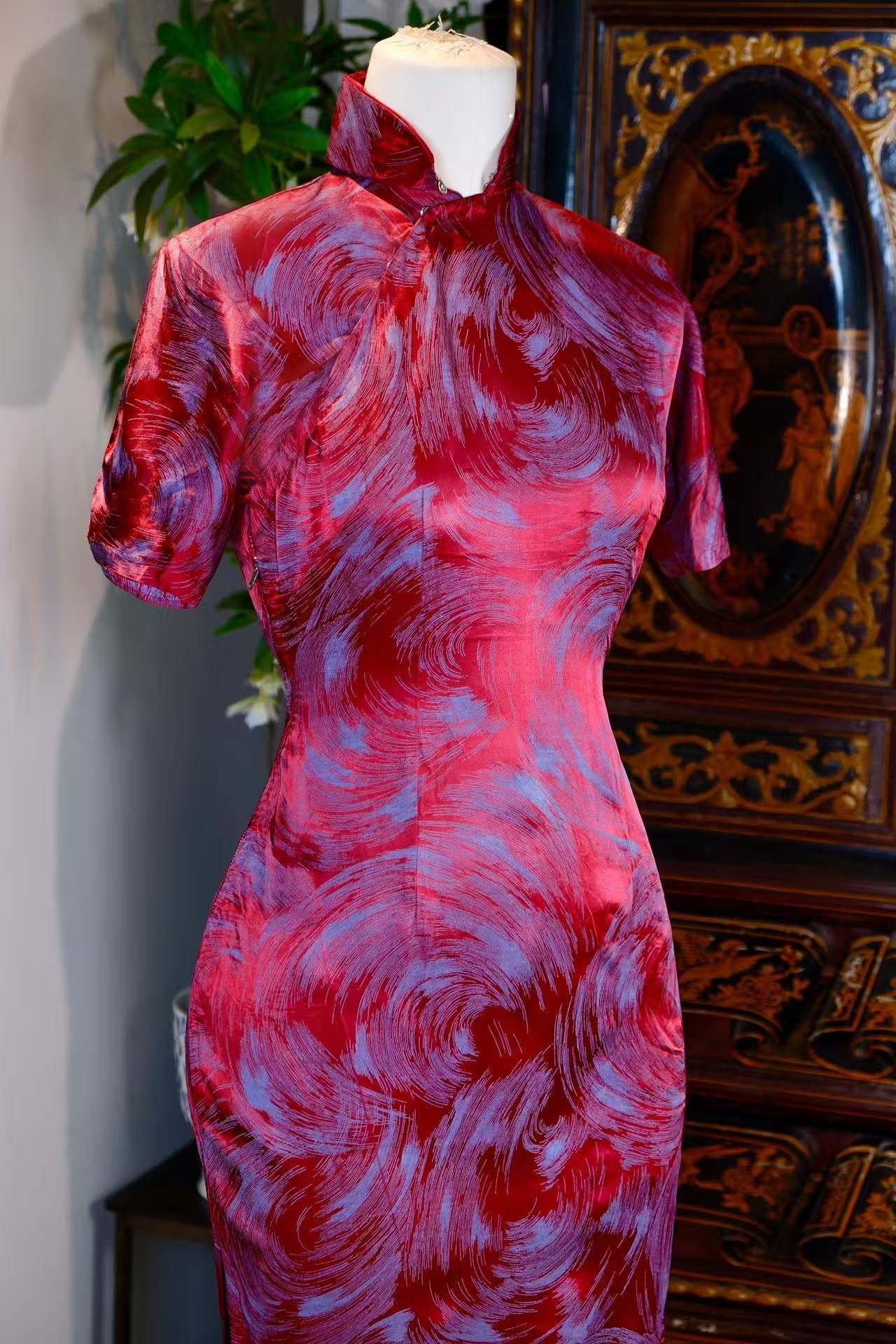
五十年代提花大陆产古董旗袍:织霞成韵,岁月凝华
织中乾坤:提花纹样的视觉诗学
这件上世纪五十年代的大陆产提花旗袍,以“霞绮流丹”为骨,以“
细观纹样,螺旋状的云纹如“云篆”般流转,每一道弧线皆暗合《
艺术风格:中西合璧的美学突围
五十年代的旗袍艺术,恰逢东西方文化碰撞的“黄金切面”。
剪裁上,它延续了海派旗袍“收腰显臀”的经典轮廓,
稀缺价值:时代洪流中的文化信物
作为大陆五十年代的提花旗袍,
更珍贵的是,它的纹样承载了特定时代的文化密码。
结语:织物上的时光琥珀
“经纬藏春秋,纹样记浮生。”这件五十年代提花旗袍,
"The universe within the weave: A visual poetics of Jacquard patterns."
This 1950s mainland Chinese jacquard Qipao uses "rosy clouds and crimson silk" as its bone and "illusory cloud patterns" as its soul. The fabric, crafted through traditional jacquard techniques, interweaves cinnabar red and twilight purple into an abstract "vortex of flowing clouds." The red base evokes the rising sun described in The Songs of Chu, while the purple patterns mirror the misty dusk of Tengwang Ge Xu. Between the warp and weft, it possesses the distinct layering of Song Dynasty Kesi (Tapestry Silk) and the fluid brushstrokes of Western Impressionism, making it a "living fossil" of textile art.
Every spiral cloud pattern conforms to the philosophy of Kao Gong Ji: "The season of Heaven, the breath of Earth, the beauty of Material, and the skill of Craft." The bold use of red and purple breaks the traditional mold of "subtle elegance," echoing the pulse of the 1950s—a time of inheriting ancient rhymes while initiating new chapters. This "Rosy Cloud Jacquard" required artisans to repeatedly hand-pick patterns on the loom, a "dance of the fingertips" that has now nearly vanished.
The Qipao art of the 1950s stood at the "golden cross-section" of cultural collision. The pattern design inherits the fluid movement of traditional Chinese cloud and vortex motifs, yet aligns with the inner spirit of Western Expressionism—resembling the swirling strokes of Van Gogh’s The Starry Night, freezing emotional rhythm upon the fabric.
In terms of silhouette, it retains the classic Haipai (Shanghai-style) contour while integrating the "simple and practical" aesthetic of 1950s Mainland China. The sleek short sleeves and knee-length hem reflect the independent and self-reliant spirit of the "New China" woman. This style—vibrant without being vulgar, graceful without being fawning—is the very essence of "New Chinese Aesthetics."
The rarity of this piece stems from its unique historical context. During this period, Chinese textile craft was transitioning from "imperial/private workshops" to "collective ateliers." Because jacquard technology was costly and complex, it was gradually replaced by simplified methods. This "dual-color jacquard" fabric required scarce imported looms and manual pattern-picking; with extremely low production, fewer than one in a hundred survive today.
Moreover, its patterns carry a specific cultural cipher. China in the 1950s was a blend of "learning from the Soviet Union" and "traditional revival." The red-purple palette aligns with the "Red Culture" of the era while preserving the traditional auspiciousness of "Purple Air from the East." It is a "wearable historical archive."
Conclusion: An Amber of Time in Fabric "The warp and weft hide the seasons; the patterns record a floating life." With rosy clouds as its brush and years as its paper, this Qipao writes the aesthetic code of an era. To collect it is to possess a segment of frozen time and a never-fading sense of cultural nostalgia.