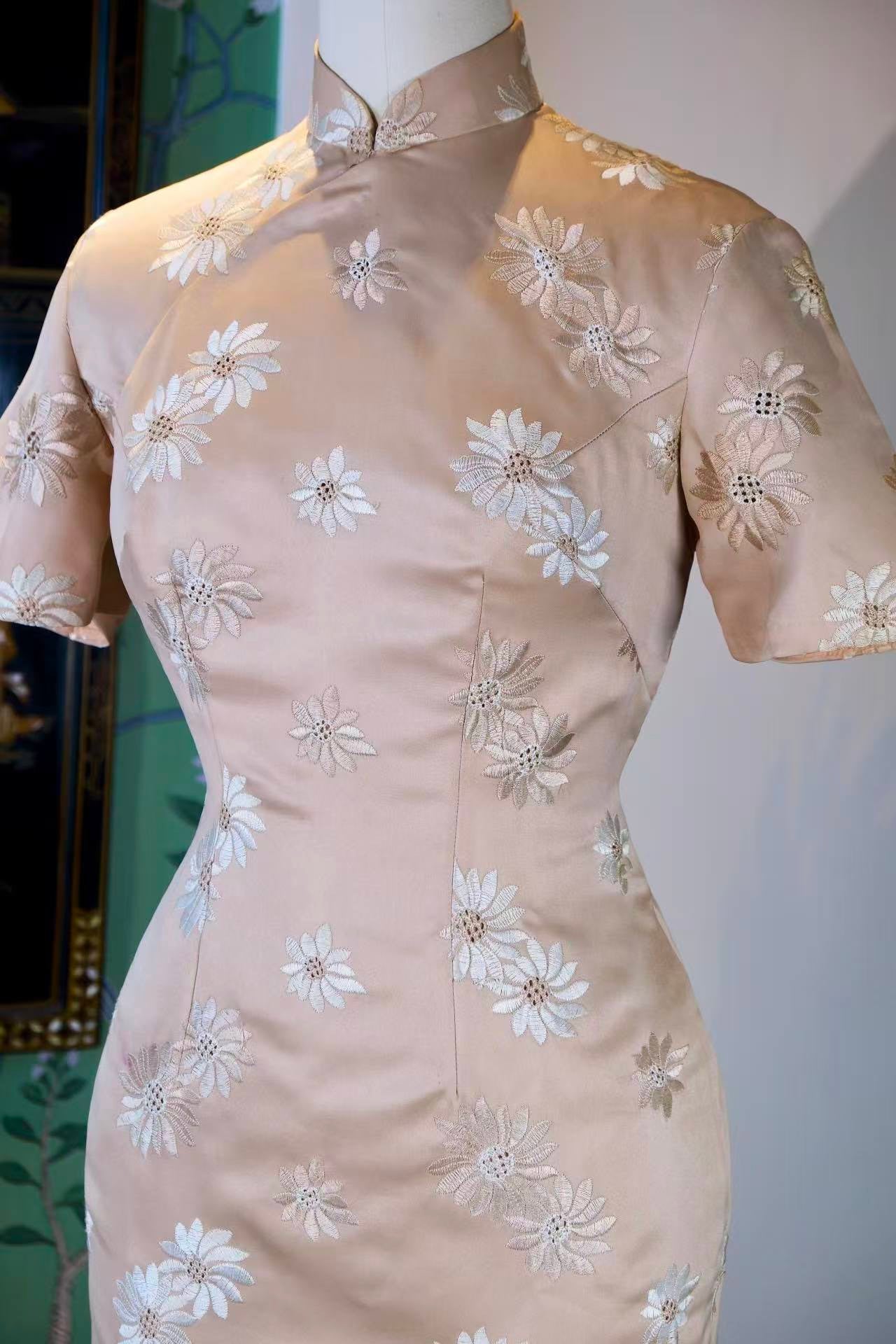
1950s Champagne Satin Machine-Embroidered Hong Kong Qipao: A Fluid Scroll of Time
A Poem of Champagne and Silk This 1950s Hong Kong antique qipao unfolds like a poetic scroll of champagne-hued brocade. Using a warm, honey-toned satin as its canvas, it employs machine embroidery to create a galaxy of daisies, with every stitch encoding a modern cipher of Oriental aesthetics.
The Geometry of Daisies: From Song Dynasty to Art Deco The base fabric is a champagne-colored plain satin, with a luster positioned between agar and dawn—reminiscent of the legendary "Soft Smoke Silk" (Ruanyuanluo) from Dream of the Red Chamber, yet imbued with a metropolitan warmth. The scattered daisy motifs represent a quintessential 1950s Hong Kong design paradigm. The designer cleverly adapts the "sparse shadows" of Song Dynasty floral paintings, replacing complex traditional hand-embroidery with machine-worked metallic threads. Gold and silver lines outline the petals, while cotton-thread "seed stitches" create a sculptural texture at the heart of each flower. From afar, it looks like crushed diamonds scattered on silk; up close, it resembles moonlight filtering through a stained-glass window, infusing traditional motifs with the geometric rhythm of Art Deco.
The "Precise Romance" of Mechanical Aesthetics This qipao serves as a physical witness to Hong Kong's 1950s revolution in embroidery technology. As the local garment industry introduced high-speed embroidery machines from Japan, they bypassed the production bottlenecks of hand-stitching and inadvertently birthed a unique "mechanical aesthetic." With stitching densities reaching 12 per inch, the metallic edges of the petals create a fluid, pearlescent shimmer under shifting light. This "precise romance" was hailed in the 1953 Hong Kong Industrial and Commercial Yearbook as "the perfect dance between Oriental silk and Western machinery."
Conclusion: A Seal of Eternal Elegance To touch this satin is to hear the jazz echoes of 1950s Lan Kwai Fong and feel the "gorgeous yet desolate" resonance of the era captured by Eileen Chang. Every daisy acts as a seal of time, engraving the eternal grace of the Oriental woman upon a champagne-colored background. To collect this piece is to preserve a fluid history of silk civilization—an aesthetic hymn to the dance of man and machine.