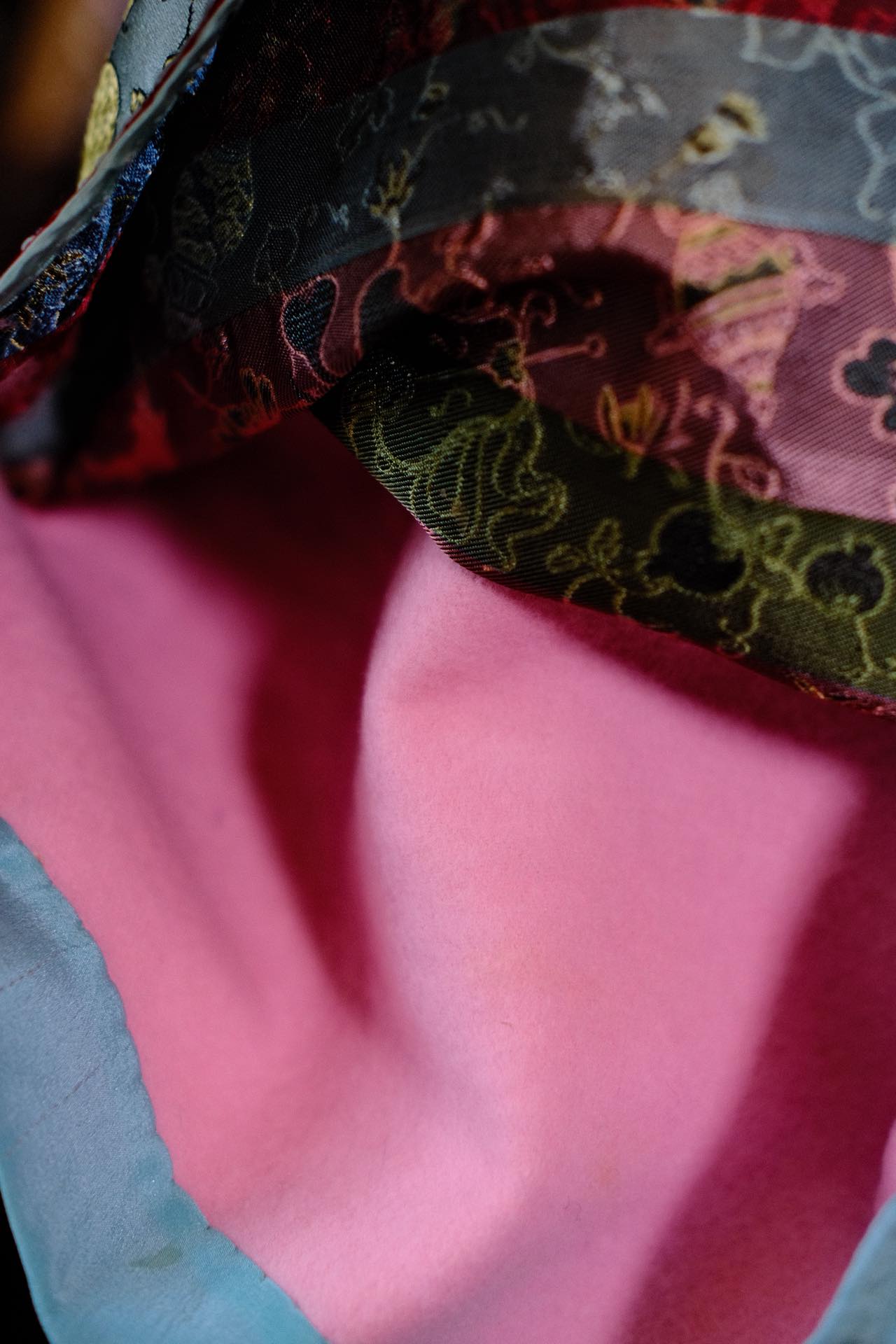
五十年代香江织锦羊绒套组:Woo女士的炉边温存
当东方的锦绣图腾遇上西方的御寒材质,这套五十年代初期的真丝提花织锦缎夹小山羊绒旗袍套装,便成了Woo女士衣橱里最温柔的“软黄金”。
一、图案:博古通今的吉祥寓言
这套服装的面料是一幅微缩的东方画卷。淡青色的缎底上,以“通经断纬”的提花工艺织就了经典的“博古纹”:金线勾勒的青铜鼎彝、宋代瓷瓶与书卷画轴穿插其间,寓意“博学雅正”;而粉荷、红菊与翠竹则以晕染技法呈现,取“和气生财、竹报平安”之意。这种纹样在清末民初多为官服所用,到了五十年代的香港,则成为了名媛阶层彰显家学渊源与富贵身份的最佳符号。
二、材质:真丝与小山羊绒的极致碰撞
这是一件极具时代特征的“混血”杰作。Woo女士作为常往返于加拿大与香港的跨国商人,深知北美冬日的严寒。因此,这套旗袍并未采用传统的单层丝绸或丝绵填充,而是大胆地在珍贵的提花织锦缎下,复合了一层极薄的小山羊绒。
这种工艺在当年极为罕见,既保留了织锦缎挺括华贵的光泽,又赋予了衣物如云朵般的轻盈保暖。领口与滚边处那一抹暗红,如同寒夜里的炉火,低调却摄人心魄。
三、工艺:对襟花扣的立体雕塑
外套采用了经典的对襟设计,最引人注目的是那几枚硕大的立体盘扣。这并非普通的琵琶扣,而是以深紫色丝线缠绕成“如意云头”状的“花扣”,每一枚都如同一朵盛开在胸前的紫藤,与衣身的淡雅色调形成绝妙的视觉对冲。这种盘扣工艺极度耗时,非拥有二十年工龄的“红帮裁缝”不能为之。
四、稀缺性:不可复制的时代孤品
五十年代初期,正值香港纺织业从转口贸易向本地制造转型的特殊时期,这种将进口羊绒与传统苏杭织锦结合的尝试,是那个物资流动频繁的黄金年代的产物。随着后来成衣工业的兴起,这种费时费料的高定手工套组逐渐绝迹。
它不仅是Woo女士在温哥华凛冽冬日里的御寒战袍,更是她作为东方女性,在西方商业世界中游刃有余、外柔内刚的精神图腾。
1950s Hong Kong Brocade and Cashmere Ensemble: Ms. Woo’s Fireside Solace
When the complex iconographies of Eastern textile art intercepted the premier insulating materials of the West, this early 1950s silk jacquard brocade satin and baby cashmere qipao ensemble emerged as the most tender "soft gold" installment within Ms. Woo’s wardrobe anthology.
I. Motif and Narrative: A Classical Allegory of Heritage and Elegance
The canvas of this ensemble operates as a masterfully rendered, micro-scale historic scroll. Set against a serene, pale celadon-green satin base, the textile utilizes an intricate structural jacquard technique to weave a classical configuration of "Bogu" motifs (Antiquity Curios). Fine metallic gold filaments trace the architectural lines of bronze vessels, Song Dynasty porcelain vases, and ancient literary scrolls—symbolizing deep erudition, cultural literacy, and refined grace. Interspersed between these curiosities are soft pink lotuses, crimson chrysanthemums, and emerald bamboo rendered in fluid, ombré dye-work, encoding traditional wishes for harmony, prosperity, and peace.
While this specific iconographic layout was historically reserved for elite court attire during the late Qing and early Republican eras, by 1950s Hong Kong it had evolved into the definitive sartorial symbol for high-society women to anchor their familial lineage and elite social composure.
II. Material Composition: The Strategic Collision of Silk and Baby Cashmere
This ensemble stands as a brilliant, hybrid manifestation of mid-century technical adaptation. Coordinating cross-border trade between Canada and Hong Kong, Ms. Woo possessed an acute operational understanding of the bitter, structural chill of North American winters. Consequently, this qipao sets aside traditional singular silk constructions or heavy cotton batting in favor of a radical engineering feat: complex jacquard brocade satin permanently bonded to an ultra-thin layer of premium baby cashmere.
This advanced fabrication was remarkably scarce during the early 1950s. It flawlessly preserves the proud, crisp, and sumptuous luster inherent to high-grade brocade while simultaneously gifting the garment a cloud-like, weightless thermal utility. The deep, muted crimson highlight contouring the collar and edge-bindings operates like an ambient hearth fire against a winter night—understated, yet commandingly pulling the eye.
III. Craftsmanship and Engineering: The Dimensional Sculpture of Center-Front Frog Closures
The outerwear jacket is structured around a classical, symmetrical center-front alignment (Duijin), anchored by a series of commanding, three-dimensional decorative frog closures (Pankou). Shunning standard flat fasteners, these buttons are painstakingly hand-wound from deep purple silk cords into sculptural "Ruyi Cloud-Head" floral shapes. Each closure rises from the chest like a blooming wisteria blossom, establishing a brilliant, high-contrast graphic counterpoint against the muted, pale celadon background of the gown.
The execution of this specific three-dimensional cord-work is exceptionally time-intensive, achievable only by senior master tailors boasting decades of specialized technical training in bespoke atelier manipulation.
IV. Cultural Archiving: A Tactile Monument to the Jet-Age Executive
This ensemble is far more than an attire; it is a profound monument to a pivotal chapter in fashion history. The early 1950s marked a unique structural transition for the Hong Kong textile trade as it evolved from an entrepôt hub into a localized powerhouse of elite bespoke design. This specific synthesis—fusing premium imported Western cashmere with legacy Eastern brocades—could only exist during this precise window of fluid global trade. As mass-market ready-to-wear production scales ascended in later decades, these highly specialized, resource-heavy artisan sets completely vanished from the market.
It served not merely as Ms. Woo’s elegant armor against the biting winters of Vancouver, but stood as the perfect material metaphor for her executive identity within the Western corporate landscape: an absolute masterclass in outer grace balanced by an unyielding, structured core.