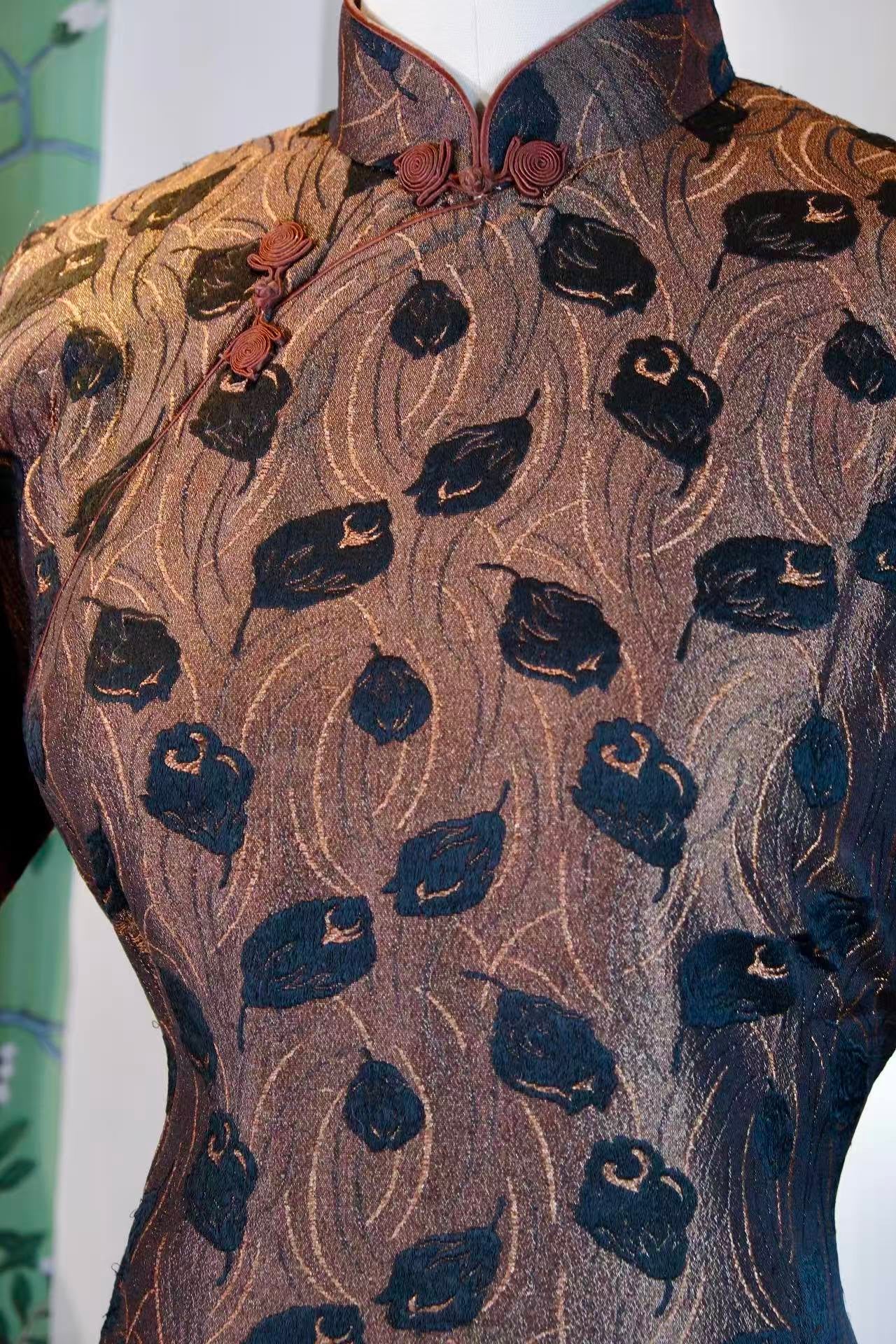
五十年代香港产提花闪缎旗袍:岁月鎏金处,暗香浮流年
一、衣纹里的时光密码:提花闪缎与线香绲的工艺诗学
这件香港产的五十年代古董旗袍,以“提花闪缎”为骨,织就了岁月鎏金的肌理。缎面在光影交错间泛起粼粼波光,恰似《红楼梦》中“金丝八宝攒珠髻,朝阳五凤挂珠钗”的流光溢彩,却又多了份民国女子的含蓄。
“线香绲”工艺则如工笔细描,在领口、袖口、襟缘勾勒出纤细如线的轮廓。这看似简约的绲边,实则是旗袍工艺的“灵魂笔触”:它以极细的布条滚出棱角,既强化了旗袍的修身线条,又如书法中的“中锋用笔”,在刚柔并济间彰显匠人对“度”的精准把控。而“寿桃花扣”的点睛之笔,更将实用与审美熔于一炉——盘扣以丝线缠绕成寿桃形态,暗合《诗经》“为此春酒,以介眉寿”的祝祷之意,让整件旗袍在举手投足间,都流淌着“福寿绵长”的文化隐喻。
二、香港记忆:五十年代旗袍的“移民美学”与“海派遗韵”
五十年代的香港,是战后移民潮中的一座“文化熔炉”。上海、广州等地的制衣匠人携“海派旗袍”的工艺南下,在维多利亚港畔续写着东方美学的传奇。这件旗袍正是这一特殊历史时期的产物:它保留了海派旗袍“收腰显臀、开衩露腿”的剪裁精髓,却又在面料选择上更趋轻盈——闪缎的光泽感与提花的立体感,既适应了香港亚热带的气候,又迎合了当时中产阶级女性对“摩登”的追求。
三、结语:旗袍是行走的史诗
当我们将目光投向这件五十年代的提花闪缎旗袍,看到的不仅是精美的纹样与工艺,更是一部“穿在身上的历史”。它以丝线为墨,以布帛为纸,书写着民国女子的优雅、香港移民的奋斗、以及东方美学在时代浪潮中的坚守与创新。正如张爱玲在《更衣记》中所言:“各人住在各人的衣服里”,这件旗袍所承载的,正是那个特殊年代里,一群女性对“美”的执着,对“福”的祈愿,以及对“自我”的追寻。
它静默地悬于衣架之上,却仿佛仍在诉说着:那些被岁月打磨的光泽,那些被时光浸润的纹样,终将在某个瞬间,与懂它的人,完成一场跨越时空的对话。
1950s Hong Kong-Made Jacquard Iridescent Satin Cheongsam: Gilded Years and Flowing Fragrance
I. Time Codes in the Weave: The Poetics of Jacquard Satin and "Incense-Thin" Piping
This 1950s antique cheongsam, crafted in Hong Kong, uses Jacquard Iridescent Satin (Shan Duan) as its backbone, weaving a texture that feels like the gilded residue of passing years. The satin surface ripples with shimmering light under changing shadows, reminiscent of the "radiant splendor" described in Dream of the Red Chamber, yet it possesses the refined restraint characteristic of a mid-century lady.
The "Incense-Thin" Piping (Xianxiang Gun) craft acts like the meticulous strokes of Gongbi painting, tracing slender, thread-like outlines along the collar, cuffs, and lapel edges. This seemingly simple piping is, in fact, the "soulful brushstroke" of cheongsam craftsmanship: using extremely fine fabric strips to create sharp, delicate edges, it reinforces the form-fitting silhouette. Much like the "centered tip" technique in Chinese calligraphy, it manifests the artisan's precise mastery over the balance between strength and grace.
The crowning touch is the "Longevity Peach" Knotted Buttons (Pankou), which fuse utility with aesthetic symbolism. Wound from silk thread into the shape of peaches, they subtly echo the blessings found in the Classic of Poetry: "With this spring wine, we pray for long life." This allows the entire garment to flow with the cultural metaphor of "enduring fortune and longevity" in every gesture.
II. Hong Kong Memories: The "Migrant Aesthetics" and "Haipai" Legacy of the 1950s
Hong Kong in the 1950s was a cultural "melting pot" amidst the post-war migration wave. Master tailors from Shanghai and Guangzhou brought the techniques of "Haipai" (Shanghai-style) Cheongsams south, continuing the legend of Oriental aesthetics by the shores of Victoria Harbour.
This cheongsam is a quintessential product of this unique historical period: it retains the "Haipai" essence of a cinched waist and defined hips, yet trends toward lighter fabric choices. The luster of the iridescent satin combined with the dimensionality of the jacquard not only suited Hong Kong’s subtropical climate but also catered to the "modernist" pursuits of middle-class women at the time.
III. Conclusion: The Cheongsam as a Walking Epic
When we gaze upon this 1950s Jacquard Satin cheongsam, we see more than exquisite patterns and craft; we see a "history worn on the body." Using silk thread as ink and fabric as paper, it chronicles the elegance of a bygone era, the struggle of Hong Kong immigrants, and the persistence and innovation of Oriental aesthetics amidst the tides of time.
As Eileen Chang noted in Chronicle of Changing Clothes: "Everyone lives in their own clothes." What this cheongsam carries is a generation of women’s dedication to beauty, their prayers for fortune, and their pursuit of self.
It hangs silently on the rack, yet seems to whisper: those lusters polished by the years and those patterns soaked in time will eventually, in a single moment, complete a dialogue across time and space with someone who truly understands them.