深圳溯源
Couldn't load pickup availability
一、面料:双宫真丝的“自然肌理”
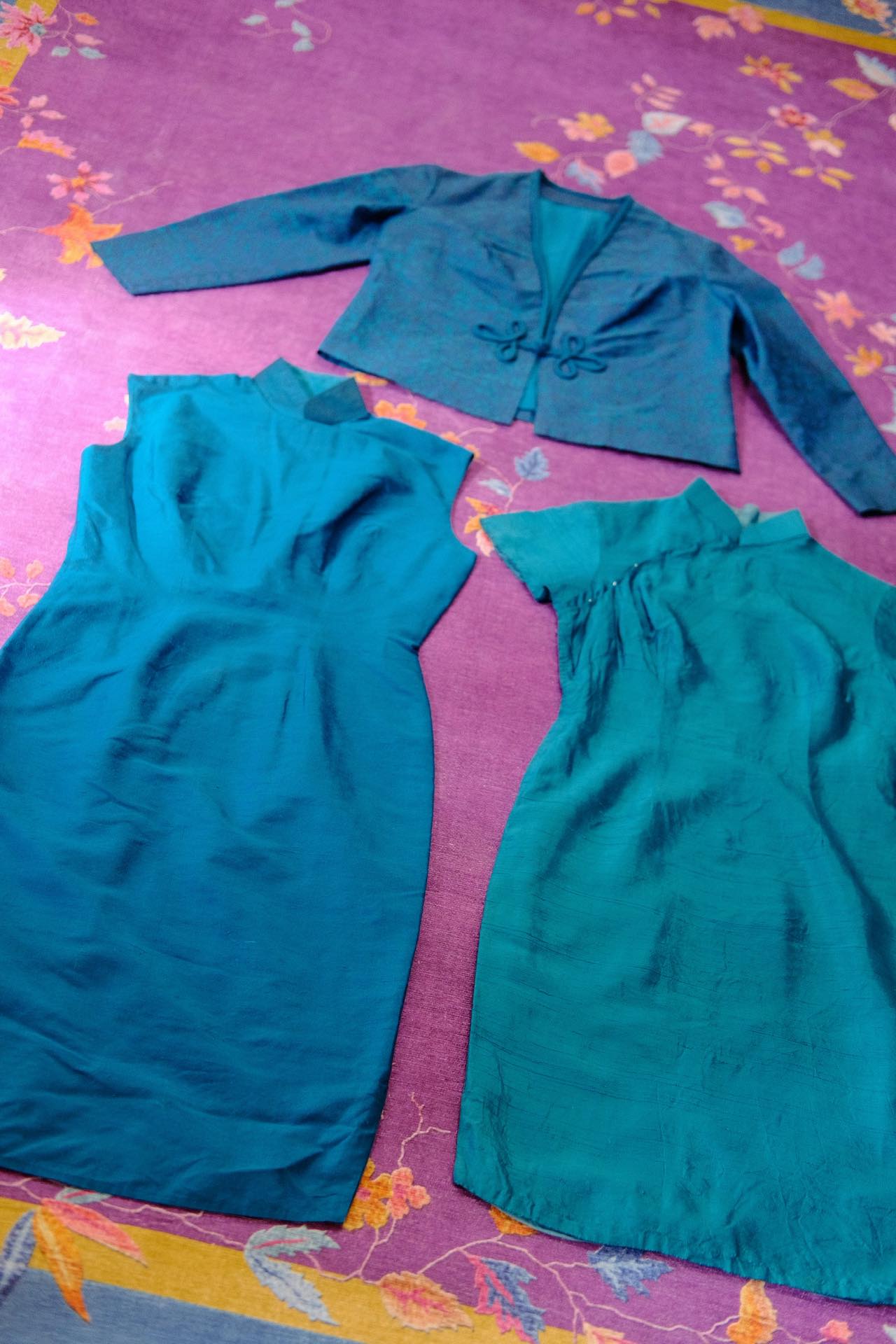
这套三件套的面料,是珍贵的双宫真丝。它并非寻常的平滑绸缎,
二、形制:三件套的“一衣多穿”哲学
套装由肩开无袖旗袍、十字袖斜襟旗袍与V领对襟外套组成,
- 肩开无袖旗袍:采用极简的肩开设计,无袖剪裁露出纤细的手臂,
- 十字袖斜襟旗袍:十字袖是传统旗袍的经典剪裁,
- V领对襟外套:V领设计修饰颈部线条,对襟剪裁简洁大方,
三、故事:Woo女士的“双城记”
这套衣服的主人Woo女士,是加拿大Super Store的老板之一,亦是五十年代“全球买手”的先驱。
- 在五十年代,像Woo女士这样的海外华商,每年必赴欧洲(
- 这套衣服就是这种生活方式的见证:
四、稀缺性:消逝的“港产高定”生态
如今这套套装的珍贵,不仅在于面料与工艺,
- 五十年代的香港,曾有数百家旗袍工坊,师傅们以“一人一版”
The structural foundation of this breathtaking three-piece ensemble resides in its magnificent material canvas: a premium, vintage-grade dupioni silk (Shuangong Zhensi). Strikingly different from standard, hyper-smoothed commercial satins, this fabrication derives its elite status from its organic, slubbed texturing:
The Slubbed Mineral Geometry: Woven naturally from twin-cocoon silk filaments, the textile yields random, highly sophisticated crosswise knots and slubs. Under directional gallery lamps, these organic irregularities capture light to create a micro-topography resembling fine, shimmering sunbursts across a rising ocean tide or the gentle, ridged patterns left on sandbars by a receding current.
The Textural Weight: The double-cocoon weave produces a highly substantive, heavy weight and a rich, light-absorbing matte finish. It beautifully balances a proud, structural skeleton with a remarkably smooth, fluid hand-feel—establishing a commanding physical presence traditionally favored across the highest tiers of 1950s European haute couture.
The conceptual soul of this masterpiece resides in its avant-garde engineering, configuring three independent garments—a sleeveless shoulder-opening qipao, a traditional cross-sleeve asymmetric qipao, and a tailored V-neck coat—into an elite manifestation of mid-century modular uniforming:
The Summer Essential: The Sleeveless Shoulder-Opening (Jiankai) Qipao: This foundational interior layer adopts an ultra-clean blueprint featuring a streamlined shoulder opening and a sleeveless silhouette that elegantly exposes the arm profile. Anchored by an impeccably crisp, upright mandarin collar, its clean drafting methodology provides maximum styling flexibility for high-summer or climate-controlled interior environments.
The Heritage Core: The Cross-Sleeve Asymmetric Placket (Xiejin) Qipao: A master lesson in legacy pattern drafting, this second dress implements traditional grown-on cross-sleeves (Shizixiu) that completely eliminate shoulder seams, paired with a sweeping diagonal placket line. This configuration anchors the ensemble's deep historical literacy, creating a highly dignified option engineered for high-stakes formal ceremonies or seasonal transitions.
The Visual Frame: The Tailored V-Neck Outerwear Coat: The long-sleeve outer coat features a tailored V-neck, center-front opening architecture designed to frame the posture with absolute geometric precision. This deep neckline beautifully showcases the standing collars of the interior qipaos, establishing a sophisticated layered juxtaposition. It masterfully balances Eastern ancestral grace with the sharp, defensive posture of a modern executive uniform.
The custodian of this artifact, Ms. Woo, operated as a co-director of a major Canadian enterprise, standing as a definitive pioneer within the early jet-age network of global luxury procurement and international lifestyle management.
During the 1950s, elite overseas Chinese entrepreneurs like Ms. Woo engaged in a highly specialized sartorial lifestyle: making regular sourcing journeys to European fashion capitals (specifically Italy and France) to personally secure advanced textile innovations, and subsequently routing these precious volumes back to Hong Kong where legacy master tailors transformed the raw yardage into bespoke, custom silhouettes.
This exact methodology functions as a captivating micro-history of Chinese capital and cultural mobility during the mid-century era. Europe provided the raw material innovation, old-world Hong Kong exported the elite artisan pattern drafting, and Canada operated as the final executive terminal—with the hybrid qipao serving as the vital material bridge unifying all three landscapes. As the fashion historian Anne Hollander eloquently observed, "Clothing is an extension of the body." Ms. Woo’s selection operates beautifully as a concrete manifestation of personal refinement and cultural authority on the global stage.
The modern rarity of this three-piece set extends far beyond its raw material worth or its unique mineral aesthetics; it stands as a pristine archive of a highly specialized, completely vanished sartorial ecosystem:
The Demise of "One Person, One Pattern" Custom Tailoring: During the 1950s, Hong Kong’s custom apparel trade thrived across hundreds of master ateliers who engineered garments based on a strict, customized blueprint philosophy, where senior artisans meticulously draped rare European imported fabrics to match individual anatomical requirements down to the millimeter.
The Artifact of a Lost Era: With the subsequent global ascension of mechanized, mass-market ready-to-wear production scales, this resource-heavy, time-intensive synthesis of European material luxury and custom Hong Kong craftsmanship permanently dissolved. The few surviving fully intact matching three-piece sets remaining today serve as priceless, living fossils—permanent physical archives recording the romance, industry, and uncompromising artistry of a bygone golden era.