深圳溯源
Couldn't load pickup availability
衣服尺寸:
胸围/腰围/臀围:98/80/106 厘米
衣长:105 厘米
细节描述:
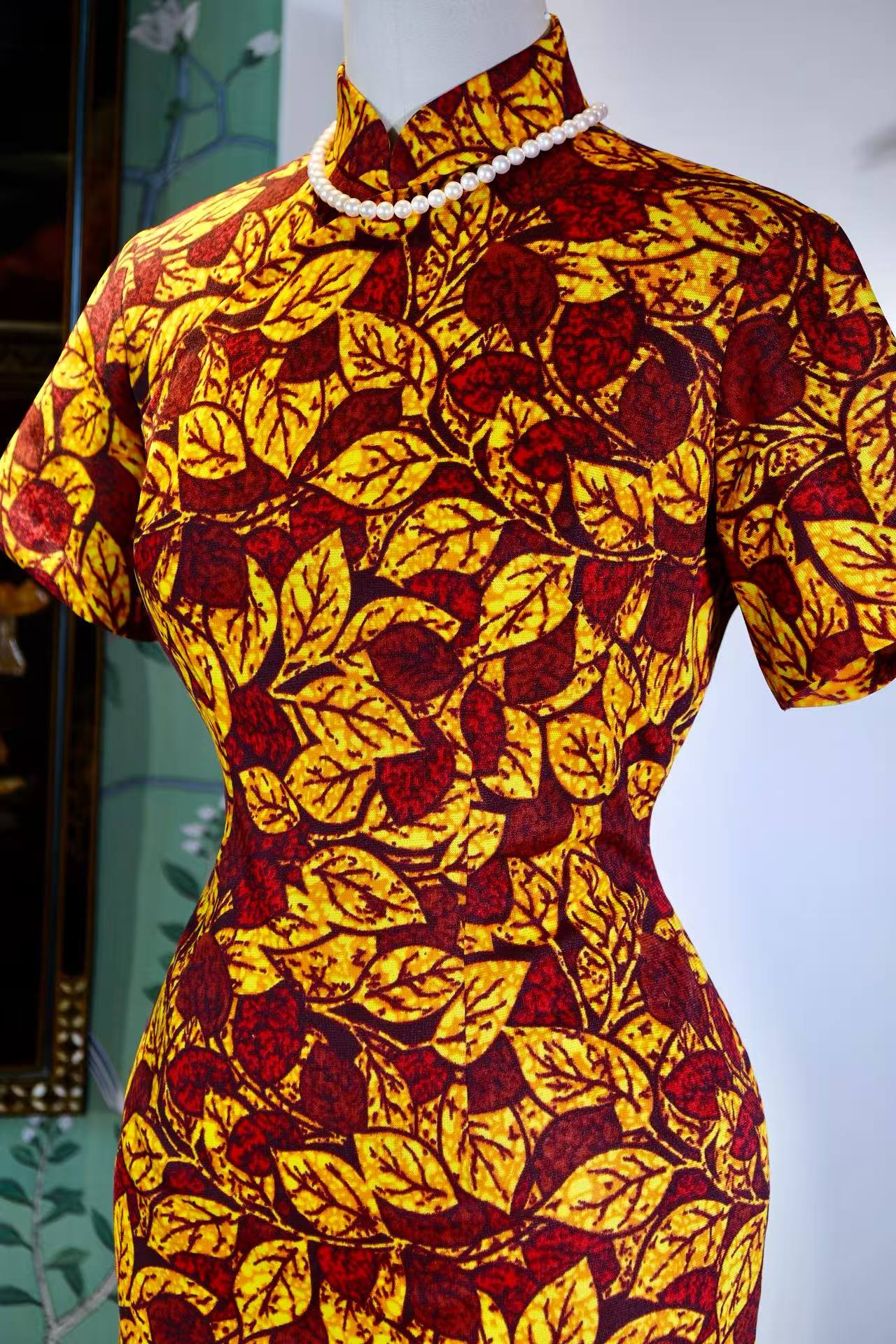
当指尖划过这件旗袍的瞬间,仿佛触到了半个多世纪前台北巷弄里的穿堂风——那风里裹着日本进口印花布的细腻挺括,也藏着台湾裁缝铺里熨斗熨烫时的温热气息。这件诞生于上世纪五十年代的古董旗袍,是战后东亚纺织贸易与本土服饰文化碰撞的珍贵遗存,每一道针脚、每一片叶纹,都在诉说着那个新旧交替年代的优雅与从容。
一、图案:秋叶鎏金里的东方写意
旗袍通体铺陈着浓墨重彩的秋叶纹样,以绛红为骨、明黄为魂,暗褐为脉,构成一幅流动的秋日盛景。叶片形态各异,或舒展如掌,或蜷曲似蝶,叶脉以细密的黑色线条勾勒,如工笔勾勒的筋骨,在暖色调的底色上迸发出蓬勃的生命力。这种图案并非简单的自然摹写,而是暗合了中国传统“折枝花卉”的构图意趣——疏密有致,虚实相生,叶片间的留白恰似宋画中的“计白当黑”,让整件衣身既饱满又不失呼吸感。
更值得注意的是其印花工艺。五十年代的日本纺织业正处于“和洋折衷”的转型期,这件旗袍的面料采用了当时先进的滚筒印花技术,色彩层次丰富且不易褪色,叶片的晕染效果带有浮世绘的细腻质感,却又融入了中国传统吉祥纹样中“叶茂枝繁”的寓意,堪称东亚美学交融的视觉标本。
二、战后东亚的衣料漂流记
1949年前后,台湾成为东亚纺织贸易的重要中转站。彼时日本凭借战后重建的工业优势,向台湾出口大量优质印花布,而台湾本地的旗袍制作业则正处于“海派旗袍”向“台式旗袍”过渡的关键期——既保留了上海旗袍的修身剪裁与立领,又因应亚热带气候调整了面料厚度与袖长。这件旗袍正是这一历史背景下的产物:日本进口的印花布经由台湾裁缝的巧手,化为一件兼具实用与审美的日常华服。
可以想见,它的主人或许是台北某位书香门第的少奶奶,或许是教会学校的女教师,穿着它在阳明山看枫,在牯岭街逛书摊,在中山堂听戏。旗袍的收腰设计贴合五十年代推崇的“沙漏型”身材审美,短袖剪裁则透露出战后女性走向社会、追求便利的时代特征。那些细密的针脚里,藏着的不仅是一个女人的衣香鬓影,更是一座岛屿在时代浪潮中的文化选择。
三、艺术风格:新古典主义的日常诗学
从服装史角度看,这件旗袍完美诠释了五十年代“新古典主义”的服饰美学。它摒弃了民国初期旗袍的繁复装饰,转而以面料图案本身作为视觉焦点,体现了“少即是多”的现代设计思维。立领的高度恰到好处,既保留了传统旗袍的端庄,又不似清代旗装的拘谨;侧缝的开衩隐而不露,行走时若隐若现的腿部线条,暗合了《诗经》中“巧笑倩兮,美目盼兮”的含蓄之美。
其艺术价值更在于稀缺性。五十年代的台湾产旗袍本就存世稀少,而采用日本进口印花布者更是凤毛麟角。据台湾纺织史学者研究,1950-1955年间日本对台出口的印花布中,仅有不到5%用于高级定制旗袍,多为民国遗老遗少或新兴中产阶层定制。这件旗袍历经七十余载岁月,仍保持图案清晰、版型挺括,堪称“穿在身上的历史文物”。
四、稀缺性:时光淬炼的孤品价值
在古董衣收藏领域,这件旗袍的稀缺性体现在三重维度:
1. 面料稀缺:五十年代日本进口的印花布多用于和服,用于旗袍者需特殊定制,现存实物不足百件;
2. 工艺稀缺:台湾老裁缝的“归拔”工艺(通过熨烫塑造立体版型)已濒临失传,这件旗袍的腰臀曲线处理堪称教科书级别;
3. 历史稀缺:它见证了台湾从“日据”到“光复”后的文化重构,是研究战后东亚服饰交流的活化石。
正如法国时尚史学家丹尼尔· Roche 所言:“衣物是记忆的容器,每一件古董衣都是一个时代的切片。”这件秋叶鎏金旗袍,不仅是一件可供穿着的艺术品,更是一段凝固的历史,一曲关于美、关于时代、关于东西方文化碰撞的无声咏叹。当它在衣架上静静垂落,那些金黄的叶片仿佛仍在风中摇曳,诉说着半个多世纪前,某个秋日午后,一位女子穿着它走过台北街巷时,裙裾带起的温柔风响。
Measurements / Size Guide:
Bust / Waist / Hips: 98/80/106 cm
Total Length: 105 cm
Detailed Description:
The moment your fingertips glide across this garment, you feel the cross-breeze from the alleys of Taipei over half a century ago—a wind carrying the crisp refinement of imported Japanese printed fabric and the lingering warmth of a tailor's iron. This antique cheongsam (qipao), born in the 1950s, is a precious relic of the collision between post-war East Asian textile trade and local dress culture. Every stitch and every leaf pattern tells a story of elegance and composure during an era of transition.
The cheongsam is adorned with rich, heavy autumn leaf motifs. Crimson provides the structure, bright yellow the soul, and dark brown the veins, composing a fluid panorama of autumn’s splendor. The leaves vary in form—some splayed like palms, others curled like butterflies—with veins outlined in fine black lines like the skeletal "iron wire" brushwork of traditional Chinese painting. This is not mere naturalism; it aligns with the "broken branch" (Zhe Zhi) composition of traditional art—dense yet airy, where the empty spaces between leaves act as the "counting white as black" (Ji Bai Dang Hei) found in Song Dynasty paintings, giving the garment a sense of "breathability."
The printing process is equally noteworthy. In the 1950s, Japan’s textile industry was in a "Wayo折衷" (fusion of Japanese and Western) transition. This fabric utilized advanced roller printing technology of the time, resulting in rich, fade-resistant layers. The gradient effects of the leaves possess the delicate texture of Ukiyo-e, yet integrate the traditional Chinese auspicious meaning of "flourishing branches and lush leaves," serving as a visual specimen of East Asian aesthetic fusion.
Around 1949, Taiwan became a vital hub for East Asian textile trade. Japan, leveraging its post-war industrial reconstruction, exported large quantities of high-quality printed fabrics to Taiwan. Meanwhile, the local qipao industry was in a critical transition from "Shanghai Style" to "Taiwanese Style"—retaining the slim fit and standing collar of Shanghai while adjusting fabric weight and sleeve length for the subtropical climate. This qipao is a product of this history: imported Japanese fabric transformed by the skilled hands of a Taiwanese tailor into a piece of daily haute couture.
One can imagine the owner: perhaps a young mistress from a scholarly family in Taipei, or a female teacher at a mission school. She would wear it to view maples on Yangmingshan, browse bookstalls on Guling Street, or attend an opera at Zhongshan Hall. The cinched waist reflects the "hourglass" aesthetic of the 1950s, while the short sleeves reveal the era’s trend of women entering society and seeking practicality. Within those fine stitches lies not just a woman's elegance, but an island’s cultural choice amidst the tides of history.
From the perspective of costume history, this piece perfectly interprets the Neoclassical aesthetic of the 1950s. It discards the redundant decorations of early Republican qipaos, focusing instead on the fabric pattern itself—embodying the modern "less is more" philosophy. The height of the standing collar is precisely measured, offering traditional dignity without the rigidity of Qing Dynasty robes; the side slits are subtle, echoing the "charming smiles and beautiful eyes" described in the Classic of Poetry.
Its artistic value is amplified by its scarcity. Surviving 1950s Taiwanese-made qipaos are rare, and those using imported Japanese prints are even fewer. According to textile historians, of the Japanese prints exported to Taiwan between 1950 and 1955, less than 5% were used for bespoke qipaos. Having survived seventy years with clear patterns and a crisp silhouette, it is truly a "wearable historical artifact."
In the realm of antique clothing, the scarcity of this qipao is manifested in three dimensions:
Material Scarcity: Japanese prints from the 50s were mostly used for kimonos; using them for qipaos required special customization. Fewer than a hundred such pieces are extant.
Craftsmanship Scarcity: The "Gui Ba" (stretching and shrinking) technique of old Taiwanese tailors—using heat to sculpt a three-dimensional fit—is a vanishing art. The waist-to-hip curve of this garment is textbook perfection.
Historical Scarcity: It witnessed the cultural reconstruction of Taiwan from the post-colonial period to the "retrocession," serving as a living fossil of post-war East Asian fashion exchange.
As French fashion historian Daniel Roche said: "Clothing is a vessel of memory; every antique garment is a slice of an era." This Gilded Autumn Leaf cheongsam is a silent aria of beauty, time, and cultural collision. As it hangs quietly, those golden leaves seem to sway in the wind, recounting a certain autumn afternoon over half a century ago, when a woman walked through the streets of Taipei, her hem stirring a gentle sound in the breeze.